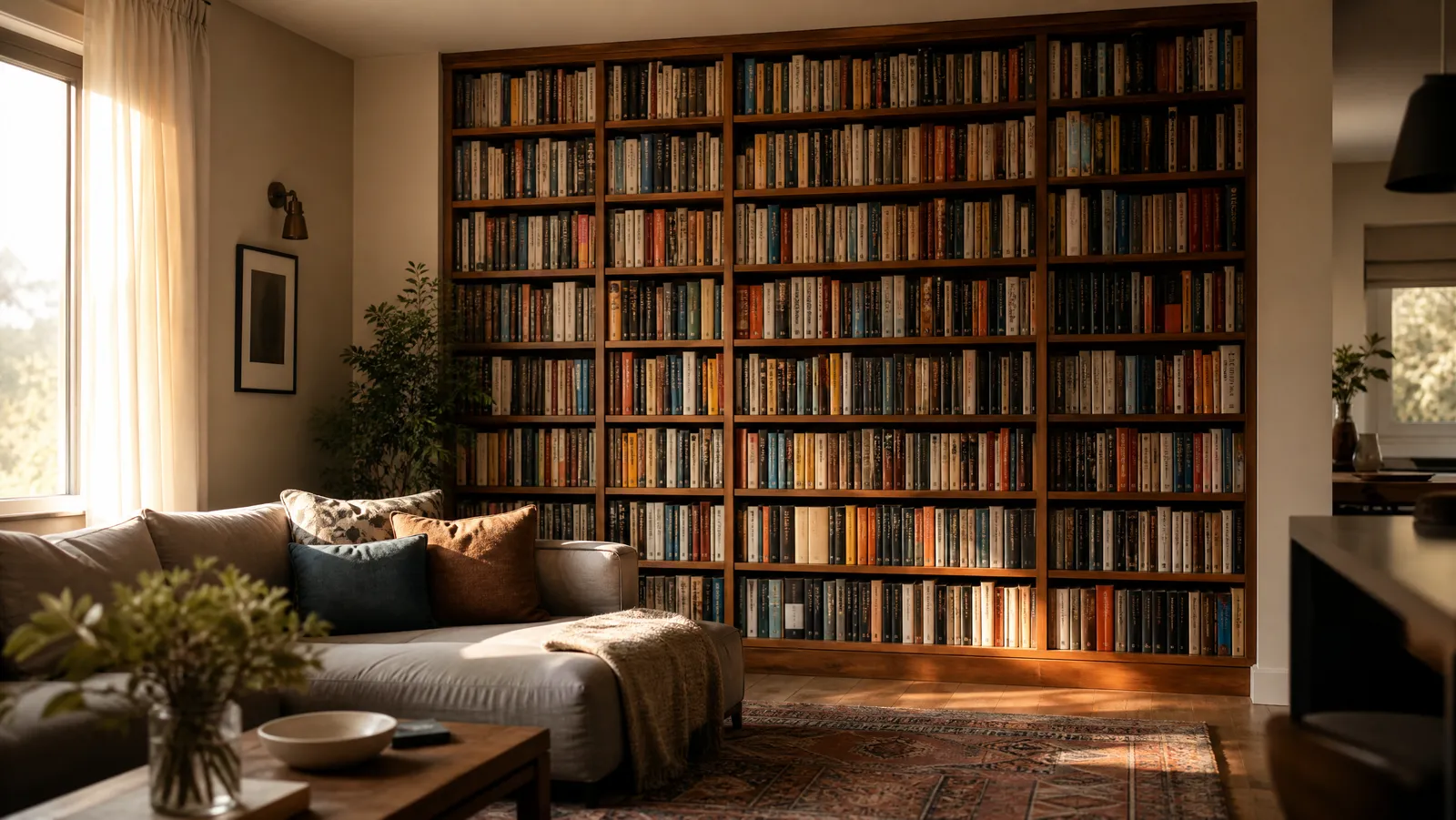
You can soundproof a wall with furniture for exactly zero dollars, and a packed bookshelf pushed tight against the shared wall is the single best free move you have. It will not stop a bass line or fully silence a loud neighbor, but it can meaningfully soften voices, TV chatter, and clatter coming through the wall. The trick is picking the right piece, covering as much of the wall as possible, and packing it dense.
We call this the Bookshelf Method because a full, deep bookcase is the closest thing to a real acoustic barrier that you already own. It is also the honest starting point for soundproofing an apartment wall before you spend a cent. Below, we will separate what furniture genuinely does from what it can not do, then walk through placing it for the most gain.
What furniture actually does to sound
Here is the distinction the whole site is built on: absorbing and blocking are two different jobs.
- Absorbing soaks up sound bouncing around inside your own room (the echo, the harsh reflections). Soft, porous stuff does this: cushions, rugs, books.
- Blocking stops sound from passing between your room and the neighbor's. That takes mass, sealing, and ideally decoupling — real barrier construction.
Furniture does a little of both. A dense bookcase adds a modest amount of mass toward blocking, and its irregular, soft-and-hard surface scatters and absorbs the reflections that make thin-wall noise feel sharp. According to Soundproof Cow, heavier items placed over the wall where you hear the most noise have the most noticeable effect, but furniture reduces sound transmission and can not replace full soundproofing. That is the whole game in one sentence: real help, real ceiling on how much.
How much does furniture really help?
Not as much as marketing implies, but more than nothing. The physics here is the mass law. According to ACT Acoustics, in the mass-controlled range a single-layer barrier gains roughly 6 dB of transmission loss every time you double its mass per unit area. Furniture only adds a fraction of the wall's existing mass, so the gain is modest by design.
For a real-world number: according to acoustics retailer Kurtens, a standard bookshelf packed full and placed against a party wall offers about 5 to 8 dB of gain, because books have an irregular fibrous structure that absorbs sound waves. That may sound small, but it lands where you feel it. According to Noise Stop Systems, every 10 dB reduction is perceived as roughly halving the loudness, so a 5-to-8 dB improvement is a clearly audible drop, not a rounding error.
Put that against how leaky a typical apartment wall is. According to Commercial Acoustics, a basic interior wall of half-inch drywall on wood studs with no insulation rates only around STC 33 — a level where loud speech is still audible through it. A packed bookcase will not turn that wall into a vault, but nudging a weak wall a few decibels quieter is exactly the kind of win a renter can get for free. For where this ranks against other no-cost options, see the cheapest ways to soundproof a wall.
Why furniture won't stop the bass
If your complaint is thumping music or a subwoofer through the wall, temper your expectations. Low frequencies are a different animal.
According to Soundproof Central, low-frequency sound has long wavelengths that bend and diffract around obstacles, set large surfaces like walls into forced vibration and resonance, and lose less energy than high frequencies as they pass through. In plain terms: bass shakes the whole wall and re-radiates on the other side, and a bookcase leaning against that wall barely slows it down.
This is why the Bookshelf Method shines against mid and high frequencies — voices, TV dialogue, dishes, footsteps up high — and disappoints against a deep, low rumble. If bass is your problem, no amount of rearranging furniture will fix it, and it is fair to set that expectation before you spend a Saturday hauling shelves.
Which furniture blocks best (and which barely helps)
Not all pieces are equal. Because the gain rides on mass and coverage, rank your options by how heavy and how large they are:
- Best: a packed, deep bookcase or a loaded wardrobe. Lots of mass, lots of surface area, and books add scattering on top. This is the whole reason we named the method after it.
- Good: a full dresser, a media cabinet, or a stuffed closet against the wall. Heavy and solid, though usually shorter, so pair it with something above.
- Marginal: sofas, upholstered chairs, and open shelving. Soft furniture absorbs reflections inside your room but adds little blocking mass. An open shelf with knick-knacks is mostly air.
- Barely worth it: hollow, lightweight, or half-empty pieces. A flat-pack shelf with three books on it is closer to a decoration than a barrier.
The pattern is simple: dense and tall beats soft and short. If you have to choose one piece for the noisy wall, choose the heaviest thing that covers the most drywall, then fill it.
The Bookshelf Method, step by step
Here is how we would place furniture for the most blocking, in order.
- Pick the densest, deepest piece you own. A solid wood bookcase beats a hollow particleboard one. A wardrobe, a loaded dresser, or a media cabinet works too. Density and depth are what matter — you want mass sitting between you and the neighbor.
- Put it flat against the noisy wall. Identify the exact stretch of wall where you hear the most, and cover that spot. According to Soundproof Cow, the larger the area the furniture covers and the heavier it is, the more noticeable the effect.
- Go floor to ceiling if you can. Sound leaks through whatever you leave uncovered. A tall shelf that nearly reaches the ceiling blocks far more than a short one with three feet of bare drywall above it.
- Pack it dense — and full. Empty shelves do almost nothing. Fill every shelf with books, packed spine-to-spine, front to back. Add records, board games, folded textiles, anything heavy and solid. Aim for no air pockets. A crammed shelf is both more mass and more scattering surface.
- Kill the air gap behind it. Push the piece as close to flat against the wall as the baseboard allows. An air cavity behind the furniture lets sound sneak around your new mass.
- Weigh the bottom, mind the tip. Heavier furniture is better, but a tall, packed bookcase can tip. Use an anti-tip strap or bracket if you have small kids or live in an earthquake zone — most straps mount with a couple of small screws.
Do these in order and the first three do most of the work. The rest is refinement.
Add a blanket or panel behind the furniture
Want a little more out of the same piece? Add a soft, dense layer between the furniture and the wall, or on the exposed face beside it.
- A moving blanket hung or draped behind the bookcase adds a thin, limp layer of mass and absorption. It is cheap, reversible, and does not touch the wall structurally.
- An acoustic panel placed on the wall beside the shelf, or in the gap behind it, adds absorption and tames reflections in your room. For which panels are worth it and how to hang them without tools, see the best acoustic panels for apartment walls.
Be honest with yourself about what this layer does. A blanket or panel is mostly absorption — it cleans up sound inside your room and adds a sliver of mass. It is not a barrier on its own. Stacked behind a full bookcase, though, every little bit compounds.
Seal the gaps around it
Mass is only half the story. According to Second Skin Audio, a wall is only as strong as its weakest point, and even a 1 percent air gap can cap the transmission loss of an otherwise expensive wall at about 20 dB — flanking and leaks are the most common reason soundproofing efforts underperform.
You can not re-seal a whole apartment wall with furniture, but you can avoid handing sound an easy path around your new mass:
- Close the gap at the floor. The strip under a bookcase, or between the wall and baseboard, is a classic leak. Position the furniture to cover it, or lay a rolled towel or rug along the base.
- Overlap your coverage. If you use two pieces, butt them together so there is no bare vertical strip of wall between them.
- Do not forget outlets and vents. Cover switch plates and outlets on that wall behave like little holes; if they sit behind the furniture, even better. Registers and vents leak too.
None of this is glamorous, but sealing is where free effort pays off, and it is entirely renter-safe.
Honest expectations, and keeping your deposit
Set the bar where it belongs. The Bookshelf Method is a modest-mass, mid-and-high-frequency softener, not a wall rebuild. Expect conversations and TV to get muddier and quieter, expect bass and heavy impact to keep coming through, and expect the biggest single gain from covering more wall, more densely.
The best part for renters is that it is completely reversible. There are no anchors, no adhesive, no patching at move-out — you are just arranging things you own. That makes it the natural first step in soundproofing without damaging the walls, before you ever consider anything that touches the drywall.
If the furniture gets you most of the way and you still want more, that is your signal to layer on the next cheap fixes — sealing, absorption, a purpose-built panel — rather than expecting one bookcase to do a barrier's job.
What to do next
Start with the wall where you hear the most, put your densest piece flat against it, run it floor to ceiling, and pack it full. Add a moving blanket behind it and seal the gap along the floor. That is a free afternoon that reliably takes the edge off voices and TV through a shared wall — and it will not touch your deposit.
Just remember the ceiling on this method: furniture adds a little mass and a lot of scattering, best against mid and high frequencies, and it will not stop bass. When you are ready to go further with the reversible, renter-friendly stack, our full guide on how to soundproof apartment walls picks up exactly where the bookshelf leaves off.

Lillie Metayer
Lillie Metayer is the founder of a local program that helps apartment-dwellers take action against noise pollution. Involved in environmental activism since high school, Lillie is passionate about raising awareness of the harms of noise exposure and helping people reduce noise in their communities. In her free time, Lillie enjoys playing the violin and spending time outdoors.