To soundproof an apartment door, seal it before you thicken it. A door has two separate leaks - the perimeter, meaning the top and the two sides where the door meets the frame, and the gap along the bottom. Close both and you have done most of what is available to you. Mass on the slab comes third, and it comes a long way behind.
That is the whole answer. The rest of this is why, in what order, and exactly where it stops working.
Most people searching how to soundproof an apartment door start by shopping for something to stick on the door. It is the wrong first move and the expensive one. A typical interior door is a thin hollow slab hung inside a frame with a deliberate air gap on all four sides, and air gaps are what sound travels through.
If you want the fast version and you want to act today rather than understand the problem, we keep a short checklist at five easy steps to soundproof your door. This page is the long version, with the honest limits attached.
A door has two leaks, and neither of them is the slab
The perimeter and the bottom gap are different openings, in different shapes, and they take different products. That distinction runs through the whole article.
The perimeter is the top edge and the two vertical edges. The door sits inside a frame with a door stop, and between the edge of the door and that stop there is clearance by design, with more of it on an older frame that has shifted. Close it with a compressible seal that the door squeezes when it latches.
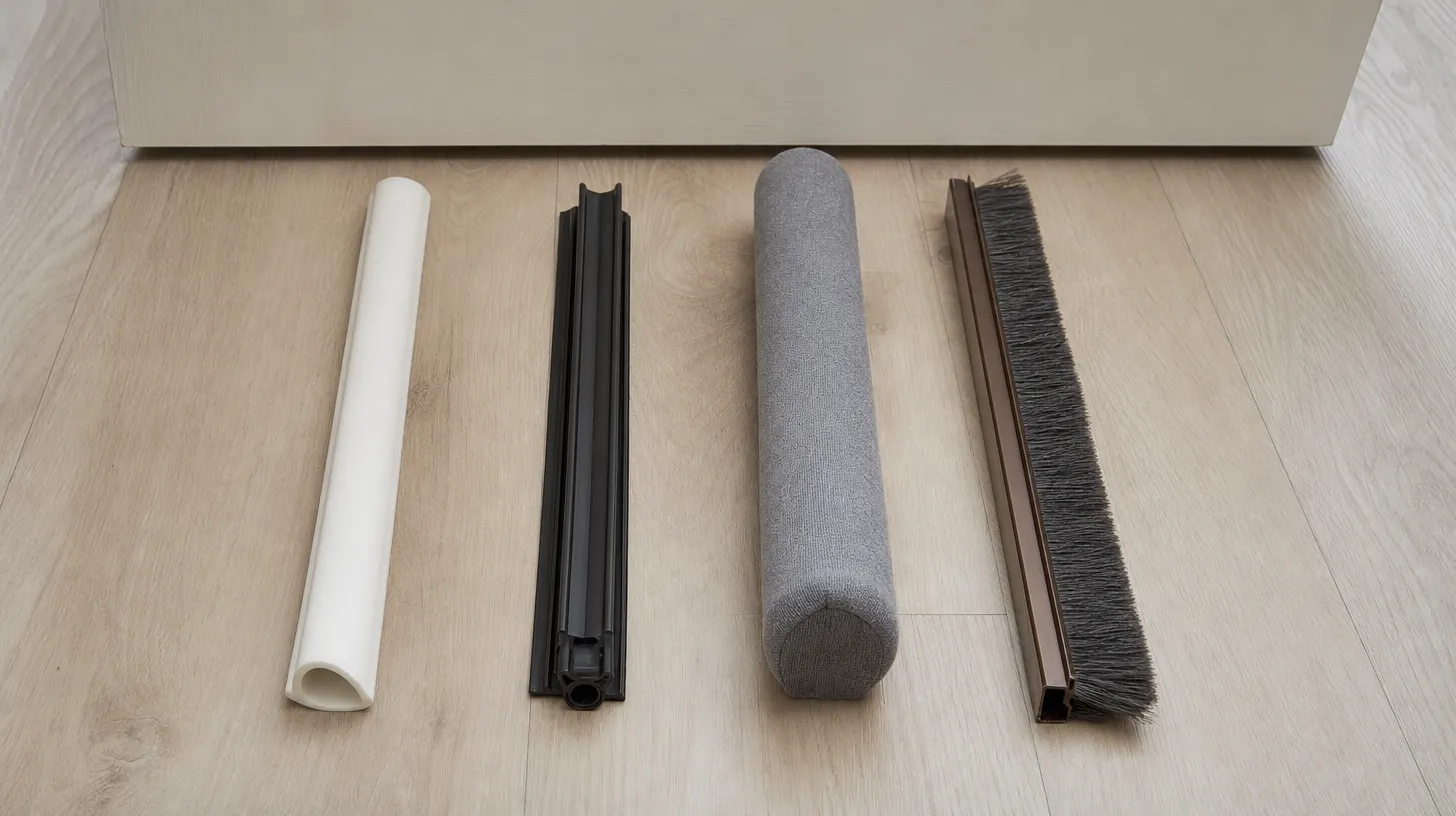
The bottom gap is the undercut. It exists so the door can swing over carpet, a threshold or an uneven floor, and it is typically the biggest single opening in the whole assembly. Close it with a sweep attached to the door, or a seal attached to the threshold.
Second Skin Audio puts the principle flatly - "Even the best door will let sound through if there are gaps around at the bottom and around the edges." The same company publishes the arithmetic that makes this worth taking seriously. By its figures, a partition with a 1 percent sound leak tops out at around 20 dB of transmission loss, while the same partition leaking 0.01 percent reaches 40 dB. Read those as modeled figures for an idealized partition, not as a measurement of a door in an apartment - but the shape of the relationship is the point. A small opening sets the ceiling for everything else you do.
A door is also almost purely an airborne noise problem. The noise started in the air on the other side, traveled through air, and arrived in your air - nothing about it involves footsteps hitting a structure, which is why the advice here looks nothing like the advice for a floor. We lay out the distinction in impact noise and airborne noise, and it is the reason absorption products disappoint people here.
Measure and look before you buy anything
Every step in this section is free, and it decides which products are even relevant.
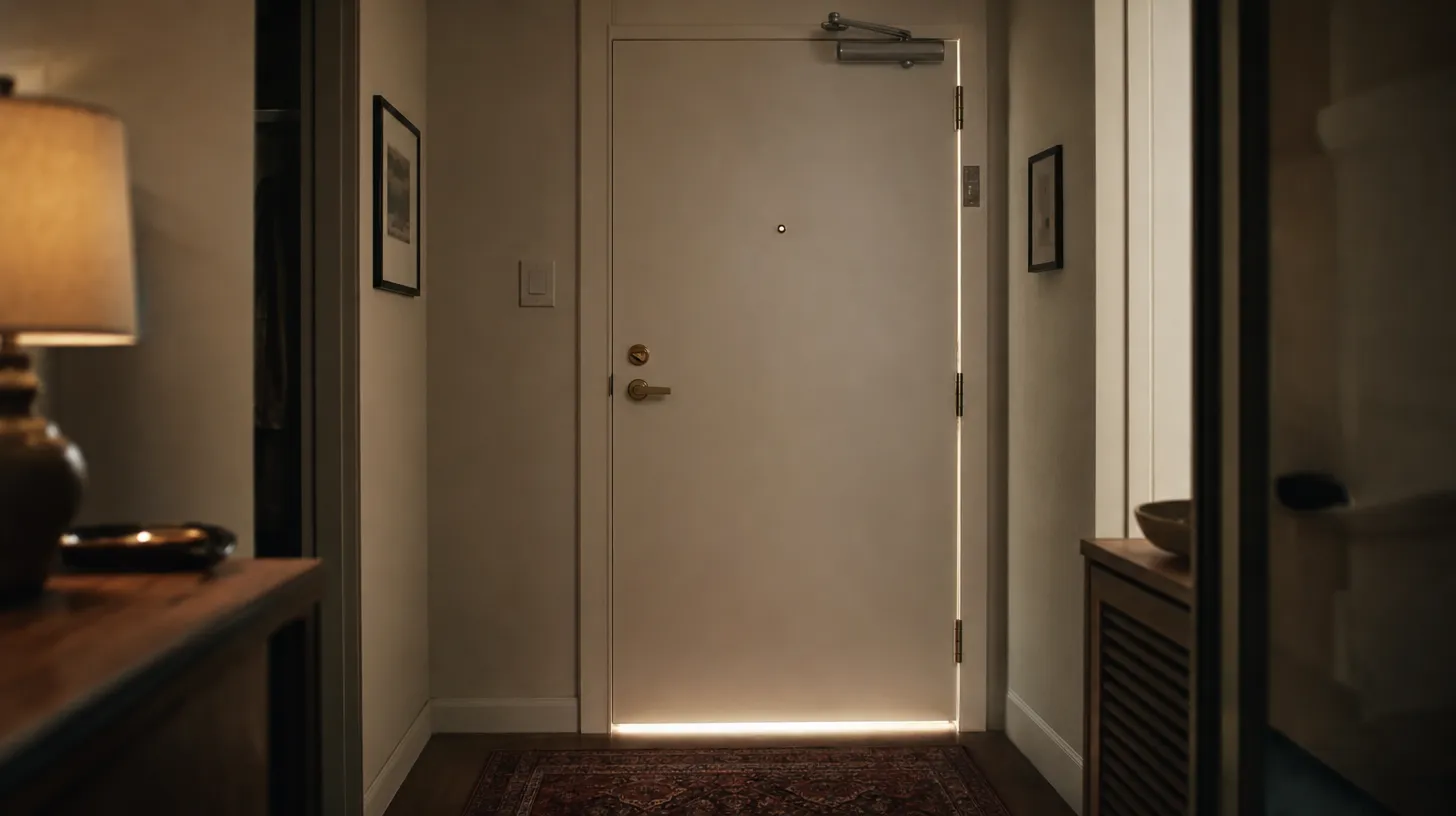
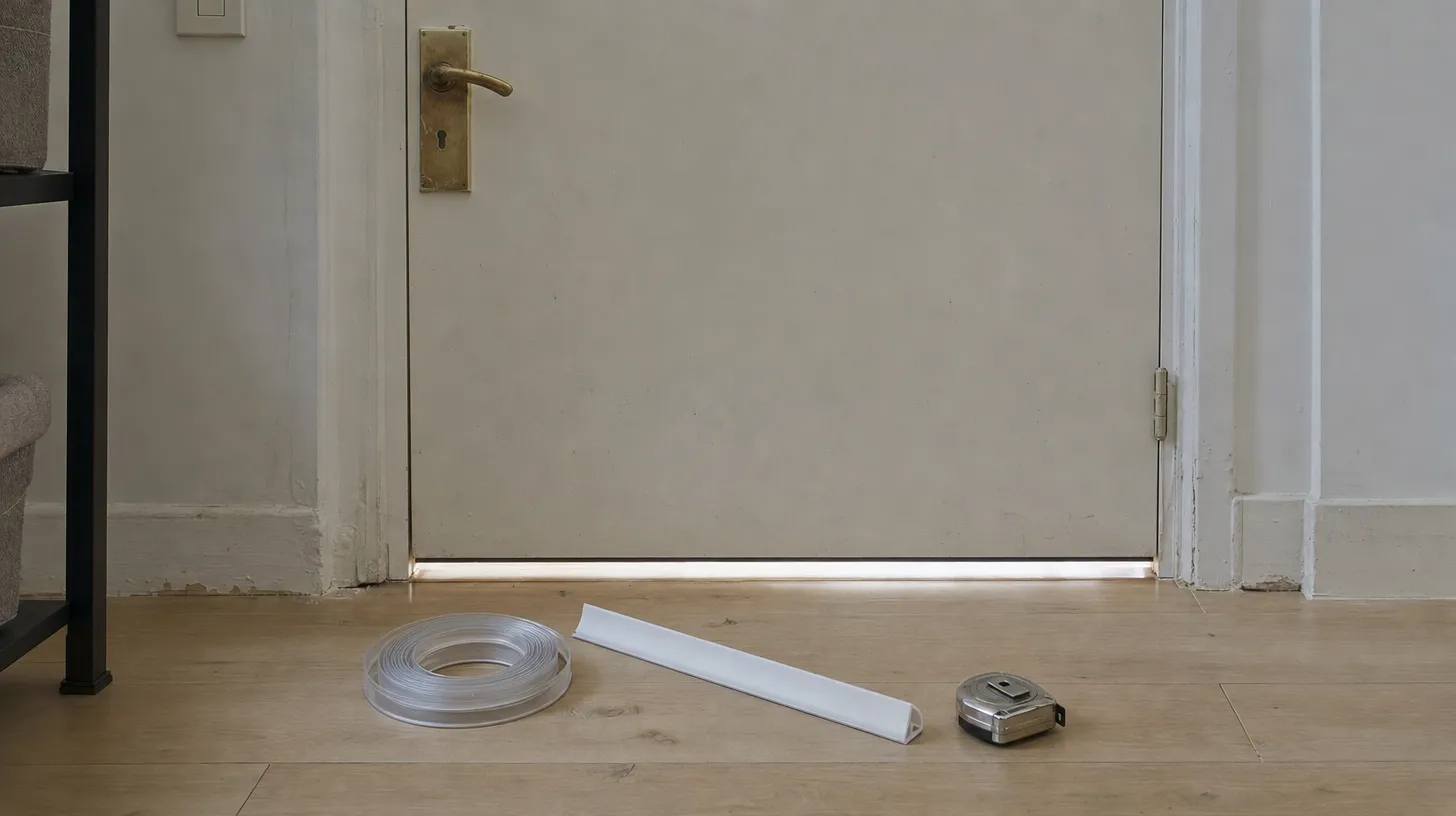
Do the daylight test. At night, kill the lights in your room and leave the hallway or the next room lit. Then look at the closed door from the dark side. Every line of light you can see is an open air path, and the brighter and wider the line, the bigger the leak. Most people find a bright band at the bottom and a thinner line down the latch side.
Measure the bottom gap with a ruler, in three places. At the hinge end, in the middle, and at the latch end. Floors are rarely level and frames are rarely square, so a door with a quarter-inch gap at one end can have three quarters of an inch at the other. Write the largest number down. That number, more than anything else, determines which sweep fits.
Test the perimeter gap with a dollar bill. Close the door on it. If it pulls out with no resistance, the door is not meeting the stop there. Walk the bill around all three edges and note where it slides free.
Push on the closed door. If it moves, the latch is not holding it tight against the stop, and a door held loosely leaks around the latch side no matter what seal you install. Look too at whether the slab sits flush with the stop or stands proud of it along one edge.
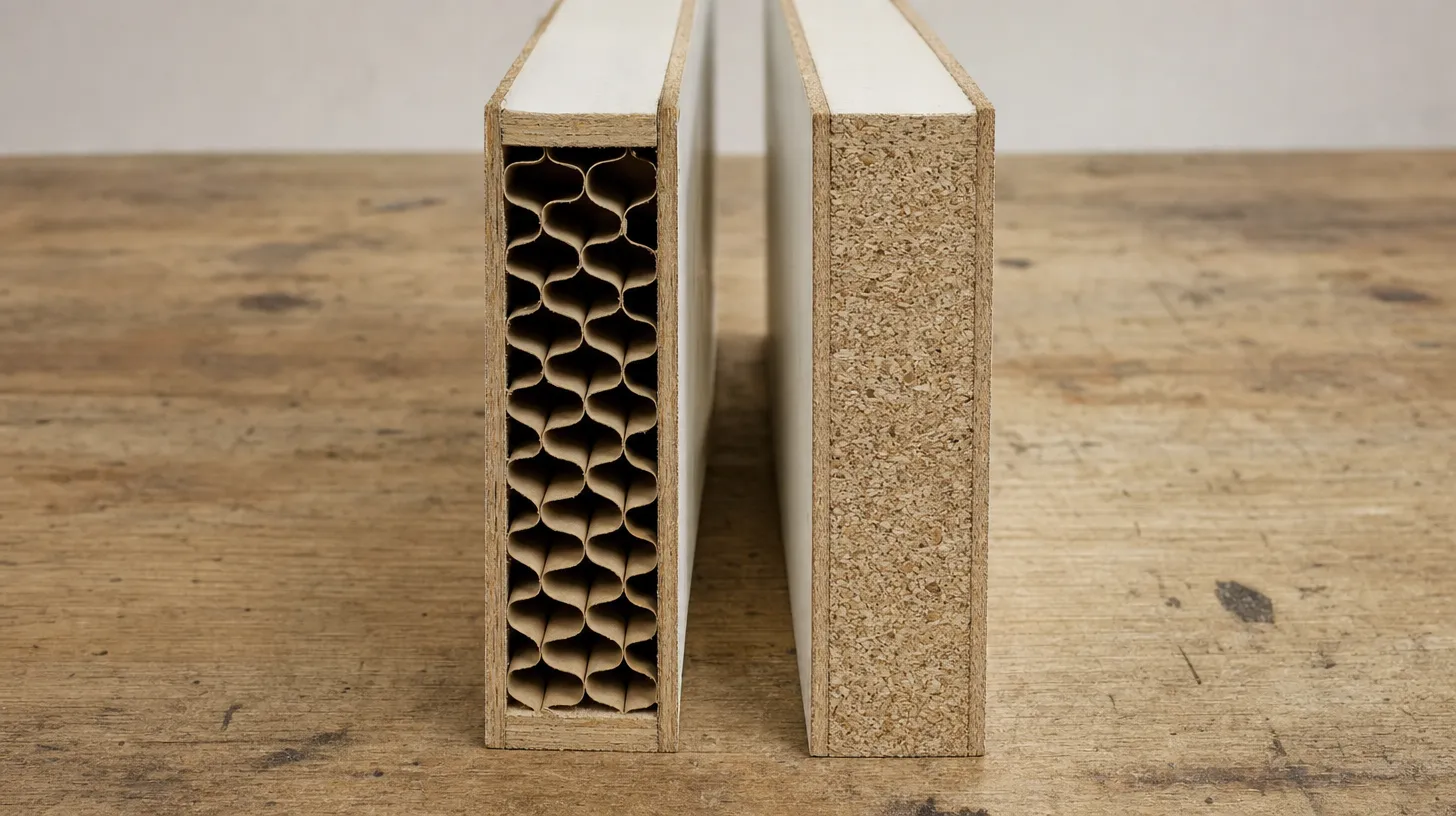
Knock on it. A hollow-core door sounds like a drum. A solid-core door sounds dull and feels heavy on the hinges. This one fact changes how much you should be willing to spend.
If any of what you find is structural - a sagging door, a loose strike plate, a frame that no longer closes square - that is a maintenance request, not a shopping list. Especially on your unit entry door, for reasons in a moment.
Hollow-core, solid-core and what you are actually working with
A door blocks sound with mass, and the two common constructions differ enormously in mass. Our full comparison of hollow-core and solid-core doors goes through the construction, the weight and what each one is realistically capable of. Here is what you need to know before spending money.
The published figures are worth looking at side by side, because they disagree. Commercial Acoustics states that "a standard hollow-core interior door tests at STC 24 to 32" and "a standard solid-core door tests at STC 32 to 36," with "an acoustic-rated door with seals" reaching "STC 40 plus." Second Skin Audio gives lower numbers for the same categories, saying hollow-core doors "generally have an STC rating of 16-21," solid core "anywhere from 29-38," and solid wood 38 to 45.
Those are lab-measured ratings for particular tested assemblies, which is why two sources can publish different ranges and both be right. Construction, thickness, frame and seals all move the number. None of them is a property of the door in front of you, and no sweep or strip you buy comes with an STC of its own. Treat the ranges as a rough ordering of door types, nothing more.
The more useful insight from Commercial Acoustics is about what a door does to the wall around it. The company writes that "the composite STC of a wall plus door assembly is closer to the door's rating than to the wall's," and that "a 25-square-foot door inside a 100-square-foot wall pulls the effective STC of the entire partition down to roughly the door's rating plus a few points." Its summary is blunter still - "the wall might block 50 dB of sound. The door blocks 25 to 35."
Commercial Acoustics also reports a field measurement from an Orlando timeshare where, even with "automatic door sweeps engaged," "the reading at the wall surface measured 60.8 dBA. The reading at the base of the door measured 69.8 dBA." That is one building with one door rather than a universal result, but it shows where the noise gets in.
Second Skin's one-line summary is the right thing to carry forward - "the things that drive STC ratings are mass and the quality of the seal." You can buy seal quality for about ten dollars. You cannot buy mass at a renter-friendly price, and you usually cannot buy a new door at all.
The order of operations
Spend in this sequence. It is ordered by result per dollar, not by price.
- Measure and look. The bottom gap in three places, the perimeter with a dollar bill, the latch, the hinges, and whether the door is hollow. Free.
- Seal the perimeter. Top and both sides. Cheapest, fastest, biggest effect for the money.
- Seal the bottom gap. Usually the single largest opening, and usually the most noticeable change.
- Only then add mass, or hang something heavy over the door.
- Accept the ceiling. A sealed hollow-core door is still a hollow-core door.
Most readers should stop after step three. The gap between steps three and four, in cost and in payoff, is larger than the gap between steps one and three.
Seal the perimeter before you add anything
The perimeter is three edges of clearance that you can close for the price of a sandwich, and it is the step people skip because the bottom gap is the one they can see.
You have two sensible profiles to choose from, and the choice comes down to how wide the gap is.
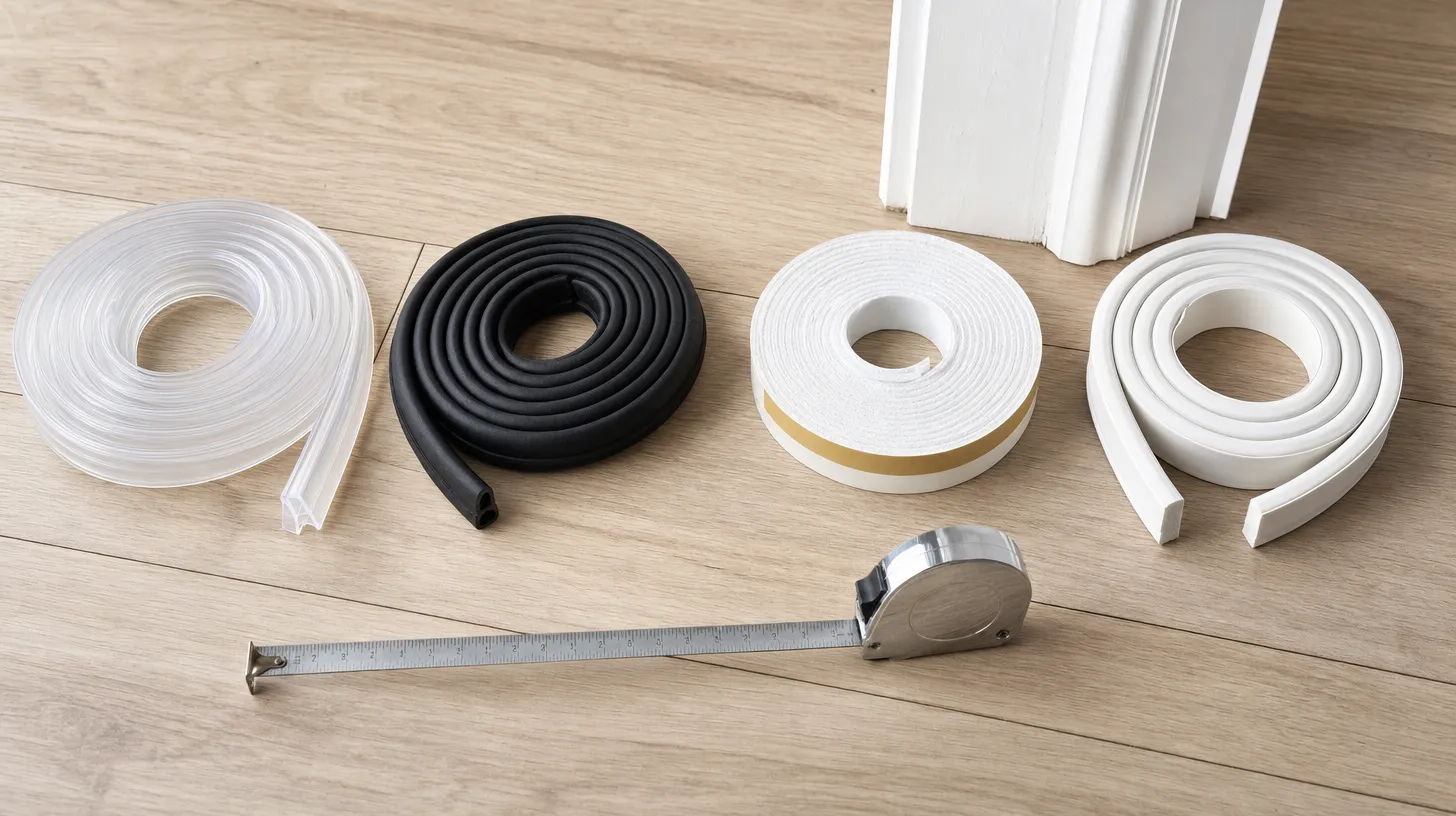
- Foam tape for hairline and small gaps. It compresses easily, conforms to a slightly irregular stop, and costs almost nothing. The Bantie EVA foam weatherstrip tape is 33 ft of 100 percent EVA per the maker, at $9.99 as of October 2026, which is enough to run a door perimeter two or three times over.
- A T-shaped or bulb silicone seal for a gap you can actually measure. The Elvone T-shaped silicone door seal is 20 ft of silicone 2 in wide and 0.07 in thick, which Elvone states seals gaps of 0 to 1 in (0-25 mm), at $19.99 as of October 2026. The T pushes into the gap between door and frame, so that side is held mechanically rather than by glue alone.
We go through the combinations, including kits that bundle a perimeter profile with a bottom seal, in our roundup of the best door seal kits. What matters at this stage is the fit rather than the brand.
The seal has to be compressed by the closed door to do anything, and the door still has to latch. A seal that is too thick holds the door off its stop, which is worse than no seal at all on a door that needs to latch shut. Fit it, close the door, and check that the latch engages normally. If it does not, you need a thinner profile.
Now the failure mode that runs through this entire product category. Adhesive is what fails, not the rubber. Every one of these products sticks on with tape, and tape needs a smooth, clean, dry surface - Elvone explicitly requires that, and recommends warming the adhesive in cold temperatures. So wipe the frame down with isopropyl alcohol, work in a warm room or warm the strip with a hair dryer, press firmly along the whole length rather than tacking it at the ends, and then leave it alone for a day. On a rough, textured or heavily painted door, expect adhesive to let go eventually.
The gap under the door
This is the one you can see light through, and usually the largest opening in the assembly. It is also the easiest thing on this page to get wrong, because the fix depends on a number you have to measure yourself.
Gap size is the spec that matters. A sweep rated to 1 in does nothing useful on a door with a 1.4 in undercut, and a bulky sweep on a door with a quarter-inch gap will drag, catch on carpet and peel itself off within a month. Measure, then shop.
For a typical renter the shortlist is short.
- A self-adhesive silicone sweep sticks to the face of the door at the bottom and moves with it. The OXRQ door draft stopper, stated at 1.96 in wide and 39 in long and rated by the maker to seal a gap up to 1.5 in, is $8.99 as of October 2026. OXRQ's own installation notes are the honest part of the listing - warm it with a hair dryer in cold weather, avoid rough or textured doors, and let the adhesive bond for 24 hours.
- A heavier silicone sweep if you want more profile and more durability. The Vellure sweep at $29.90 as of October 2026 is about three times the price, states 2 in by 39 in, and the maker says removal will not damage the door.
- A slide-under draft stopper if you cannot or will not use adhesive at all, or if the door swings over a rug.
Our full comparison lives at the best door sweeps and draft stoppers, and the older walkthrough of how to measure and which type suits which floor is at stop noise leaking under the door.
It is worth knowing what the professional version looks like, because it tells you what you are approximating. An automatic door bottom is a drop seal fitted to the bottom of the door that retracts when it opens and lowers when it closes. The Soundproofing Company describes the ZERO unit it sells as a "Compress-O-Matic" design with "a sound-absorbing neoprene bulb that compresses to form a tight seal as the door is closed," "fully adjustable up to .3 inches," and tested "through 5 million cycles." It is listed at $203.79.
That is the hardware a studio uses, and the price gap tells you something real - a $9 adhesive sweep is a reasonable approximation of a sealed bottom, not an equal to one. It is also hardware that fastens to the door itself - The Soundproofing Company lists this model as surface-mounted and trimmable, and ZERO sells mortised versions too - and either way that means screwing or cutting into a door you do not own. More on that next.
What your lease will and will not let you do
This is the part of door soundproofing where the stakes are not acoustic.
Your unit entry door is very often a fire door, and that changes what may legally be done to it. According to iDigHardware, the code and hardware resource run by Lori Greene, "the doors leading from an interior corridor to a residential dwelling unit are typically required by current codes to be fire door assemblies rated for 20 minutes," meaning the "doors, frames, and hardware have been successfully tested and listed to provide at least 20 minutes of protection." The same source notes that "it's important for these doors to be self-closing and self-latching," that "fire doors must latch when in the closed position," that "there must be no holes or breaks in the surfaces of the door or frame," and that "the components of the fire door assembly must not have been modified in a way that voids the label."
Read those four requirements again as a renter and the practical rules fall out on their own.
- Do not drill, cut, mortise, undercut or replace your unit entry door. Not for a drop seal, not for a screw-on sweep, not for anything. That is a modification to a listed assembly.
- Do not defeat the closer or the latch. Nothing wedged, nothing taped over the strike, and no seal so thick that the door no longer latches on its own.
- Anything added to a fire door assembly has its own compliance requirements. That is a conversation with your building, not a judgment call you make from a product listing.
- Adhesive-mounted and friction-fit products are where a renter's options actually live.
iDigHardware also notes that "building owners are responsible for keeping their fire door assemblies code compliant." Which means a door that does not latch, or a closer that slams, is your landlord's problem to fix rather than yours to work around.
Leases, buildings and local codes vary, and this is general guidance rather than advice about your specific unit - if you are unsure whether something is permitted on your entry door, ask your landlord or building manager in writing before you buy anything. You will usually find they are more receptive to "the door does not seal properly" than to "I would like to modify the door."
Your front door and the hallway outside it
An interior bedroom door and a unit entry door are different jobs, and the entry door is the harder one.
The hallway on the other side is an acoustically awful space - hard floors, hard walls, no soft surfaces at all. Every conversation, suitcase wheel and door slam bounces down that corridor and arrives at your door having lost very little energy, and you control none of it.
So quieting your front door is almost entirely about the seal, not the slab. The perimeter and bottom-gap work above is the whole playbook, with three additions specific to an entry door.
- Treat your own entry area. A rug, a coat closet with coats in it, a bench with cushions. None of this blocks hallway noise, but it stops what does get in from ringing around a hard, empty entryway - absorption doing an absorption job.
- Leave the peephole and the mail slot alone. They are genuine leaks, but they are part of a listed assembly, so report a loose or rattling one rather than sealing it up.
- Escalate the closer. If the door bangs shut on its own, the closer is out of adjustment. That is a maintenance ticket.
Adding mass to the slab
Here is where the honest version of this advice diverges from what the internet sells.
Blocking sound takes mass and a seal. Absorbing sound takes a soft, porous surface. They are different jobs and you cannot substitute one for the other. Acoustic foam glued to a door blocks essentially nothing, because foam has almost no mass - it was built to soak up reflections inside a room, which is a real job, just not this one. We cover what absorption on a door can and cannot do at absorption on a door, because the two categories get sold interchangeably.
If you want the blocking job done, the material has to be heavy. We go through the renter-viable options - sheet goods hung rather than fixed, dense panels, mass-loaded vinyl, and what each one weighs - in how to add mass to a door.
Three constraints to carry in before you start.
- Hinges and latches have limits. A hollow-core door was not designed to carry a heavy sheet of vinyl, and loading one up can leave the door sagging, rubbing or no longer latching. On a fire-rated entry door, this is not an option at all.
- Partial coverage buys very little. Mass works as a continuous barrier. A panel on the middle of the door with bare slab and open gaps around it is mostly decoration.
- The ceiling is low and arrives fast. Going from a sealed hollow-core door to something meaningfully better usually means a different door, which is not a renter decision.
This is also where the overall logic of your apartment matters. A well-sealed door in a thin wall just relocates the weakest point, which is why how to soundproof apartment walls is the companion piece to this one. If the wall beside your sealed door is a single layer of drywall on a shared stud, that wall is now your limit.
Curtains and blankets over a door
Hanging something heavy over a door is the most popular renter fix on the internet and the most oversold.
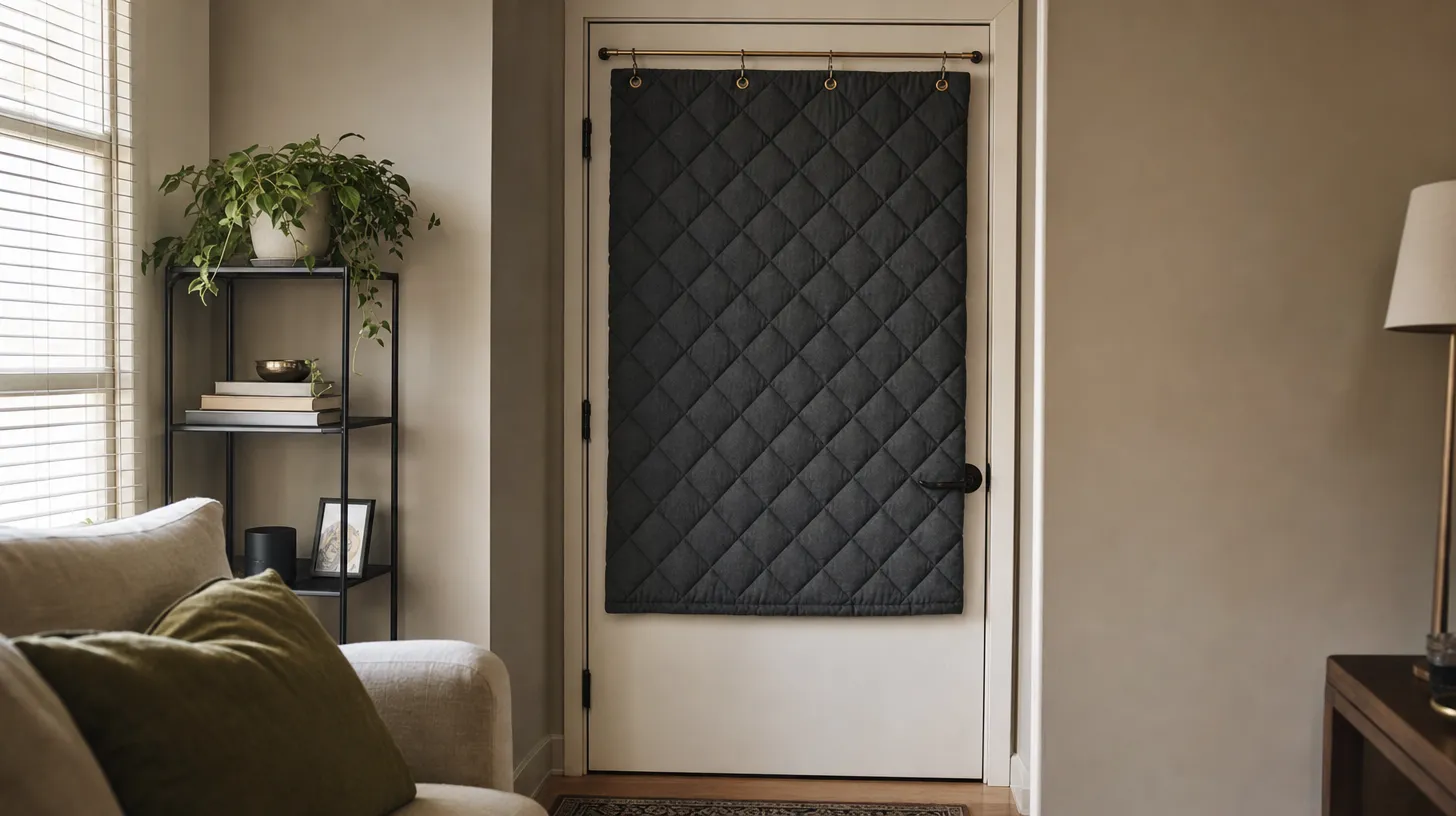
Start with the physics. According to EngineerFix, "curtains, being flexible and lacking significant mass, cannot effectively impede the transmission of airborne sound waves," and "curtains function primarily as sound absorbers." The same source notes that "by reducing the overall reverberation time, curtains make the room sound quieter and more comfortable, even though the actual volume of the noise source outside remains unchanged," and that the materials which do block sound well are the heavy, rigid ones - "multiple layers of drywall, concrete, or specialized laminated glass."
So a curtain over a door changes how your room sounds, not how much gets in. That is the accurate sentence, and it is why we will not tell you a moving blanket turns a hollow-core door into a quiet one.
There is one genuine exception. If the curtain is wider and taller than the door frame, hangs past the edges of the opening, and is heavy enough to hang to the floor, then some of what it is doing is covering the leak paths rather than absorbing. That is a real effect, and it is why some people notice a change. It is also an inefficient way to buy a seal, when a perimeter strip does it better and permanently.
Our rundown of soundproof curtains and blankets for doors covers which products are heavy enough to be worth the rod and which are blackout curtains with an acoustic label.
Doorways with no door at all
An open doorway between two rooms, or an archway into a hall, is the hardest case on this page, because there is no slab and no frame contact to seal against.
Be realistic first. Blocking sound requires a continuous barrier with mass and no gaps, and an opening has none. Anything you do here is partial, and the honest best case is turning clearly audible speech into muffled speech.
The things that actually help, in order.
- A heavy curtain on a wrap-around rod, hung so the fabric overlaps the opening on all sides and touches the floor. EngineerFix recommends extending curtain overlap "at least six to twelve inches on both sides" of a window frame, and the same logic applies to a doorway - the overlap is what closes the leak path at the edges.
- A freestanding bookcase, filled, where the layout allows. Books are dense and a full shelf is heavier than any curtain you can hang.
- Asking the landlord about a door. In many buildings an interior doorway without a door is a missing fitting rather than a design choice, and this is a cheap request for them to fulfill.
We go into the full set of options, including rods, panels and dividers, at soundproof a doorway with no door.
Rattles, latches and slams
Some door noise is not transmitted noise at all. The door itself is the source.
- A rattle means the door is loose in its frame and moving under air pressure - a window open across the apartment, HVAC cycling, or the stack effect in a corridor. A compression seal on the perimeter usually stops it. A misaligned strike plate is the other common cause, and on an entry door that is a maintenance request.
- A slam on a self-closing entry door means the closer needs adjusting. Do not disable it, wedge it, or tape the latch - iDigHardware is explicit that these doors need to be self-closing and self-latching, and that fire doors must latch when closed. Report it instead.
- Latch click and hardware noise is the easiest win in this article. Felt or rubber silencer bumpers on the door stop take the crack out of a closing interior door for a couple of dollars.
Every one of these is worth fixing before you buy a single soundproofing product, because they are often the actual noise the household is complaining about. We have a short troubleshooting piece on a door that rattles and slams for the cases this list does not cover.
What this actually gets you
Set expectations properly, because the gap between what sealing a door does and what people hope it does is where this whole category loses trust.
A well-sealed door stops you hearing hallway conversation as words and starts you hearing it as a murmur. That is the realistic, repeatable result, and it is genuinely worth $20 and an afternoon. In our experience sealing feels more effective than any decibel figure suggests, because what goes first is your ability to make out the words.
What it will not do is stop a subwoofer. Low-frequency energy goes through the slab, around through the wall, under through the floor and along the structure, and a silicone strip does not touch any of that. If the noise that is ruining your week is bass, the door is not your problem and sealing it will not fix it.
Sealing a door also does not change the rest of the partition. Commercial Acoustics' composite STC point cuts both ways - the door drags the whole wall down, and once the door is no longer the worst element, the wall is. So when readers ask us whether soundproofing a door actually works, the full answer is that sealing reliably improves speech privacy, does nothing for bass, and hands the problem to the next weakest surface.
That is still a good trade. It is the cheapest meaningful improvement available to a renter on any surface in the apartment.
What it costs
Here is the arithmetic, using the prices on the products in this guide as of October 2026.
- The honest minimum, around $19. The Bantie foam tape at $9.99 for the perimeter plus the OXRQ silicone sweep at $8.99 for the bottom gap. Both leaks closed, nothing else bought.
- The better version, around $50. The Elvone T-shaped silicone seal at $19.99 for a measurable perimeter gap plus the Vellure sweep at $29.90 for a door that gets heavy use.
- The professional version, over $200 for one component. The Soundproofing Company lists the ZERO automatic door bottom at $203.79, and that is the bottom seal alone, before jamb gasketing, before a threshold, and before fitting it to a door you are allowed to modify.
Add nothing for the first step - measuring and testing the latch costs nothing.
The useful way to think about what it costs to soundproof a door is that the first twenty dollars buys most of the available result, and everything past it buys progressively less. That is unusual in soundproofing and it is the best news on this page.
The bottom line
Measure first. Seal the perimeter. Seal the bottom. Then stop and listen for a week before you spend anything else.
A door has two leaks and they need two products, and together those two products cost under $20 as of October 2026. The slab matters far less than the air around it, mass is a job most renters cannot do, and curtains change your room rather than your neighbor's volume. If hallway voices have turned into a murmur, the job worked. If you can still hear bass, the door was never the path.
For the fastest possible version of all of this, go back to five easy steps to soundproof your door and work down the list.
Explore the full series
- Hollow-Core vs Solid-Core: Why Your Door Leaks Sound - Why a hollow-core door is mostly air, how to tell which one you have, and what STC really tells you.
- The Best Door Sweeps and Draft Stoppers for Blocking Noise - The gap under the door is the biggest opening in the room. Five sweeps compared, and the adhesive caveat.
- Hallway Voices and Door Slams: Quieting Your Front Door - Hallway voices, door slams and corridor noise - plus the fire-rating limits on a unit entry door.
- The Best Door Seal Kits for Apartment Doors - Perimeter gasket kits for the top and sides, where generic foam tape runs out of road.
- How to Add Mass to a Door Without Replacing It - Mass is what blocks sound. How to add it to a door you are not allowed to replace.
- Does Soundproofing a Door Actually Work? - An honest accounting of what sealing and mass-loading a door does and does not buy you.

A 33 ft roll of self-adhesive foam tape, stated by Bantie as 100 percent EVA, which cuts freely to fit. Sold for door frames, window gaps, vents, appliances and furniture, with an upgraded mesh adhesive the maker says peels and sticks easily and leaves no traces.
The cheapest way to close the perimeter gap at the top and sides of a door, which is the whole reason it is first in this list rather than last. Bantie states the foam is softer and wider than common foam strips, and 33 ft is enough to run the full perimeter of a door two or three times over. The listing names sound insulation among many uses, but no rating is published for it, so we read that as marketing copy and not a measurement.
*Price shown on Amazon and subject to change.

20 ft of clear silicone in a T-shaped profile, 2 in (50 mm) wide and 0.07 in (1.8 mm) thick, cuttable to fit. The T pushes into the gap between the door and the frame, so that side of the seal holds its position without relying on adhesive.
The better perimeter choice when you have a gap you can measure rather than a hairline one, because Elvone states it seals gaps of 0 to 1 in (0-25 mm) and gives the material as 100 percent silicone. The caveat applies to this whole category - Elvone requires a smooth, clean, dry surface and recommends warming the adhesive in cold temperatures, so a rough or textured door is where this fails. Its windproof and soundproof claims are listing language with no published rating behind them, so we treat them as claims and not numbers.
*Price shown on Amazon and subject to change.

A self-adhesive silicone sweep for the bottom of the door, stated by OXRQ as 1.96 in wide and 39 in long, which the maker says seals a gap up to 1.5 in.
The bottom gap is usually the single largest opening in a door, and at $8.99 as of October 2026 this is the cheapest way to close it. Measure the gap before you order, because the 1.5 in figure is the spec that decides whether this fits your door at all. OXRQ warns against rough or textured doors, recommends warming the strip with a hair dryer in cold weather, and states the adhesive bonds firmly after 24 hours, so press it on and then leave it alone for a day. Its noise, draft, dust, odor and light claims are listing copy with no rating published.
*Price shown on Amazon and subject to change.

A self-adhesive, trimmable sweep in what Vellure calls industry-grade silicone, stated at 2 in high and 39 in long, with thick 3d chambers molded into the profile.
Roughly three times the price of the budget silicone sweeps, and the reason to pay it is build rather than data. Vellure credits those 3d chambers with reducing sound, which is a maker claim with no rating published behind it, so do not read it as a number. The genuinely useful line in the listing is that removal will not damage the door, which matters more than it should if you are a renter thinking about a deposit.
*Price shown on Amazon and subject to change.
| Pick | Product | Link | |
|---|---|---|---|
| Start Here | Bantie — Bantie EVA Foam Weatherstrip Tape (33 ft) | $9.99 | Check → |
| Best Perimeter Seal | Elvone — Elvone T-Shaped Silicone Door Seal (20 ft) | $19.99 | Check → |
| Best for the Bottom Gap | OXRQ — OXRQ Door Draft Stopper / Door Sweep (39 in, silicone) | $8.99 | Check → |
| Upgrade Sweep | Vellure — Vellure Premium Door Sweep / Draft Stopper (39 in, silicone) | $29.90 | Check → |

Lillie Metayer
Lillie Metayer is the founder of a local program that helps apartment-dwellers take action against noise pollution. Involved in environmental activism since high school, Lillie is passionate about raising awareness of the harms of noise exposure and helping people reduce noise in their communities. In her free time, Lillie enjoys playing the violin and spending time outdoors.