There is more bad soundproofing advice on the internet than almost any other home topic. People glue foam to a wall to block a neighbor (it can't), buy a "soundproof" curtain expecting silence (it won't), and add one more layer of drywall expecting a miracle (the physics says otherwise). The frustrating part is that acoustics is not mysterious. The behaviour of sound in a room, and through a wall, is described by equations that have been settled for a century.
So we built three calculators around those equations. They are free, there is nothing to sign up for, and each one shows you the exact formula it used — with your numbers plugged in — so you can check our work. Use them to predict three different things before you spend money:
- How echoey your room is (and how much absorption will fix it) — the Sabine equation.
- How much quieter a treatment will actually feel — the loudness rule.
- How much sound a wall, door, or barrier can block from its weight alone — the mass law.
A quick reminder that runs through all three: absorbing sound and blocking sound are different jobs. Soft, fluffy things (panels, curtains, carpet) absorb — they cut echo inside a room. Heavy, sealed things (mass, dense layers) block — they stop sound passing through to the other side. The first calculator is about absorption; the second and third are about blocking. If that distinction is new to you, start with our guide to absorbing versus blocking sound.
1. The Room Echo Calculator (reverberation time)
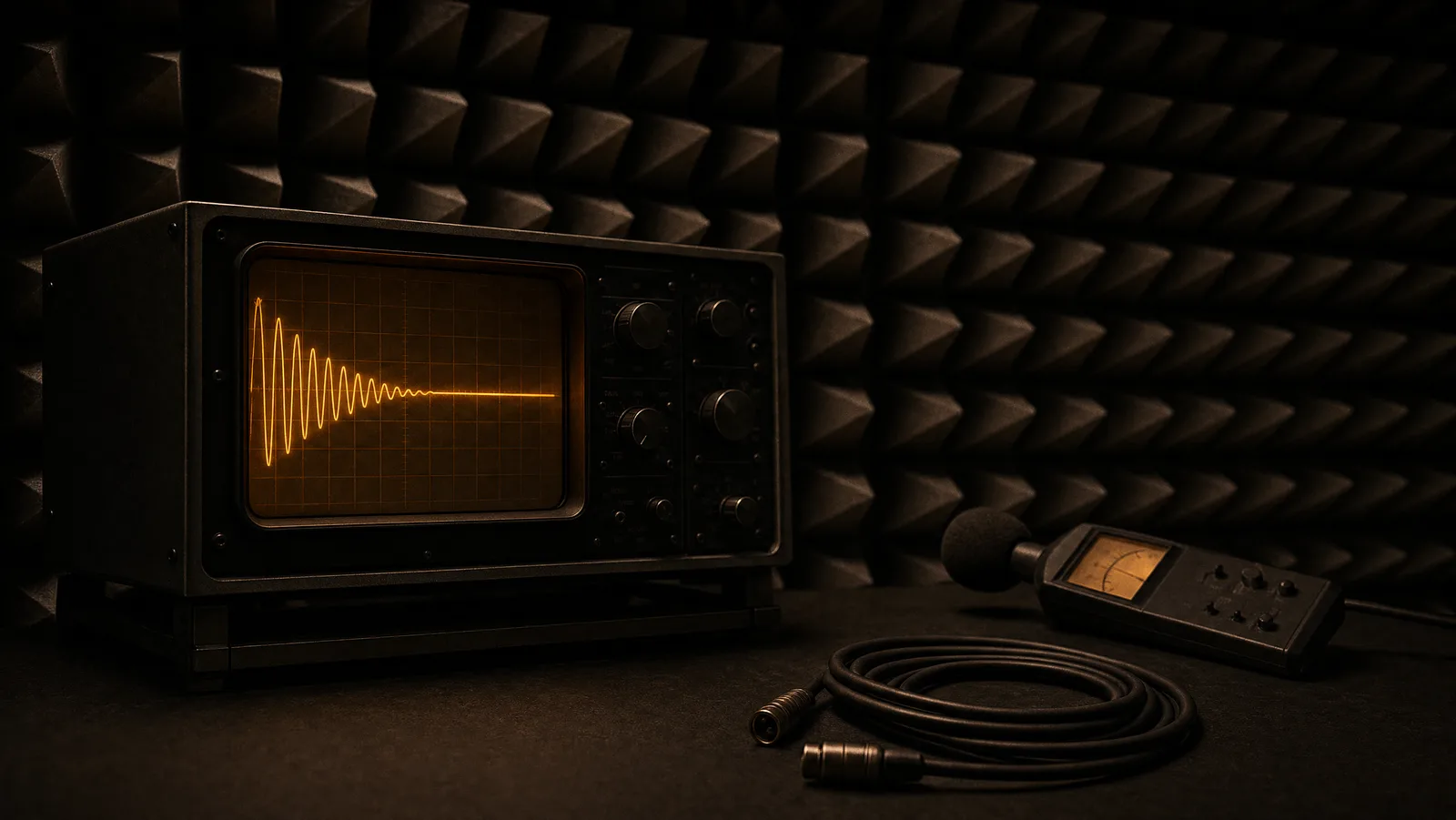
When a room sounds boomy, hollow, or "live" — when voices echo and music turns to mush — what you are hearing is reverberation: sound bouncing off hard surfaces and taking a long time to die away. The standard measure is RT60, the time in seconds for a sound to fade by 60 decibels (to about a thousandth of its energy). A bare, hard room can ring for two seconds or more. A comfortable living room sits closer to half a second.
Reverberation time was first quantified by Wallace Clement Sabine at Harvard in the 1890s, and his equation is still the one acousticians reach for:
RT60 = 0.161 × V / A
- V is the room's volume in cubic metres.
- A is the room's total absorption in sabins — found by multiplying each surface's area by its absorption coefficient and adding them all up.
- 0.161 is a constant in metric units (it becomes 0.049 if you work in feet). It comes from the speed of sound and the 60-decibel decay target.
The lesson hidden in that fraction is simple: reverberation time goes down as absorption goes up. Double the absorption in a room and you roughly halve the echo. That is the entire reason acoustic panels work — they pile sabins into the bottom of that equation.
Reverberation Time (RT60)
RT60 = 0.161 × V ÷ A = 0.161 × 50.00 ÷ 7.25 = 1.11 sMean absorption α = A ÷ S = 7.25 ÷ 85.00 = 0.085 · critical-listening target for this volume (EBU Tech 3276, 0.25 × (V ÷ 100)^⅓ with V in m³): 0.20 s
How this is calculated
RT60 = k × V ÷ A — k = 0.161 (V in m³, A in m²-sabins) or 0.049 (V in ft³, A in ft²-sabins); A = Σ (surface area × absorption coefficient) + furnishings + panels
Reverberation time is how long sound takes to fade by 60 decibels after the source stops. Sabine's equation says that time rises with the room's volume — more air to fill — and falls as its absorption rises, so doubling the absorption roughly halves the echo. Absorption is counted in sabins: multiply each surface's area by how much of the sound hitting it is soaked up rather than reflected, then add the surfaces together along with your furnishings and any panels.
This is an estimate, not a measurement. It is computed from the published formula above using the values you entered — a real room has leaks, flanking paths and geometry that no single equation captures.
- The equation is the Sabine equation, RT60 = k × V ÷ A, with k = 0.161 when volume is in cubic metres and absorption in m²-sabins, and k = 0.049 for cubic feet and ft²-sabins. The constant is not fitted to data: it is 24 × ln(10) ÷ c, which at c = 343 m/s gives 0.16111 (rounded to 0.161) and 0.04911 per foot (rounded to 0.049).
- A is the sum of each surface’s area times its absorption coefficient. The nine single-material coefficients are representative mid-frequency (NRC) figures from standard architectural-acoustics tables.
- Two wall options are our own composites, not table values, because they describe a wall only partly covered: "Drywall + heavy curtains" at 0.30 assumes roughly half the wall carries an 18 oz draped curtain (the drape alone is about NRC 0.58), and "Acoustic-panelled" at 0.65 assumes roughly two thirds of the wall is covered with NRC 1.0 panels. If your coverage differs, so will your result — which is also why the panel counter stays at zero when you pick the panelled wall.
- Each panel is treated as 2 ft × 4 ft with one face exposed at NRC 1.0 — 8 ft²-sabins, or 0.743 m²-sabins. NRC is the average of absorption at 250, 500, 1000 and 2000 Hz, so it describes speech and music frequencies and says nothing about bass: the 2-inch mineral-wool panel we link to measures 1.17 at 500 Hz but only 0.12 at 125 Hz. Panels clean up a ringing room; they do not fix boom. We also count each panel as a full absorber without subtracting the small patch of wall it covers (0.037 m²-sabins against painted drywall, about 5% of the panel).
- The soft-furnishings setting is our estimate and the one number here with no standard behind it. We add sabins in proportion to floor area — 0.1 light, 0.22 medium, 0.38 heavy — the same form published tables use for auditorium seating (0.49 to 0.88 per square foot of floor area), scaled to what a domestic room holds: "medium" is about a sofa, an armchair, a bookcase and some soft goods in a 20 m² room.
- The floor covering is counted separately from the furnishings, so do not count a large rug twice. We cap the two together at an effective floor coefficient of 0.85, because carpet with a thick pad plus heavy furnishings would otherwise imply 0.93 — a floor no real material achieves.
- On the target band: 0.3 to 0.6 seconds is our comfortable range for a living room or home office, and the upper end lines up with ANSI/ASA S12.60, which caps unoccupied furnished classrooms under 10,000 cubic feet at 0.6 seconds. A dedicated critical-listening room is deliberately drier — EBU Tech 3276 asks for 0.2 to 0.4 seconds, nominally 0.25 × (V/100)^⅓ seconds, about 0.2 s for a 50 m³ room — so aim below our band if that is what you are building.
- Where this stops being accurate: Sabine assumes sound spread evenly through the room, and once the room’s mean absorption coefficient passes about 0.15 it overestimates reverberation time, where acousticians switch to Norris-Eyring, RT60 = k × V ÷ (−S × ln(1 − α)); in a well-treated small room the gap is 10 to 15 per cent, always in the direction of this tool reporting more echo than you have. We ignore air absorption, negligible in an apartment-sized room below about 2 kHz, and we do not check that your panels would physically fit on your walls. This is a well-founded estimate, not a lab measurement.
- UIUC Physics 406, Acoustical Physics of Music, Lecture 9 (Prof. Steven Errede) — Sabine equation, K = 0.049 secs/ft = 0.161 secs/m, T60 definition, 1 ft² = 1 absorption unit, air-absorption correction
- Room Acoustics lecture notes, TU Berlin (arXiv:2111.01900) — Sabine eq. 5.34, the constant derived analytically as 8 ln(10^(60/20))/c₀, Eyring eq. 5.56 and the α > 0.15 crossover
- EBU Tech 3276 (1998), Listening conditions for the assessment of sound programme material, s.2.3 — "0.2 < Tm < 0.4 s", Tm = 0.25(V/V₀)^⅓, V₀ = 100 m³
- Sengpielaudio — absorption coefficients of building materials (the octave-band table used to verify every surface value)
- ATS Acoustics Panel 24 × 48 × 2 in — published RAL absorption data (NRC 1.00; 0.12/0.67/1.17/1.12/1.08/1.08)
- Armstrong World Industries Cortega 770 acoustical ceiling tile — NRC 0.55 (manufacturer listing)
- Intertek — ASTM C423: NRC is "the average of the absorption coefficients at 250, 500, 1000 and 2000 hertz, rounded to the nearest multiple .05"
- Armstrong Ceilings white paper — Quiet in the Classroom: ANSI/ASA S12.60, 0.6 s limit for unoccupied furnished classrooms under 10,000 ft³
- ScienceDirect topic page, Sabine Equation — absorption tabulated per sq ft of floor area for upholstered seating, the only published precedent for the per-floor-area form
Formula and constants last reviewed October 2026.
How to use it. Enter your room's length, width, and height, then pick the dominant material for the floor, walls, and ceiling. Set roughly how furnished the room is (a sofa and a rug absorb a surprising amount), and then add acoustic panels one at a time to watch the reverberation time drop. The readout shows your RT60, the room's volume, and the total absorption, with a target band of 0.3 to 0.6 seconds — the range most people find comfortable for an apartment living room or home office, and the upper end lines up with the 0.6-second ceiling ANSI/ASA S12.60 sets for small classrooms. A dedicated critical-listening or mixing room is deliberately drier: EBU Tech 3276 asks for 0.2 to 0.4 seconds, so aim below our band if that is what you are building. One detail worth knowing before you read the absorption figure — the per-panel value is unit-dependent too, so one 2 ft × 4 ft panel adds 8 ft²-sabins in imperial mode but 0.74 m²-sabins in metric. Above about one second, the room will sound noticeably echoey.
Two things usually surprise people. First, bare rooms are far worse than they expect — a room with hard floors, painted drywall, and no furniture can post an RT60 over two seconds. Second, it takes more absorption than you think to fix it. One foam square does almost nothing; you are trying to move a number that scales with the whole room's volume. A few full-size NRC 1.0 panels, a thick rug, and heavy curtains together will move it a lot. Keep one limit in view, though: NRC is an average of the absorption measured at 250, 500, 1000 and 2000 Hz, and the panel linked above measures 1.17 at 500 Hz but only 0.12 at 125 Hz. Panels clean up a room that rings. They do not fix boom.
One honest caveat, and this one has a number on it: the Sabine equation assumes sound spreads evenly through the room, and once the room's mean absorption coefficient climbs past about 0.15 it begins to overestimate reverberation time — that is the point where acousticians switch to the Norris-Eyring equation instead. In a well-treated small room the gap runs 10 to 15 per cent, and it is always in the same direction: this tool reports more echo than you really have, so the calculator now shows you both figures once your room crosses that line. Treat the result as a well-founded estimate, not a lab measurement.
2. The Noise Reduction Calculator (how much quieter?)
This is the calculator that settles the most arguments, because it corrects the single most common misunderstanding in soundproofing: the difference between decibels and loudness.
Decibels are a logarithmic measure of sound energy. Loudness is how loud something seems to your ears. They are not the same, and the gap between them is huge:
- Cutting the sound energy in half lowers the level by only 3 dB — a change you can barely notice.
- To make something seem half as loud, you have to lower the level by about 10 dB — which actually removes 90% of the energy.
That second relationship is the one that matters when you are deciding whether a treatment is worth it. The rule, drawn from decades of psychoacoustic research, is that perceived loudness roughly halves for every 10-decibel drop:
Perceived loudness = 2 ^ (−ΔdB / 10)
So a 10 dB reduction feels half as loud (a 50% improvement). A 20 dB reduction feels a quarter as loud. A 30 dB reduction feels about an eighth as loud. The improvements stack up fast, which is good news: you do not need to block all of a noise to make a room feel peaceful. Aim at an absolute level rather than a fixed cut, though, because 20 dB off a 95 dB source still leaves you at 75. The World Health Organization's community-noise guidelines put the indoor bedroom target at 30 dB for continuous noise and 45 dB for an individual night event — and that, rather than a round number of decibels removed, is what the calculator's second figure is measuring.
How Much Quieter Will It Get?
No STC descriptor here, by design: a barrier's own STC does not add to your wall's STC, and an add-on's gain is not a rating of the finished partition. A +5 dB increment is all this mode claims — the STC ladder describes whole walls, and lives in the other mode.
Loudness = 2^(−ΔdB ÷ 10) = 2^(−5 ÷ 10) = 0.707 → about 29% quieter · Received = 70 − 5 = 65 dB
How this is calculated
Perceived loudness = 2^(−ΔdB ÷ 10) · % quieter = (1 − 2^(−ΔdB ÷ 10)) × 100 · Received = max(30 dB, source − reduction)
Decibels add logarithmically, so the level that reaches you is simply the noise on the source side minus the reduction the barrier provides — floored at the background noise your own room already makes. How much quieter that feels is a separate question, and the answer comes from the psychoacoustic convention that perceived loudness roughly halves for every 10 dB you remove: 10 dB feels about half as loud, 20 dB about a quarter. The plain-language verdict is read from the level that actually reaches you against WHO's indoor targets, not from the size of the reduction, because a big reduction applied to a very loud source still leaves a loud room.
This is an estimate, not a measurement. It is computed from the published formula above using the values you entered — a real room has leaks, flanking paths and geometry that no single equation captures.
- Perceived loudness follows the standard psychoacoustic convention that it roughly halves for every 10 dB drop (loudness = 2^(−dB/10)) — the rule behind the National Hearing Conservation Association’s chart, which calls 10 dB "about twice as loud", 20 dB "about four times as loud" and 3 dB only "barely perceptible". It is a convention, not a law: it is calibrated for steady tones around 1 kHz at moderate levels, and at very low frequencies a doubling of loudness can take as little as 5 dB.
- The percentage is perceived loudness, not energy. A 10 dB drop halves the loudness but removes 90% of the energy — two different, correct numbers for the same change (1 − 2^(−dB/10) versus 1 − 10^(−dB/10)).
- The two whole-partition options are published laboratory STC ratings for a complete assembly (2×4 wood studs with a single gypsum layer each side and no insulation = STC 33; double ½-inch drywall each side with batt insulation = STC 45). They are not gains you add on top of a wall you already have, because STC values do not add up — which is why they live in their own mode and are read against the level on the far side of the wall.
- The add-on figures are increments. Adding mass-loaded vinyl to an existing insulated stud wall was measured at about +5 dB (STC 40 to STC 45), not the sheet’s own STC 20–26 rating measured alone. Sealing an apartment entry door to its frame measured about 4–5 STC points across nine transmission-loss tests on five doors for Canada Mortgage and Housing Corporation.
- The curtain and blanket figures are our own conservative house estimates with no standards-based test behind them. Curtains are absorbers, the few independent measurements we could find showed roughly 1–4 dBA, and they did nothing at all on bass; side and top gaps defeat them.
- STC is a laboratory rating measured on a sealed specimen under ASTM E90/E413, so the level difference you actually get in a building is typically several dB lower because of flanking paths, gaps and construction reality — the CMHC study measured a door rated STC 36 in the lab delivering STC 32 once it was operable and hung.
- ASTM E413 states the rating is not appropriate for sound sources whose spectra differ significantly from speech, radio and television. That means an STC-derived answer tells you almost nothing about a subwoofer, a bass line or footsteps overhead; expect far less than the headline figure on low-frequency and impact noise.
- The level reaching you cannot fall below your own room's background noise — about 30 dB in a quiet bedroom — however good the treatment, so the second number floors there. WHO's community-noise guidelines put the indoor bedroom target at 30 dB for continuous noise and 45 dB for individual night events, which is a better goal than any fixed number of decibels removed. The everyday reference levels come from the American Academy of Audiology's NIOSH-sourced chart and vary by 5–10 dB between published charts.
- National Hearing Conservation Association — Decibel (Loudness) Comparison Chart, incl. “Perceptions of Increases in Decibel Level” (1 dB imperceptible, 3 dB barely perceptible, 10 dB about twice as loud, 20 dB about four times as loud)
- American Academy of Audiology — Levels of Noise in Decibels (2023), citing NIOSH: whisper 30, quiet library 40, normal conversation 60, traffic/vacuums 70, lawnmowers 90, plus the 85 dB hearing-protection statement
- CDC / NIOSH — Noise and Hearing Loss: recommended exposure limit 85 dBA over an 8-hour workday, exposure time halved for every 3 dBA increase
- Purdue University PRIME Lab — Noise Sources and Their Effects, incl. the explicit “half as loud as 70 dB” (60) / “one-fourth” (50) / “one-eighth” (40) loudness ladder
- Georgia State University HyperPhysics — Loudness: “the power must be increased by about a factor of ten to sound twice as loud”; “an approximate general statement… not to be taken as a hard and fast rule”
- ASTM E413 Classification for Rating Sound Insulation — ratings correlate with speech/radio/TV sources and are “not appropriate for sound sources with spectra significantly different”; field ratings may be lower “because of flanking transmission or construction errors”
- The Construction Specifier — STC ratings, reproducing the NBS Handbook 119 (Berendt et al., 1976) ladder: 25/30/35/40/45/50/55
- Soundproofing Company — Mass Loaded Vinyl datasheet: wall = STC 40 (Test OL 05-1057), same wall + 1 lb MLV = STC 45 (Test OL 05-0822); “We do not recommend the use of MLV in walls, floors and ceilings”
- MJM Acoustical Consultants for Canada Mortgage and Housing Corporation (Feb 1993) — access doors in multi-dwelling buildings: “STC 27 to STC 32 when operable and from STC 31 to STC 37 when sealed to their frame”
- Commercial Acoustics — STC ratings for common wall assemblies: 2×4 wood stud, single layer each side, no insulation STC 33; double ½in drywall each side with batt STC 45
- Acoustical Solutions / AudioSeal MLV data sheet — 1 lb/ft² MLV rated STC 26 per ASTM E90/E413
- WHO Guidelines for Community Noise (1999) — indoor bedroom guideline 30 dB LAeq continuous and 45 dB LAmax for individual events
Formula and constants last reviewed October 2026.
How to use it. Set the slider to how loud the noise is now — there are reference points along the way (a normal conversation is about 60 dB, a TV around 70, city traffic near 80). Then choose how you are thinking about the fix, because the two modes mean different things. Add to what you have takes a treatment you are layering onto your existing wall or door — seals, a curtain, a sheet of mass — and subtracts its incremental gain from the level you measured. Replace the barrier instead reads a whole partition’s laboratory STC rating, so there the slider is the level on the other side of the wall, not the level in your own room. Mixing those up is the single most common way to talk yourself into a number that cannot happen: subtracting a whole wall’s STC from a reading you took on your own side counts that wall twice. Either way you can drag the fine-tune slider to any value you like. The tool shows two numbers: the sound that still gets through in decibels, and how much quieter that feels as a percentage, along with a plain-language verdict. One warning it will not let you skip: if the level still reaching you is 85 dB or more, NIOSH recommends hearing protection, and the recommended exposure time halves for every 3 dB above that. A treatment that leaves you there has changed how loud the noise feels — it has not made the exposure safe. Note too that the percentage is perceived loudness (2^(−ΔdB/10)); the share of the sound energy removed is a different and much larger number (1 − 10^(−ΔdB/10)).
Some of the treatment presets quote STC values, the standard single-number rating for how well a wall or door blocks airborne sound. Treat that as a loose guide and not an exchange rate. STC is a laboratory rating, measured on a sealed specimen under ASTM E90 and E413, and the level difference you actually get in a building — field NIC — is typically several decibels lower, thanks to flanking paths, gaps and ordinary construction reality. A study of apartment entry doors for Canada Mortgage and Housing Corporation measured five doors at STC 31 to 37 when sealed to their frames, but only STC 27 to 32 once they were operable. One more trap: an STC rating belongs to a whole partition and does not add to the wall you already own — hanging mass-loaded vinyl on an insulated stud wall was measured at about +5 dB, not the sheet's own STC 20 to 26. The interpretation acousticians use, from the ladder in NBS Handbook 119:
- STC 25 — normal speech is easily understood through the wall.
- STC 30 — normal speech is audible but hard to follow; loud speech is still clear.
- STC 35 — loud speech is understood.
- STC 40 — the onset of privacy: loud speech is audible, but not intelligible.
- STC 45 — loud speech is barely audible.
- STC 50 — shouting is barely audible, though a stereo or a party can still leak faintly.
The big caveat — and the tool says so too — is bass. STC is measured for speech-range frequencies, so it tells you very little about a subwoofer, a bass guitar, or the thump of footsteps overhead. Low frequencies leak through far more than an STC number suggests, which is why you can still feel a party's bass line through an otherwise solid wall. For low-frequency and impact noise from neighbors, expect less than the calculator's headline figure.
3. The Mass Law Calculator (will adding mass help?)
The first rule of blocking sound is the oldest one: mass. A heavy, limp barrier is harder for sound to vibrate, so less energy makes it to the other side. Physicists describe a single, solid panel with the mass law, and it is worth knowing because it tells you exactly how much a heavier door or an extra layer of drywall will buy you.
TL = 20 × log₁₀(m × f) − 47
- TL is transmission loss in decibels — how much the barrier knocks down the sound.
- m is the barrier's surface mass: its weight per square metre, in kg/m².
- f is the frequency of the sound, in hertz.
- 47 is the field-incidence constant for a real, randomly-arriving sound field.
Two rules of thumb fall straight out of that formula, and both are baked into the calculator:
- Double the mass, gain about 6 dB. Twice as heavy is meaningfully — but not dramatically — better. This is why "just add mass" has diminishing returns, and why stacking endless drywall is a losing game.
- Every octave up, gain about 6 dB. Mass blocks high frequencies far more easily than low ones. Bass is hard to stop — exactly what the noise calculator warned about.
Will Adding Mass Block It?
TL = 20·log₁₀(m × f) − 47 = 20·log₁₀(10.7 × 500) − 47 = 27.6 dB
How to use it. Build up a barrier by adding layers — sheets of drywall, mass-loaded vinyl, plywood, glass — and the tool sums their surface mass and reports the transmission loss at the frequency you choose. The little spectrum chart shows that 6 dB-per-octave slope at a glance: tall bars on the right (treble blocked well), short bars on the left (bass leaks through). Switch the frequency to 125 Hz to see how little even a heavy wall does against deep bass.
This is where mass-loaded vinyl earns its place in a renter's toolkit: it adds real kilograms per square metre to a thin hollow-core door without any construction — exactly the surface mass this calculator rewards. A heavy sound blanket is cheaper by the square foot, but be clear-eyed about it: at barely a kilogram per square metre it adds only a little mass, so it tames echo far more than it blocks.
Two important caveats live inside this one. First, the mass law describes a single, solid layer. The best-performing walls don't just pile on mass — they decouple, using an air gap or resilient channels so the two sides can't vibrate together. A decoupled wall outperforms what the mass law predicts, so treat the calculator's number as the floor for a simple barrier, not the ceiling for a clever one. Second, a single-frequency transmission loss is only a rough proxy for STC, which is a curve fit across many frequencies. Use the mass-law number to compare options and understand why mass matters — not as a precise STC rating.
The fine print: how accurate are these?
Every formula here is a textbook standard, and we tested each calculator against worked examples computed by hand before publishing. But a few honest limits apply to all three:
- They are estimates, not measurements. Real rooms have leaks, flanking paths, and odd geometry that no simple equation captures. A 1% air gap can turn a 40 dB wall into a 30 dB wall — which is why sealing gaps almost always beats adding material.
- Perceived loudness is personal and depends on frequency; the "10 dB sounds half as loud" rule is a well-established convention, not an exact law.
- STC and single-frequency numbers understate the bass problem. If your noise is low and rhythmic, expect less than the headline figure.
Used with those limits in mind, the calculators will keep you from the two most expensive mistakes in soundproofing: buying absorption when you needed mass, and expecting a small change to deliver a big result. If you want the full playbook, start with genius ways to silence noisy neighbors, seal your door and window, and mask whatever survives with earplugs or a white noise machine.
FAQ
What is a good RT60 for a room?
For a home living room or office, an RT60 of roughly 0.3 to 0.6 seconds feels balanced — speech is clear and music isn't muddy — and ANSI/ASA S12.60 caps small classrooms at 0.6 seconds for the same reason. Below about 0.3 seconds a living room starts to feel unnaturally "dead"; above one second it sounds echoey. A dedicated listening or mixing room is the exception: EBU Tech 3276 asks for 0.2 to 0.4 seconds, with a nominal target of 0.25 × (V/100)^(1/3) seconds, which works out near 0.2 seconds for a 50 m³ room. Larger spaces and concert halls are deliberately longer.
Why does my room need so many acoustic panels?
Because reverberation depends on the whole room's volume, and one full-size 2 ft × 4 ft panel adds only 8 ft²-sabins — 0.74 m²-sabins — of absorption against it. The Sabine equation scales with volume, so a big, hard room genuinely needs several square metres of absorption — a few full-size panels plus a rug and curtains — to drop into the comfortable range.
Does doubling the drywall double the soundproofing?
No. The mass law says doubling the mass adds only about 6 dB of transmission loss — a real improvement, but far from double the blocking and nowhere near double the perceived quiet. Decoupling the wall (an air gap or resilient channels) usually buys more than another layer of mass.
Is STC the same as decibels blocked?
Roughly, for speech — but not literally. An STC 45 wall does not block exactly 45 dB at every frequency. It is a single number fitted to a curve across the speech range (125–4000 Hz), and it overstates how much bass a wall stops. For low-frequency noise, the real-world reduction is less than the STC number.
Why does bass get through everything?
Both the mass law and STC show why: barriers block roughly 6 dB less for every octave you go down in frequency, and STC barely measures the lowest frequencies at all. Long bass wavelengths vibrate a wall easily, so stopping them takes far more mass, decoupling, and sealing than stopping speech does.
Sources and method
The formulas here are textbook standards, and most of the constants trace to a primary document. A few are our own documented estimates, and we would rather name them than let them pass as physics.
Reverberation time uses the Sabine equation (RT60 = k·V/A). The constant is not fitted to data — it is 24·ln(10)/c, which at c = 343 m/s gives 0.1611 s/m, rounded to 0.161, and 0.0491 per foot, rounded to 0.049 (UIUC Physics 406, Lecture 9; TU Berlin room-acoustics notes, which also give the Norris-Eyring crossover near a mean absorption coefficient of 0.15). The single-material absorption coefficients are mid-frequency NRC values from standard absorption tables, and NRC itself is the average at 250, 500, 1000 and 2000 Hz under ASTM C423. Panel absorption uses the published data for the 2-inch panel we link to, rated NRC 1.00. Target ranges come from ANSI/ASA S12.60 for speech rooms and EBU Tech 3276 for critical listening.
Our estimates, not published values. The soft-furnishings allowance in the echo calculator is ours, as are the two part-coverage wall options — "drywall + heavy curtains" and "acoustic-panelled" assume roughly half and roughly two-thirds coverage respectively. The curtain and blanket figures in the noise calculator are conservative house estimates too: the few independent measurements we could find put curtains at 1 to 4 dBA, and nothing at all on bass. Each calculator's own "How this is calculated" panel spells out exactly what it assumes.
Perceived loudness uses the standard convention that a 10 dB change doubles or halves loudness (National Hearing Conservation Association; HyperPhysics, which is careful to call it "an approximate general statement... not to be taken as a hard and fast rule"). Everyday reference levels come from the American Academy of Audiology's NIOSH-sourced chart, and the exposure warning from NIOSH. The STC ladder follows NBS Handbook 119 (Berendt et al., 1976), the incremental mass-loaded-vinyl figure comes from paired ASTM E90 wall tests, the door-seal figure from nine transmission-loss tests for Canada Mortgage and Housing Corporation, and the indoor targets from the WHO community-noise guidelines.
Transmission loss uses the mass law (TL = 20·log₁₀(m·f) − 47), with surface masses taken from manufacturer nominal weights. We are currently re-checking that constant: the random-incidence value in the literature is 48 rather than 47, which would make every figure in the mass calculator about 1 dB less optimistic, and we will correct the calculator and this note in the same change rather than leave the two disagreeing. Either way, treat the mass figure as the idealised value for a single bonded layer — a real panel dips below it near its coincidence frequency, and a decoupled wall can beat it above the mass-air-mass resonance.
Every result on this page is computed live in your browser from the formulas printed above.
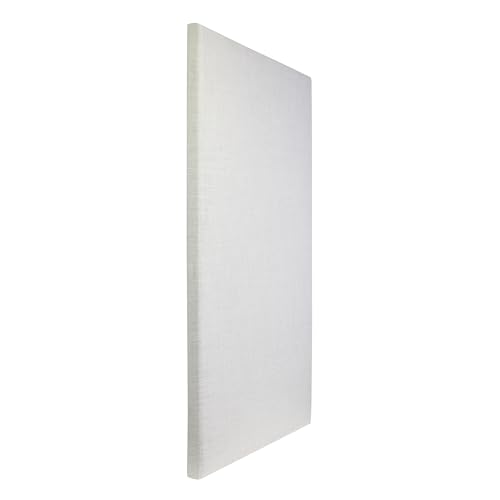
A mineral-wool, wood-framed panel rated NRC 1.0 — the maximum. Each 2 ft × 4 ft panel adds about 8 ft²-sabins of absorption — 0.74 m²-sabins if you run the calculator in metric — which is the unit the Room Echo calculator counts in. Made in the USA.
Drop the panel count into the RT60 tool and watch the reverberation time fall. Two or three of these transform a hard, ringing room.
*Price shown on Amazon and subject to change.

Mass-loaded vinyl is the renter's way to add the surface mass the Mass Law calculator rewards. Rated STC 20, it both blocks and absorbs, and it hangs over a door or wall without construction.
Add an "MLV layer" in the Mass calculator and you can see why it works — it stacks real kilograms per square metre onto a thin door.
*Price shown on Amazon and subject to change.
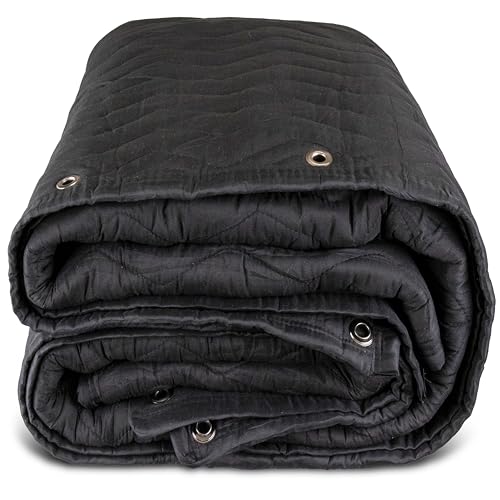
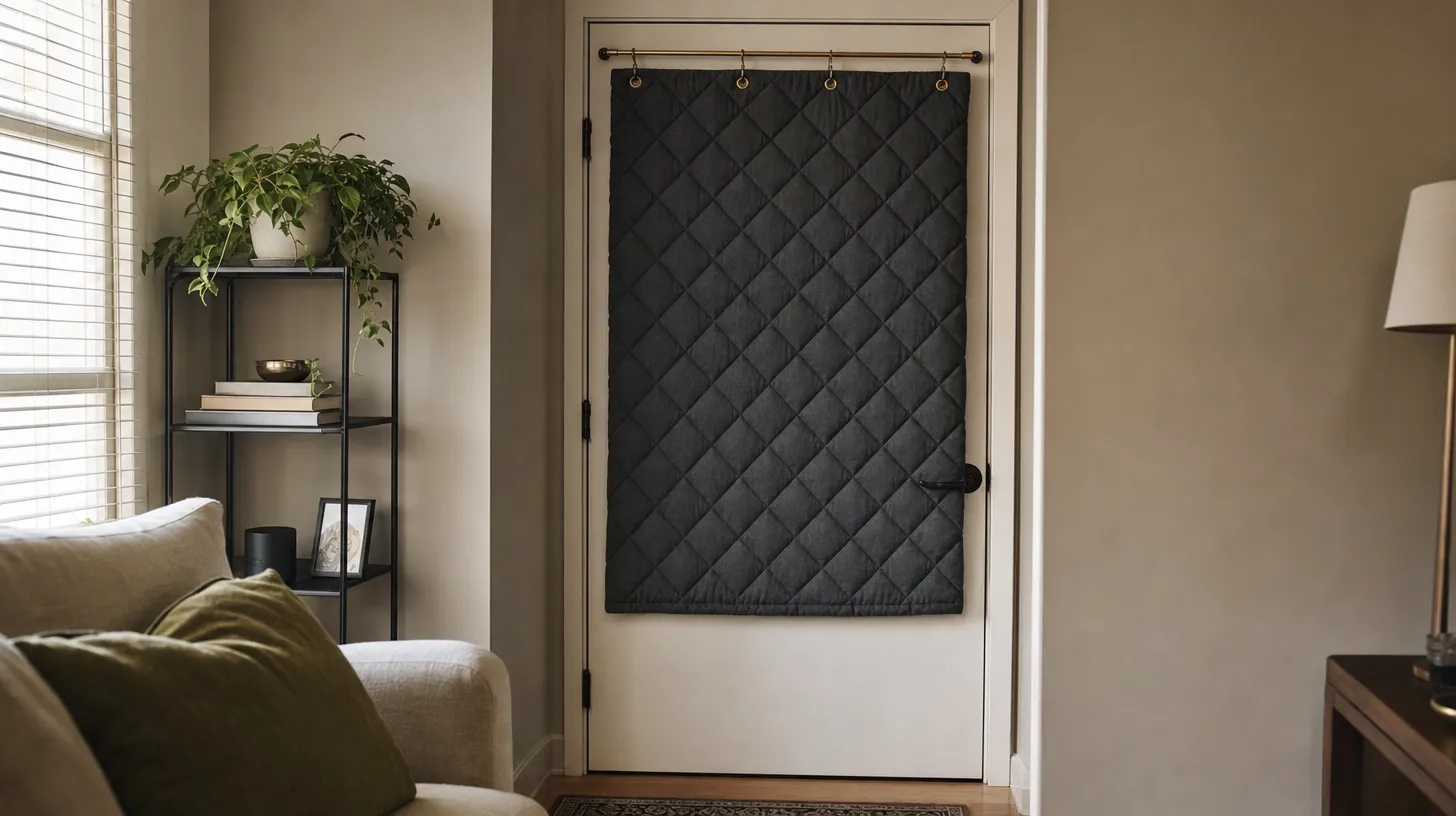
A heavy, washable moving-style blanket (NRC 0.35) with 18 grommets — by the square foot the cheapest way to hang a layer over a door or doorway. It's an absorber that tames echo and takes the edge off noise, and it adds only a little mass, so lean on it for the Room Echo tool, not for blocking.
It is huge and genuinely heavy for a blanket. Hung over a door it kills echo and softens what comes through — a cheap way to hear what absorption does before you spend on mass.
*Price shown on Amazon and subject to change.
| Pick | Product | Link | |
|---|---|---|---|
| Best for Echo | ATS Acoustics — ATS Acoustics Panel 24 x 48 x 2 in (NRC 1.0) | $79.95 | Check → |
| Best for Mass | Audimute — Audimute isolé Sound Barrier + Absorber (MLV, STC 20) | $149.00 | Check → |
| Budget Absorber | US Cargo Control — US Cargo Control Sound Dampening Blanket (96 x 80 in) | $76.48 | Check → |

Lillie Metayer
Lillie Metayer is the founder of a local program that helps apartment-dwellers take action against noise pollution. Involved in environmental activism since high school, Lillie is passionate about raising awareness of the harms of noise exposure and helping people reduce noise in their communities. In her free time, Lillie enjoys playing the violin and spending time outdoors.