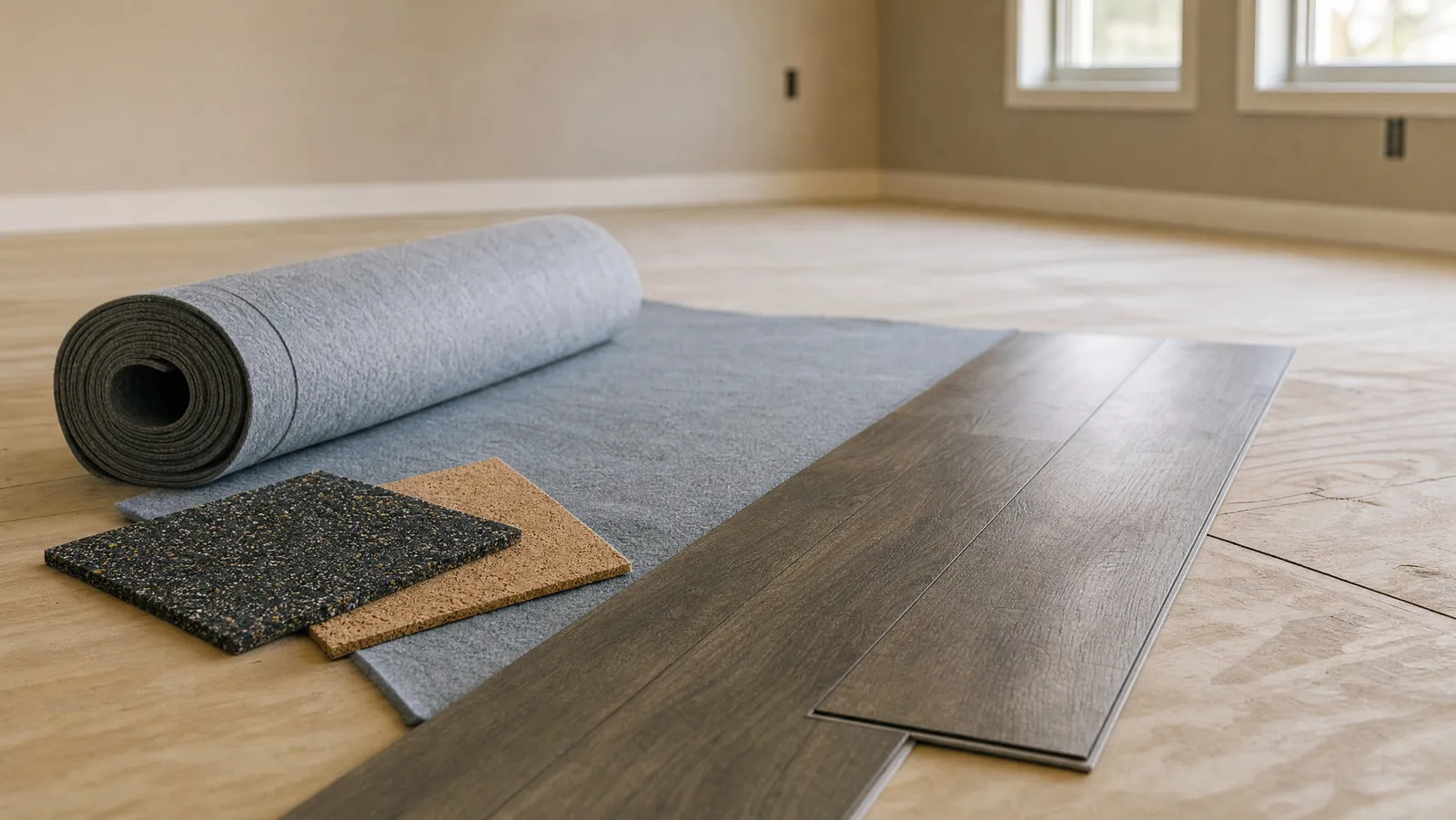
The best floor underlayment for soundproofing is a dense resilient sheet installed under a floating floor, and on published numbers the best value in this group is QuietWalk at about 48 cents a square foot. That answer only helps you if a floor is actually going down, though. Underlayment is not something you add to a floor that already exists.
So before the comparison, the qualifying question - because it rules out most of the people who land on this page.
First: is acoustic underlayment for renters even an option?
Underlayment goes between the subfloor and the surface you walk on. It exists as an option only if you are laying laminate, luxury vinyl plank or engineered wood yourself - in a home you own, or in a rental where you have written permission to install flooring.
If the floor in your apartment is already down and staying down, this is not your product. Wanting it to work does not change the geometry: you cannot get a resilient layer underneath a floor without taking the floor up first.
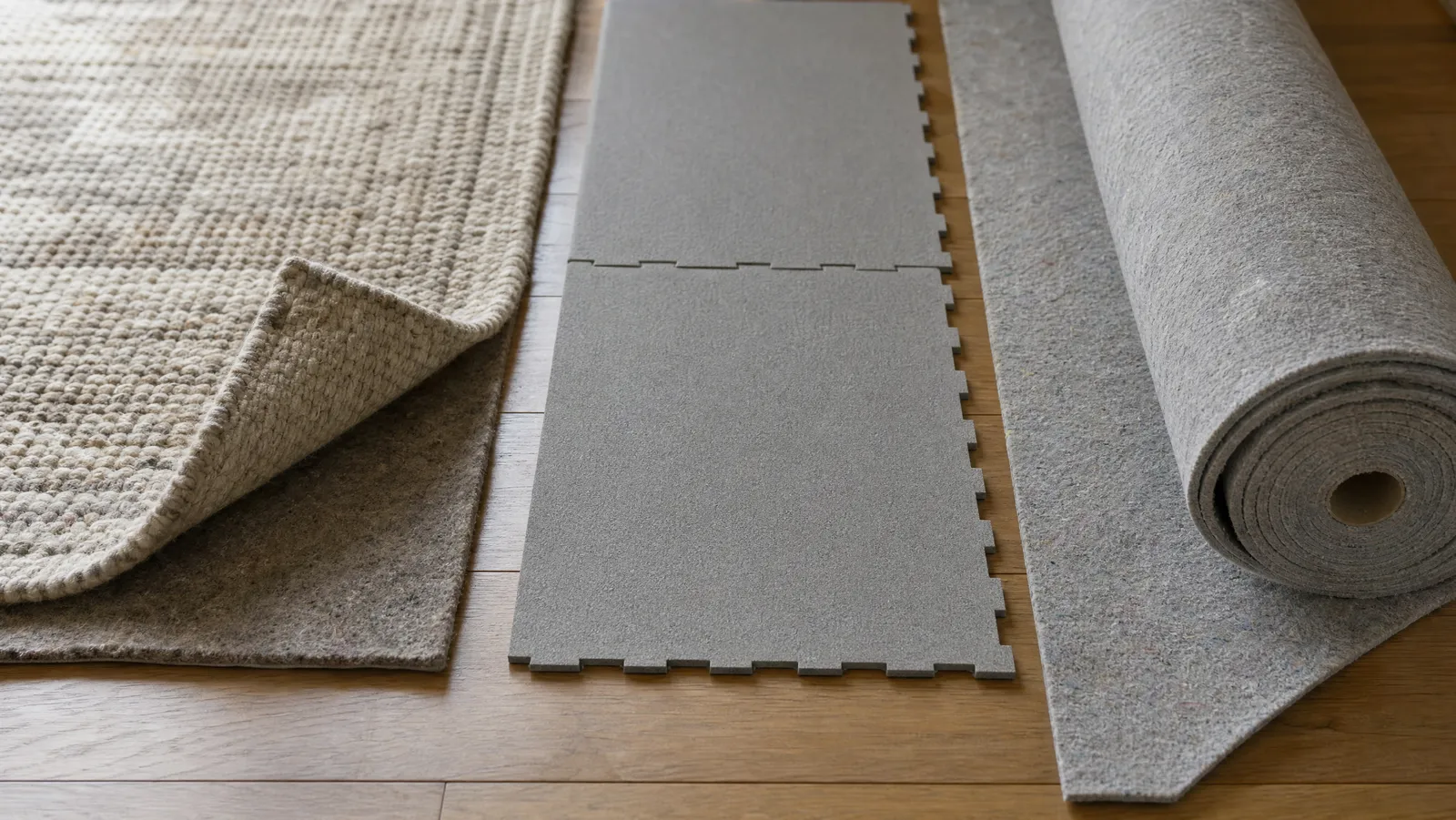
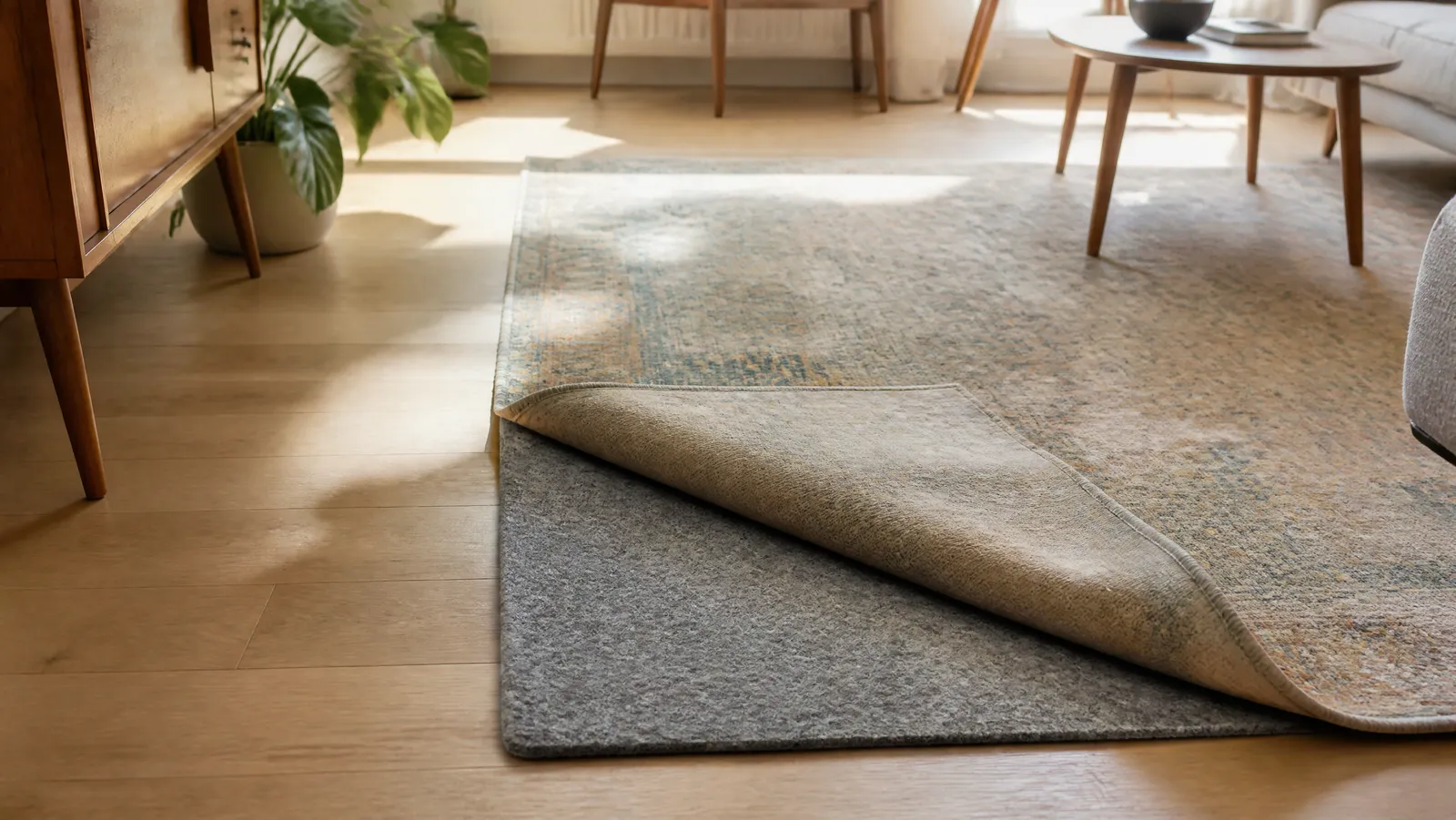
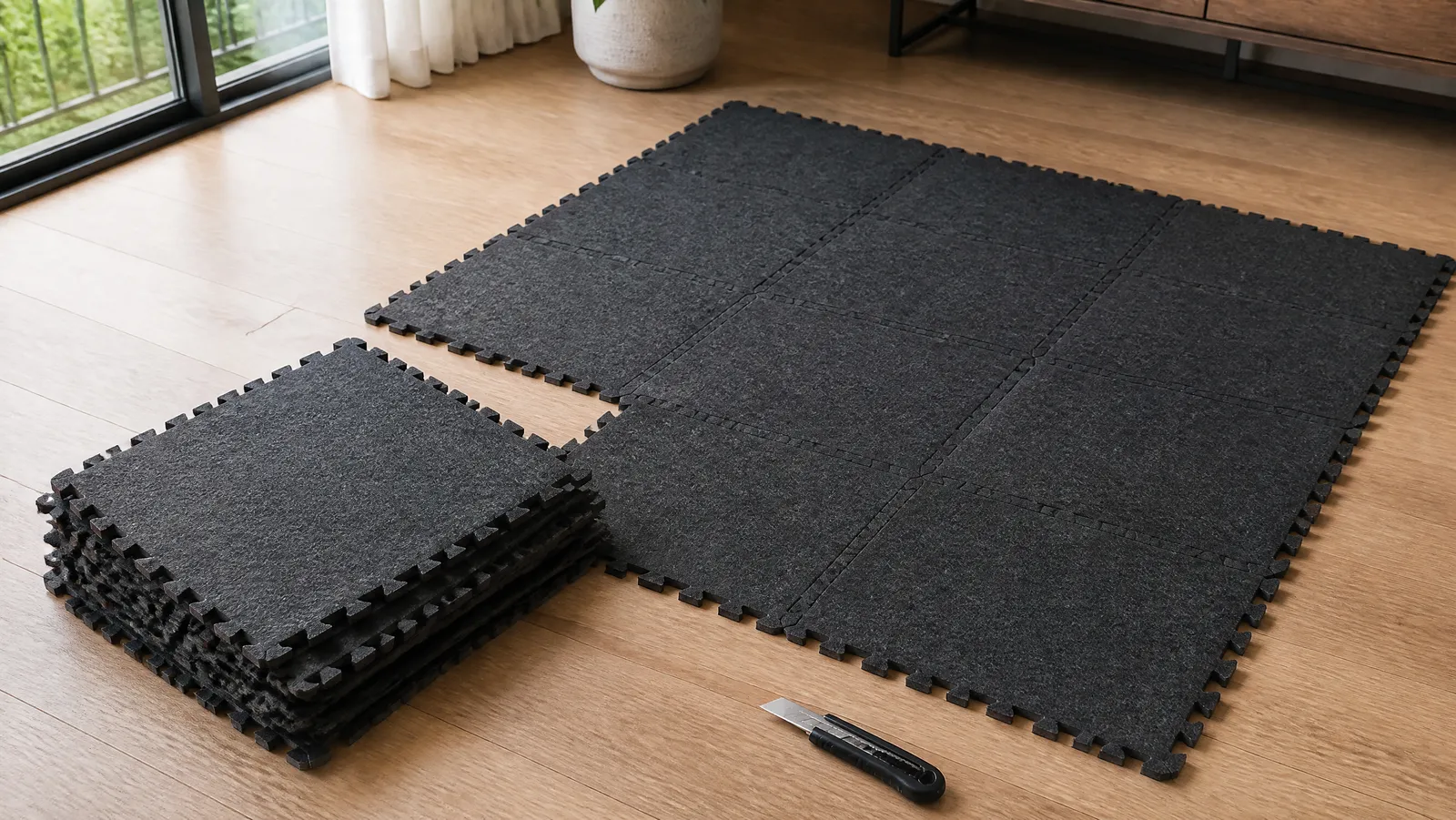
That reader still has real options, and they are the ones we would send you to. For the full order of operations on a rental floor, start with how to soundproof an apartment floor. Our guide to the best soundproof floor mats covers the interlocking felt tiles this category actually sells to renters, including the uncomfortable truth about what their published numbers measure. And rug pads that reduce footstep noise is the single highest-value purchase available to anybody whose floor is not coming up - a large rug over a genuinely dense pad is the closest a renter gets to the mechanism this page is about. We put all three next to each other in rugs, mats and underlayment compared.
If you are laying a floor, this is the best impact-noise money you will ever spend. Not because the material is special, but because of where it ends up.
How acoustic underlayment actually works
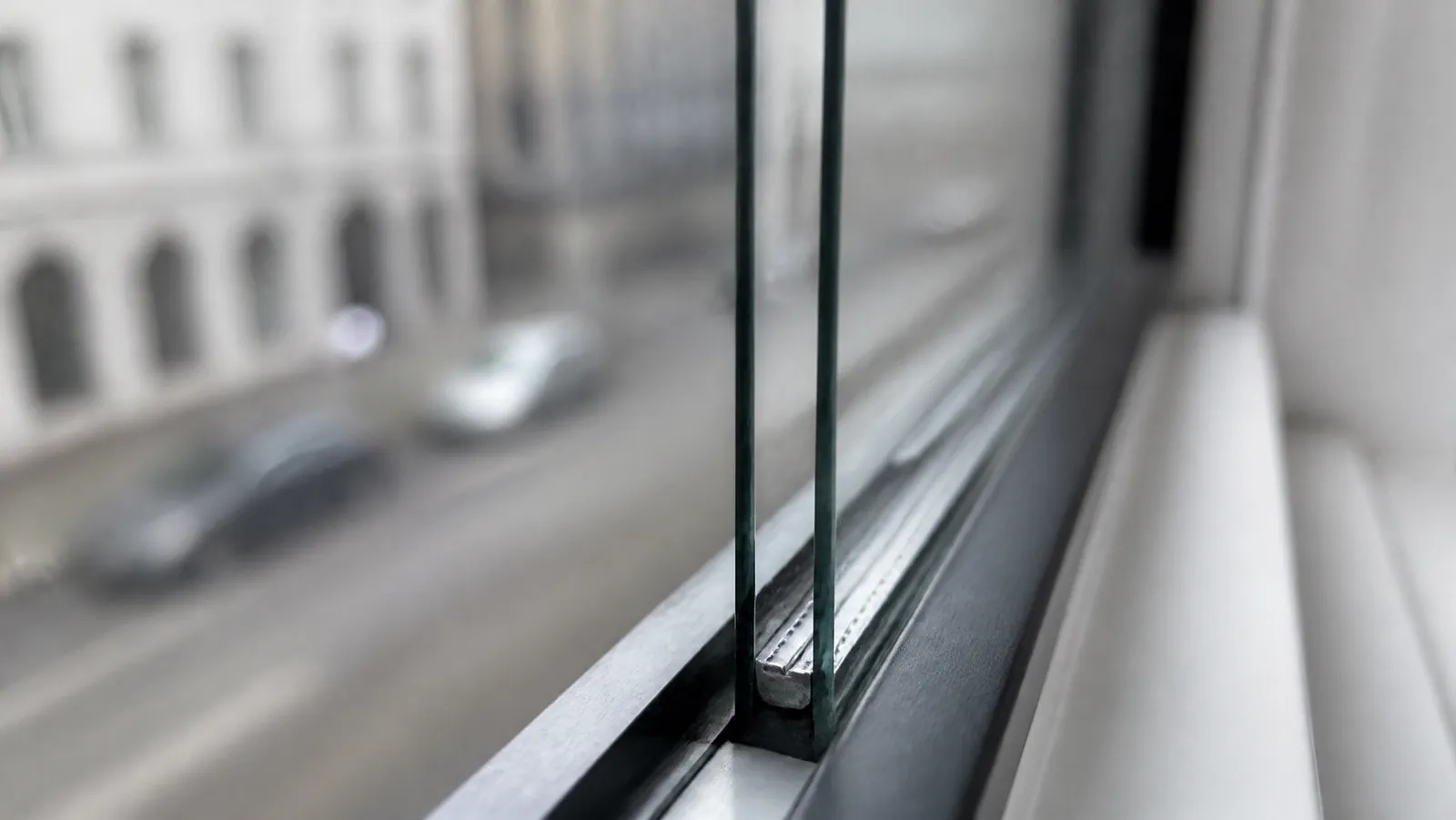
According to US Rubber, acoustic underlayment is "the resilient layer between the subfloor and the finished floor that decouples the two and reduces structure-borne and airborne sound transmission." The mechanism is separation plus softness: a footstep puts energy into the floor, the resilient layer absorbs part of it, and less of it reaches the joists that carry sound through the building.
Position in the assembly matters more than thickness. A mat on top of your floor sits above the hard surface, so the impact still lands on something rigidly connected to the structure. Underlayment sits below it and breaks that connection. Three millimetres in the right place beats half an inch in the wrong one.
The same source makes the corollary blunt: "Mechanical fastening through the underlayment to the subfloor defeats the decoupling." A row of screws through the layer rebuilds the rigid path you just paid to interrupt, which is why floating installations are the norm.
This is decoupling, the principle we walk through in decoupling and why renters usually cannot do it. Underlayment is the one form of it that occasionally comes within a renter's reach, and only in the narrow window while a floor is going down.
The number that matters is delta IIC, not IIC
IIC rates a whole floor. According to Wikipedia's entry on impact insulation class, IIC is "an integer-number rating of how well a building floor attenuates impact sounds, such as footsteps," derived from ASTM method E989, which in turn uses a tapping machine specified in ASTM method E492. ASTM titles E492 precisely as it works: laboratory measurement of impact sound transmission through floor-ceiling assemblies using the tapping machine. Weighted hammers strike the floor above, microphones listen below, and the result is scored across sixteen standard frequencies from 100 to 3150 Hz.
Read what is being rated there. The assembly - subfloor, joists, cavity, ceiling board, finish floor, all of it together. No sheet of foam, cork, felt or rubber has an IIC of its own. When a listing prints one beside a product photo, that figure came from one specific tested build the roll happened to be part of.
Delta IIC rates the layer. According to MP Global Products, Delta IIC "measures the added impact sound isolation from underlayment. It reflects the difference between the IIC of the untreated assembly and the IIC achieved once underlayment is added." Commercial Acoustics says it more directly: delta IIC "measures how many impact-isolation points a single underlayment or floor covering adds on its own."
The test behind it is ASTM E2179. According to Intertek, that standard measures the effectiveness of floor coverings in reducing impact sound transmission through concrete floors - a bare reference slab measured first, then the same slab measured again with the covering installed, the gap between the two being the delta.
Two caveats before you lean on the figures.
- The reference slab is concrete. Commercial Acoustics is explicit that delta IIC is a product-comparison tool rather than an assembly prediction, that every value comes off the same bare 6 inch concrete reference slab, and that it does not transfer to wood-framed floors or predict your finished IIC. Rank products with these numbers; do not forecast your building with them.
- Delta IIC is not NRC. NRC, the noise reduction coefficient, is an absorption rating measured in a reverberation room under ASTM C423, and it describes echo inside your own room. It is never evidence that the neighbour below hears less. Two different quantities, two different tests, and we unpack why in impact noise and airborne noise are different problems.
Cork vs rubber underlayment: the four material families compared
Delta IIC ranges below are Commercial Acoustics' figures for the material family, not for these specific products - only QuietWalk, QuietWalk LV and IsoRubber publish a delta IIC for the thing in the box. Prices are as of September 2026, and cost per square foot is the listed price divided by the roll coverage.
| Family | Product here | Thickness | Delta IIC | Roll | Price | Cost / sq ft |
|---|---|---|---|---|---|---|
| Recycled fibre (felt) | QuietWalk | 3 mm | 22, published by MP Global (family 16-20 at 3 mm) | 100 sq ft | $47.99 | $0.48 |
| Recycled fibre (felt, for vinyl) | QuietWalk LV | 1.4 mm per maker | 28, published by MP Global | 100 sq ft | $51.75 | $0.52 |
| Cork | QEP natural cork | 6 mm | family 20-23 at 6 mm | 200 sq ft | $226.16 | $1.13 |
| Rubber | IsoRubber reclaimed | 5 mm | 20, published by IsoRubber (family 21-25 at 5 mm) | 120 sq ft | $249.00 | $2.08 |
| EVA foam | HOLNURY 3-in-1 | 3 mm | PE foam families 15-20; no EVA figure published | 200 sq ft | $64.99 | $0.32 |
Install difficulty is simpler than the table suggests. Felt and foam roll out, cut with a knife and seal along a pre-attached lip - a one-person afternoon. Cork is loose-lay or glue-down, and glue-down is a different order of job. Rubber is the heavy one. On compatibility: QuietWalk for laminate and hardwood, QuietWalk LV for vinyl and rigid core, HOLNURY for hardwood, laminate and other floating floors, QEP cork for tile, stone, marble, glued wood and floating systems - the only one here that goes under tile.
That last column is the point of the whole table. The cheap-looking roll is not the cheap material. QEP's cork is the biggest single ticket at $226.16, but across 200 square feet it lands at $1.13 per square foot, a little over half the cost of IsoRubber's $249.00 across only 120 square feet. HOLNURY's $64.99 roll, also 200 square feet, is the cheapest material here by a factor of six against the rubber.
Put a real room against it. A 12 by 15 foot bedroom is 180 square feet: two 100 square foot rolls of QuietWalk at $95.98, two of QuietWalk LV at $103.50, one QEP cork roll at $226.16, one HOLNURY roll at $64.99 - or two IsoRubber rolls at $498.00.
Recycled fibre: soundproofing under hardwood floors and laminate
The mainstream answer, and Our Pick for most people actually laying a floor.
QuietWalk is 3 mm of recycled synthetic fibre on a 100 square foot roll at $47.99 as of September 2026, with a Dri-Wick moisture barrier, a crush-resistant structure and a pre-attached lip and taping system. MP Global publishes a Delta IIC of 22 for it - an improvement the layer adds, not a rating of a finished floor.
Two things put it top of the list: it is cheap per square foot, and the brand publishes real acoustic data instead of an assembly rating. For laminate, engineered wood or hardwood, this roll is where we would start.
If you are laying luxury vinyl, buy the other one. QuietWalk LV is built for LVP, LVT, SPC, WPC and rigid core, plus laminate and engineered wood 4 mm or thicker, and MP Global publishes a Delta IIC of 28 for it - the highest published product figure on this page, at a maker-stated 1.4 mm. It supports floating, glue-down and nail-down installs and is GREENGUARD Gold certified. At $51.75 as of September 2026, the LV roll costs four cents a square foot more than the standard product, which is not a reason to buy the wrong one.
One caution: those published delta figures come from two manufacturers reporting their own testing - MP Global for both QuietWalk products and IsoRubber for the rubber - not from a head-to-head study. Do not read a six-point gap as a precise ranking.
Cork: the traditional answer, and the only one that goes under tile
QEP's 72000Q is 6 mm natural cork, 4 feet by 50 feet, 200 square feet a roll, $226.16 as of September 2026. It installs glue-down or loose-lay, it reduces thermal transmission so it suits floor heating, and it acts as a crack isolation membrane that resists transfer of stress cracks up to 1/8 inch from the subfloor through to the finished surface.
That last feature is why cork is still specified. If you are setting tile, nothing else on this page does the crack isolation job.
QEP states the cork is sound absorbing and reduces sound transmission from the floor surface upward as well as from the floor to the living space below. That is the listing's marketing language rather than a lab result, so we report it as QEP's claim. The sourced case for cork is the family figure: Commercial Acoustics puts 6 mm natural cork at a delta IIC of 20 to 23 - solid, not class-leading.
The costs are thickness and money. Six millimetres eats into door clearances and transition heights in a way 3 mm does not, and $1.13 per square foot is more than double the felt. Buy the cork roll if you want cork on purpose or you need crack isolation, not as a default.
Rubber: the highest sourced delta IIC of any material family here
IsoRubber is 5 mm reclaimed rubber, a 4 by 30 foot roll covering 120 square feet, $249.00 as of September 2026. IsoRubber publishes a Delta IIC of 20 for the product and states it has been through more than 550 independent laboratory and field tests for sound and structural integrity.
The material data points the same way. Commercial Acoustics puts 5 mm recycled rubber at a delta IIC of 21 to 25 and 10 mm at 25 to 29, and summarises the driver plainly: "Thickness and density drive most of the difference - thicker, denser rubber generally posts the highest values." US Rubber notes that 5 mm to 12 mm is the common thickness range specified on multi-family and hospitality projects.
IsoRubber also claims the same performance as cork at one third of the required thickness. That is the maker comparing its own material against a competitor material, and we report it as the company's claim, not as our finding.
Buy the rubber if impact noise is the whole reason you are laying this floor and $2.08 per square foot does not end the conversation. Otherwise the felt gets you most of the way for a quarter of the money.
EVA foam: the cheapest pad that still does something
HOLNURY's 3-in-1 is 3 mm EVA with a silver foil vapour barrier and pre-attached lip tape, 200 square feet a roll, $64.99 as of September 2026, sold for on-grade, above-grade and below-grade floating installs. At $0.32 per square foot it is the cheapest material here and the easiest to handle.
It is also the weakest acoustically, and we would rather say so than dress it up. Commercial Acoustics puts closed-cell PE foam at 2 mm around delta IIC 15 to 18 and cross-linked PE foam at 3 mm around 17 to 20 - the bottom of the table either way.
HOLNURY's listing states a Sound Transmission Class of 72 and an Impact Isolation Class of 73. Those are assembly ratings, measured on a complete floor and ceiling build in a laboratory, so they describe whatever construction was tested rather than the properties of a 3 mm foam sheet. Nothing sold in a roll delivers IIC 73 on its own.
Framed honestly, the HOLNURY roll is what you buy when the floor needs a pad, the vapour barrier is genuinely useful, and the budget is the constraint. It is not the acoustic choice.
The compatibility trap that wastes the most money
A great deal of laminate and rigid-core flooring now ships with a pad already bonded to the underside of the plank. According to Leonardo's Flooring, if your flooring comes with pre-attached underlayment you should not add another layer, because doing so voids most manufacturer warranties and creates an unstable surface. FloorMuffler's guidance is that an attached-pad manufacturer may not uphold the warranty if a separate underlayment is added, and that you should verify the underlayment you chose is approved.
The failure is mechanical as well as contractual: stack a soft layer under a plank that already has a pad and the floor flexes further than it was engineered to, and that flex goes straight into the click joints holding the planks together.
- QuietWalk and QuietWalk LV are both sold as approved for floors with a pre-attached pad. MP Global backs the standard product with a number, stating that QuietWalk's compression resistance exceeds the requirement for pre-attached flooring of greater than 29 psi per ASTM D1667.
- Luxury vinyl needs the LV product, not standard QuietWalk. The maker directs vinyl users to QuietWalk LV on its own listing. Buying the wrong QuietWalk is the easiest fifty dollars to waste on this page.
Read your flooring's installation manual before the underlayment arrives. The flooring manufacturer, not the underlayment manufacturer, holds the warranty you care about.
What underlayment will not do
- It is an impact-noise product. Footsteps, dropped objects, chair castors - energy put into the floor by contact. That is what delta IIC measures and what the resilient layer is built for.
- It will not stop your neighbour's television. Voices, TV and music are airborne noise. Acoustical Surfaces frames the split the same way: airborne noise control comes down to airtight construction and high-mass barriers, while impact noise is vibration moving through structure and calls for isolation instead.
- It does nothing for noise coming up from below. Underlayment reduces what you send downward. If the problem is the apartment beneath you, nothing you install on your side of the floor is the lever.
- It will not turn a wood-frame building into a concrete one. Those delta IIC figures were measured on a concrete slab, and low-frequency thump below 100 Hz sits outside the tapping-machine test range entirely.
Installing it so the decoupling survives
- Keep the floor floating. Do not fasten through the resilient layer - US Rubber is explicit that mechanical fastening through the underlayment to the subfloor defeats the decoupling.
- Do not double up. One layer, chosen for your flooring type. If the plank already has a pad, you probably need nothing.
- Use the lip and tape you paid for. A sealed seam keeps the vapour barrier continuous.
- Respect the expansion gap at the perimeter. A floating floor binding against the wall is a rigid contact path in a smaller package.
- Check transition heights first. Six millimetres of cork plus flooring can stop a door closing.
Which one we would buy
- Laying LVP, LVT or rigid core: QuietWalk LV. Built for vinyl, and the highest published delta IIC on this page.
- Laying laminate, engineered wood or hardwood: QuietWalk. Cheapest good option at $0.48 a square foot, with published data behind it.
- Impact noise is the whole point and budget is not the constraint: IsoRubber, with its maker-published Delta IIC of 20.
- You want cork specifically, or you need crack isolation under tile: QEP.
- You need the cheapest pad that still does something: HOLNURY, at $0.32 a square foot.
And if you arrived hoping underlayment was the answer and leave realising your floor is not coming up, the page has done its job. Most people reading this should buy a large rug and a dense pad, and treat felt tiles as spot treatment for the walkway. The whole sequence, ranked by what it returns per dollar in a rental, is in our guide to reducing impact noise through the floor.

A 100 sq ft roll of 3 mm recycled synthetic fibre with a Dri-Wick moisture barrier, a pre-attached lip and taping system, and a crush-resistant structure. GREENGUARD Gold certified, made in the USA from recycled materials, and safe to use over QuietWarmth radiant heat systems.
The default buy for anyone laying laminate or hardwood. It is explicitly approved for floors that already carry a pre-attached pad, which is where most underlayment money gets wasted, and MP Global publishes a Delta IIC of 22 for it - an improvement figure for the layer itself rather than a rating of a finished floor. If you are laying luxury vinyl, the maker sends you to QuietWalk LV instead, and you should listen.
*Price shown on Amazon and subject to change.

A 4 ft by 50 ft roll of 6 mm natural cork covering 200 sq ft, sold for use under ceramic tile, stone, marble, glued wood flooring and floating floor systems. It installs either glue-down or loose-lay, and doubles as a crack isolation membrane that resists the transfer of stress cracks up to 1/8 in from the subfloor through to the finished surface.
The pick if you want cork specifically, or if you are setting tile and need crack isolation as well as impact isolation - nothing else here does that second job at all. QEP states the cork is sound absorbing and reduces sound transmission both upward from the floor surface and downward into the living space below, which is listing language rather than a lab result, so we treat it as a claim and not a number. At 6 mm it is also the thickest option here, and it works out to about $1.13 per square foot.
*Price shown on Amazon and subject to change.

A 4 ft by 30 ft roll - 120 sq ft - of 5 mm reclaimed rubber, manufactured in the US. IsoRubber publishes a Delta IIC of 20 for the product and states it has been through more than 550 independent laboratory and field tests for sound and structural integrity.
Buy this when impact noise is the entire reason you are laying the floor and price is not the deciding factor. Delta IIC is the right kind of number for an underlayment, and a manufacturer that publishes one for its own product is rarer in this category than it should be. IsoRubber also claims the same performance as cork at one third of the required thickness - that is the maker comparing its material to a competitor material, not a finding of ours. At about $2.08 per square foot it is the most expensive option on this page by a wide margin, and a rubber roll is heavy to wrestle into a room alone.
*Price shown on Amazon and subject to change.

A 200 sq ft roll of 3 mm EVA with a silver foil vapour barrier and pre-attached lip tape for a peel-and-stick seam, sold for hardwood, laminate and other floating floors on-grade, above-grade and below-grade. HOLNURY combines sound insulation, a moisture barrier and thermal insulation in one layer.
The cheapest way to get a pad under a floating floor at roughly $0.32 per square foot, and the weakest of these four materials acoustically, because foam sits at the bottom of the material table. HOLNURY's listing states a Sound Transmission Class of 72 and an Impact Isolation Class of 73; ratings like those are measured on a complete floor and ceiling assembly in a laboratory, not on 3 mm of foam by itself, so do not read them as what this roll adds to your floor. Buy it when the floor needs a pad and the budget makes the decision.
*Price shown on Amazon and subject to change.

A 100 sq ft roll of 100 percent recycled synthetic fibre made for luxury vinyl plank and tile, SPC, WPC, rigid core, laminate and engineered wood 4 mm or thicker. It carries patented DriWick technology plus an integrated 6-mil vapour barrier, is GREENGUARD Gold certified with zero VOC emissions, is radiant heat compatible, and is dense enough to resist crushing under heavy furniture and traffic.
The one to buy if you are laying LVP, LVT or rigid core, because standard QuietWalk is not the product for vinyl and the maker says so on its own listing. MP Global publishes a Delta IIC of 28 for it, the highest published figure of any product on this page, and it supports floating, glue-down and nail-down installations as well as flooring that already has pre-attached padding. It costs about four cents a square foot more than standard QuietWalk, which is not a reason to buy the wrong one.
*Price shown on Amazon and subject to change.
| Pick | Product | Link | |
|---|---|---|---|
| Our Pick | Quiet Walk — QuietWalk Underlayment (100 sq ft roll, 3 mm recycled fiber) | $47.99 | Check → |
| Best Cork | QEP — QEP 72000Q Natural Cork Underlayment Roll (4 ft x 50 ft x 6 mm, 200 sq ft) | $226.16 | Check → |
| Best for Impact Isolation | IsoRubber — IsoRubber Reclaimed Rubber Underlayment (5 mm, 4 ft x 30 ft roll) | $249.00 | Check → |
| Best Budget | HOLNURY — HOLNURY 3-in-1 Acoustic Floor Underlayment (200 sq ft roll, 3 mm EVA) | $64.99 | Check → |
| Best for Luxury Vinyl Plank | Quiet Walk — QuietWalk LV Underlayment for Luxury Vinyl (100 sq ft roll) | $51.75 | Check → |

Lillie Metayer
Lillie Metayer is the founder of a local program that helps apartment-dwellers take action against noise pollution. Involved in environmental activism since high school, Lillie is passionate about raising awareness of the harms of noise exposure and helping people reduce noise in their communities. In her free time, Lillie enjoys playing the violin and spending time outdoors.