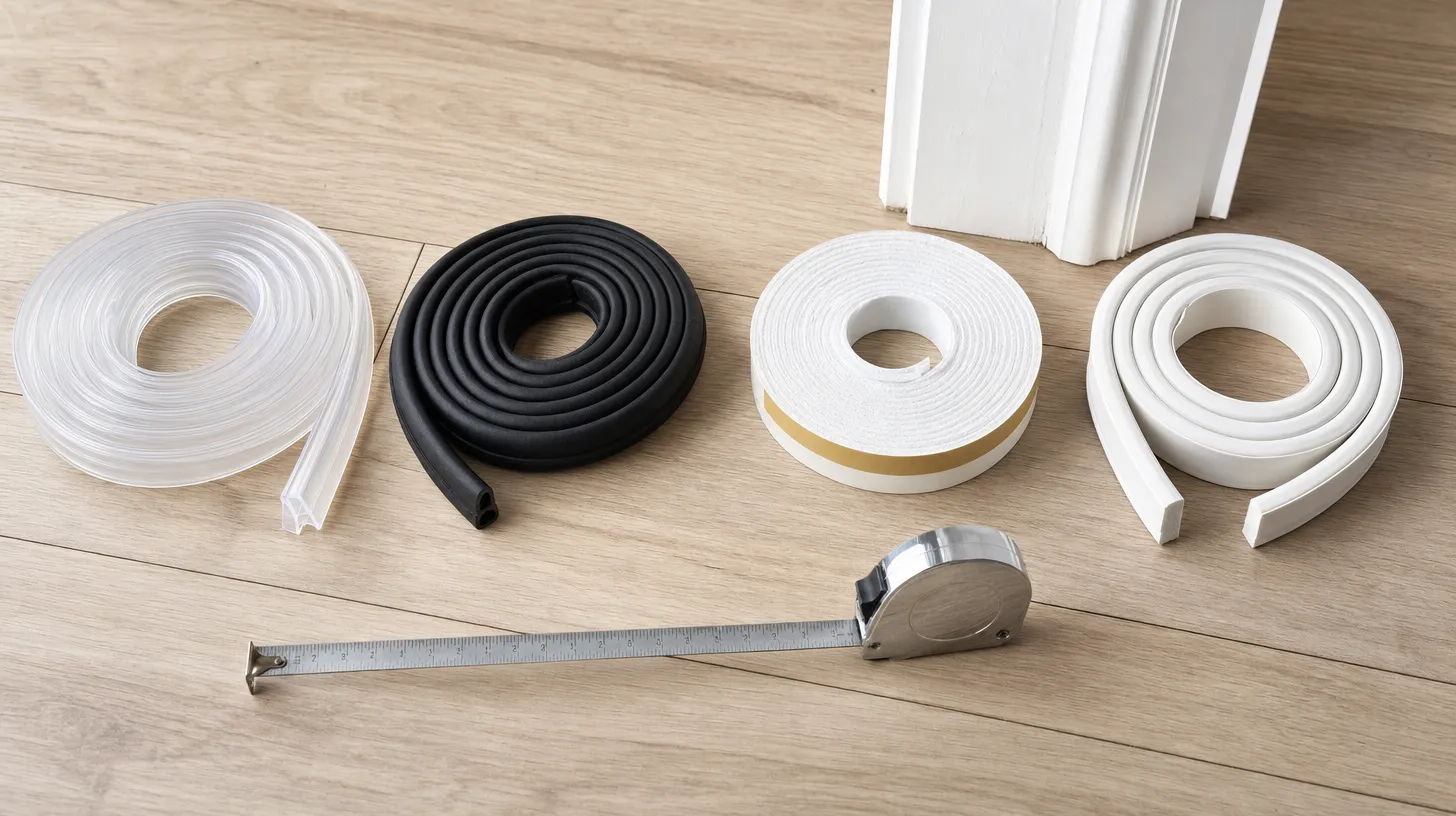
The best door seal kit for soundproofing is whichever profile fits the gap you measured, and on most apartment doors that is a $10 to $20 roll of silicone or foam run around the top and the two sides. Find the widest point of the perimeter gap, match a published gap range to it, prep the surface, and you have bought almost everything this category has to sell.
That is the answer. The rest of this page is what the listings leave out: five of the six products below publish no acoustic rating of any kind, and the sixth publishes real measured figures and costs $525.
The order of operations for apartment door soundproofing is seal the perimeter, seal the bottom gap, then think about mass. This is the shopping list for step one, which has the best return per dollar in the whole project.
A "kit" in this category is mostly a marketing word. Open most of these boxes and you get a roll of strip, occasionally an adhesive promoter, and an instruction to cut it to length. What makes a perimeter job work is matching the profile to the gap and prepping the surface it sticks to, and a box with the word kit on it does neither for you.
What this page covers, and what it does not
A door has two separate leaks and they take two different products.
The perimeter is the top edge and the two vertical edges, where the slab meets the door stop - a long, thin gap, usually between a sixteenth and a quarter of an inch on an interior door, and the whole subject of this page.
The bottom gap is the undercut, usually the largest single opening in the assembly, and it needs a sweep fixed to the door or the threshold. Different mechanism, different failure modes, and we compare those in the best door sweeps and draft stoppers. A perimeter strip run along the bottom edge gets scuffed off by the floor inside a week.
Why a gap you can barely see sets the ceiling
In Canadian Building Digest 186, published by the National Research Council of Canada, A.C.C. Warnock writes that "Sound energy will always seek out the easiest path through or round a partition, and performance will be severely downgraded unless all weak elements are identified and strengthened." Then the arithmetic: "A sound leak amounting to one-tenth of one per cent of a partition area will limit the effective STC to about 30, whether the basic partition is rated at STC 40 or STC 60." The leak need not look like a hole, either, because "a crack 1 mm wide by 1 m long at the top of the wall is just as detrimental."
A perimeter gap is that crack, three edges long. Warnock applies it to doors himself, noting that "typical doors and windows have quite low STC values" and that "because doors must be operable, the sealing around the edges becomes extremely important."
How little it takes is the surprise. Writing in The Construction Specifier, Jerry Heid puts the threshold at an eighth of an inch: "a gap of less than 3 mm (1/8 in.) may only allow a small amount of air to pass through, but it is still large enough to completely cancel out any noise-reduction benefits of an acoustic door." That is less perimeter clearance than most apartment doors have. For how to read a published STC figure without being misled, our hollow-core and solid-core comparison covers what those lab numbers are measured on.
The door industry treats the seal as part of the assembly rather than an accessory. The Steel Door Institute, the trade body for steel door manufacturers, describes an inoperable test in which the "Perimeter of the door opening is sealed with putty and tape," giving a value "solely for the door and frame assembly" - and says plainly that "While this is a valid test condition, it is not indicative of the STC performance of an operable door." By SDI's figures, the difference between a door caulked shut and the same door working normally with its seals fitted is "typically 1 to 5 STC points depending on the quality of the seal and threshold assembly." The NIH Office of Research Facilities, in its December 2020 bulletin on acoustical door design, puts the job functionally: "Door seals and gaskets create a continuous airtight seal and are compressed against the leaf and frame," with the caution that "ratings can differ when door assemblies are tested in the field."
None of that is a rating of any product below. It is the reason the category exists.
Measure the gap before you shop
Every strip below publishes a gap range, and the range is the decision.
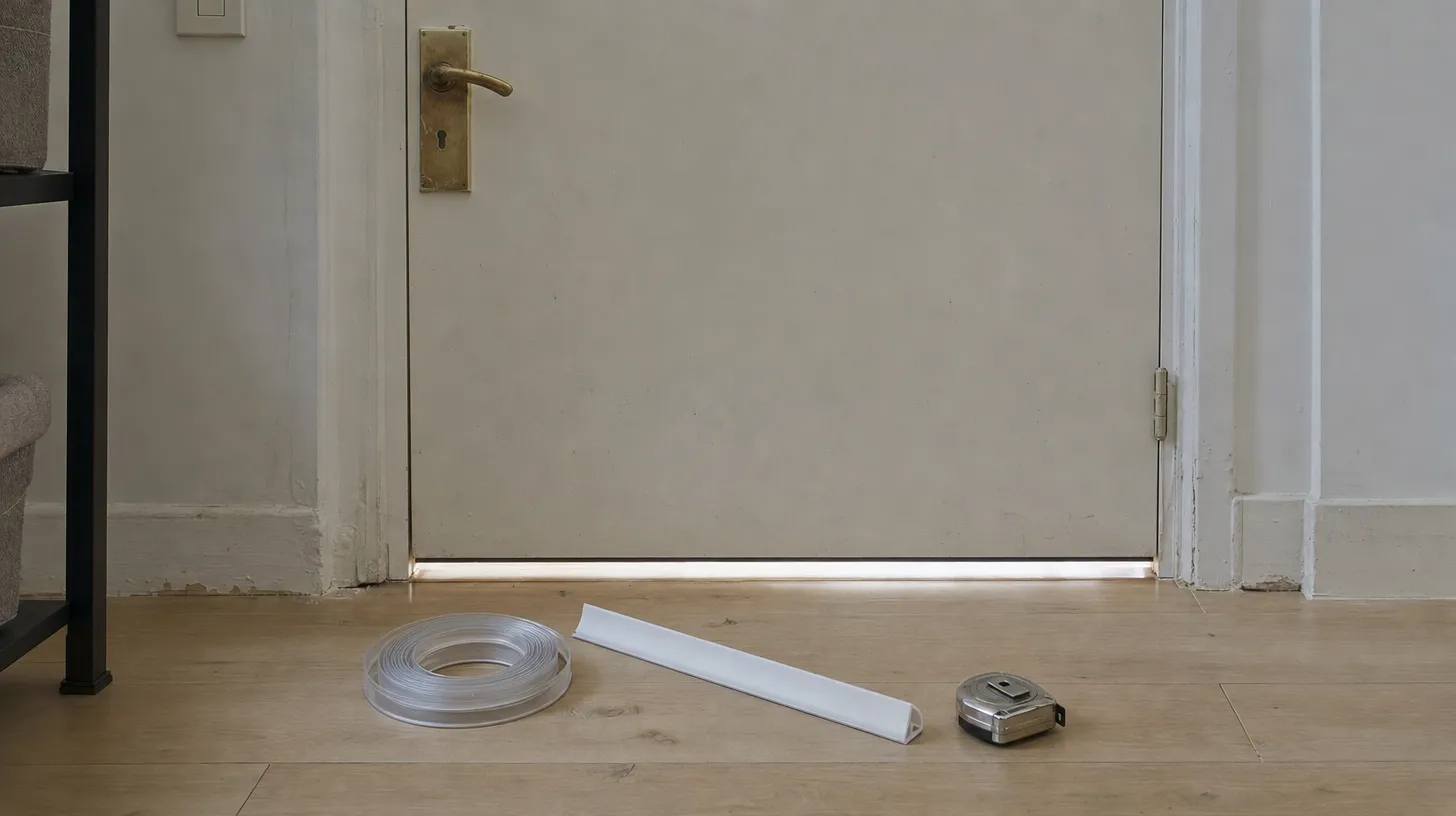
- Daylight test first. At night, kill the light in your room and leave the hallway lit. Every line of light you can see from the dark side is an open air path, and the widest stretch is where the money goes.
- Walk a folded sheet of paper around the perimeter. Close the door on one sheet of copier paper and pull. Then fold it once, then twice. You are not after three decimal places, only which band you are in: hairline, an eighth, a quarter, or more.
- Use a feeler gauge for the real number. An automotive set costs a few dollars and reads in thousandths of an inch, the unit these makers publish in. An eighth is 0.125 in, a quarter is 0.25 in.
- Check three edges, three places each. A door can be tight at the top and show a quarter inch halfway down the latch side, and the widest point governs the purchase.
- Push on the closed door. If it rocks against the stop, the latch is not holding it tight and that edge leaks past whatever you fit.
Look for a kerf in your door stop
A kerf is a narrow saw-cut slot running along the face of the door stop, the part of the frame the door closes against, and it exists so a seal can be pushed in and held by the slot. Run a fingernail or the corner of a credit card along the stop, and if you feel a groove, buy a kerf seal.
That one check reroutes you to a completely different product. A kerf seal needs no adhesive at all, so there is nothing to peel, nothing to clean off the paint on moving day and nothing to argue about with a landlord. No groove, skip that pick - nothing will make a kerf profile stay in a flat stop.
Our pick: Elvone T-shaped silicone door seal
The Elvone T-shaped silicone door seal is the strip we would buy first, at $19.99 as of October 2026 for 20 ft, and the reason is the shape. Every other adhesive strip here is a bead of foam or rubber held on by tape, which makes the tape the single point of failure. The T pushes its stem into the gap between door and frame, so one side of the seal is held by geometry rather than glue.
Elvone states 100 percent silicone, 2 in (50 mm) wide and 0.07 in (1.8 mm) thick, rated for gaps of 0 to 1 in (0-25 mm) - the broadest range of any adhesive product here, and the safe answer when your three measurements disagree. It wants a smooth, clean, dry surface and a hair dryer pass on the adhesive in cold weather. Its windproof and soundproof naming is listing language with no published rating attached to it anywhere, so fit and gap range are the only specs worth paying for.
Best budget perimeter seal: Bantie silicone D-shaped strip
At $9.99 as of October 2026, the Bantie silicone D-shaped seal strip is half the price of our main pick and the right call when the gap is genuinely small. Bantie publishes a recommended range of 1/8 in to 1/4 in, and that range is the whole decision: a door with a half-inch gap at the top squashes this flat, and you have bought a draft excluder rather than a seal.
The useful extra is in the box, because Bantie ships an adhesive promoter for smooth surfaces - unusual at this price, and aimed squarely at the thing that actually kills these products. Bantie names outside noise among the things it helps with and publishes no rating behind that, which is the pattern across the whole category rather than a knock against Bantie.
Best for a narrow measured gap: alophoty TPE rubber strip
The alophoty TPE rubber door seal strip is the pick for someone who did the measuring, at $9.99 as of October 2026 for 23 ft. alophoty is the only maker here publishing two sizes with their own gap ranges: the small at 0.35 in wide by 0.24 in high for gaps of 0.1 in to 0.22 in, and a large listed separately at 0.39 in by 0.39 in for gaps of 0.2 in to 0.37 in.
The listing tells you to measure before ordering, which is the correct instruction and the one most buyers skip. Over 0.22 in, take the large size. Buying the small size for a big gap is the commonest way to waste ten dollars here, and pressing it on harder will not fix it. The maker asks you to keep the strip dry for 24 hours after fitting.
Best for a kerf frame: M-D foam top and sides door seal
If your stop has that groove, the M-D foam top and sides door seal is the seal your frame was built for, at $17.99 as of October 2026. It is vinyl-coated foam in a kerf profile that presses into the slot already cut into the stop instead of sticking to the face of the frame. M-D states 40 ft to a pack, cut-to-length with scissors, no tools or hardware needed, and a seal for gaps up to 1/2 in - wider than any other published range here except the Elvone's.
It is also the only product here that needs no adhesive, which makes it the most renter-safe option on the page and the likeliest to still be sealing in two years. M-D Building Products is the one established weatherstripping manufacturer in this group rather than a marketplace brand. The hard limit is the frame: no kerf, no fit.
Most forgiving on a rough frame: Bantie EVA foam weatherstrip tape
The Bantie EVA foam weatherstrip tape is $9.99 as of October 2026 for 33 ft, and it is the softest seal here. That is its whole argument. A rigid silicone bead needs a flat, true surface to touch along its full length, and plenty of rental frames are painted four times, lightly textured or slightly racked in the opening, where a stiff profile contacts in patches and leaks between them. Compressible foam follows what it is pressed onto.
Bantie states the foam is 100 percent EVA, with what it calls an upgraded mesh adhesive that the maker says peels and sticks easily and leaves no traces behind. The trade is durability, because the most compressible seal is the one that takes a set and stops springing back. This is the roll we recommend as the opening move in our main door guide, so if it is already around your frame you are not behind.
The real acoustic kit: Audimute Acoustic Pro Sound Kit
We include the Audimute Acoustic Pro Sound Kit to show the ceiling of this category and the price of honesty. It is $525.00 as of October 2026, and the only product here that is a kit in any real sense: four 96 by 48 in sound absorption sheets at 0.85 NRC, one 82 by 34.5 in isole barrier sheet at 0.75 NRC and 20 STC built around a 1/16 in layer of mass loaded vinyl, a 3/16 by 1/2 in by 25 ft door seal and a 1/2 by 1.5 in by 4 ft door sweep, made in the USA.
Those are published measured figures, and it is the only listing in this roundup with any. Better still, Audimute states plainly that the absorption sheets are not designed to block sound and that the isole barrier is the component that does. That one piece of self-limiting honesty is worth more than every soundproof claim on the strips above, because it is the exact distinction those claims blur.
The price is the problem. Fifty times a ten dollar strip buys a seal plus a sweep plus a barrier plus absorption, and on a door that is the wrong trade for most renters. Buy it if you are treating a studio or a home office and need a published figure rather than a promise.
The adhesive is the failure mode, not the rubber
Every self-adhesive product above fails the same way, and it is not the silicone giving up. It is the tape letting go, usually at a corner, usually in the first winter.
The makers name the conditions themselves. Elvone requires a smooth, clean, dry surface and suggests warming the adhesive in the cold. alophoty asks you to keep the strip dry for 24 hours after fitting. Bantie ships an adhesive promoter with the D-shaped strip precisely because a bare peel-and-stick back struggles on some surfaces. Read all of it as one shared instruction rather than three product quirks.
- Clean the stop with isopropyl alcohol and let it dry. Dust and old cleaning residue are what the tape sticks to otherwise.
- Do not fit a strip to fresh paint. Latex keeps curing for weeks, and tape pulls it off in sheets.
- Work warm, and press along the entire length. Tacking the ends is how corners lift.
- Then leave it alone for a day before closing the door on it repeatedly.
Material decides how long you get. The Maryland Energy Administration, summarising aging tests on weatherstripping, reports that "Most types of stripping held up well enough through 600 hours of test" and that "Plastic and bronze tension seals, felts, and silicone gaskets hold up well." Its verdict on the cheapest option is blunt: "The worst, open-cell foam tape, becomes dry, brittle, and powdery." On air sealing it adds that "Two types work well--closed-cell foam with rubber tapes, and strips with a tight-sealing, rigid gasket." That is general weatherstripping guidance rather than a test of anything above, but it points where the prices point: a rubber or silicone profile outlasts a foam one.
If the door is your entry door to the hallway
Your unit entry door is very often a rated fire door assembly, and that changes the rules rather than the products.
Those clearances are specified, not accidental. According to Lori Greene of iDigHardware, NFPA 80, the Standard for Fire Doors and Other Opening Protectives, "limits perimeter and meeting stile clearance to a maximum of 1/8 inch for wood doors and 1/8 inch +/- 1/16 inch for steel doors, when measured on the pull-side face of the door," while "For most fire doors, clearance at the bottom of the door is limited to 3/4 inch."
Hold that against Heid's eighth of an inch and you have the honest picture of an apartment entry door. A fully compliant one is allowed a perimeter clearance right at the width that cancels an acoustic door's benefit, and a bottom gap six times larger than that. The leak is the design, which is why sealing is the move on these doors and buying mass for them usually is not.
Greene also notes that listed gasketing products exist in quantity, but that "almost all of these products are designed and tested for use on doors which have clearances within the acceptable limits shown in NFPA 80," and that "Installing this gasketing on a non-compliant fire door assembly will not bring the opening back into compliance." She flags the latch too: where clearance is too large, "latchbolts at the bottom of the door or on the latch edge may not engage the strike securely enough," and "If gasketing and/or door bottoms are added to an existing door, the assembly must be tested to ensure that the door will still close and latch properly."
So an excessive gap on a rated door is a maintenance request rather than a product problem, and anything beyond a reversible strip is a conversation with your building. We take the entry door apart in full, hallway noise included, in quieting your front door.
What a perimeter seal does and does not buy you
Sealing the perimeter deletes a direct air path. What you notice is not the volume dropping but the words dissolving - hallway conversation stops being sentences and becomes a murmur, and latch clicks and rattles soften. That is a real gain in speech privacy for under twenty dollars.
What it is not is a number. Nothing above except the Audimute kit publishes a rating, so anyone quoting you decibels for a ten dollar strip is quoting you nothing. The nearest honest reference point is SDI's 1 to 5 STC points between a door caulked shut and the same door operable and sealed. A rental door with a visible quarter inch of daylight starts from a worse place than that test does, so there is more on the table for you - but it is a few points in a leaky assembly, not a new door.
It will not touch bass, which travels through the slab, the wall, the floor and the structure, none of which a silicone bead on the stop affects. Our full accounting of the category is at does soundproofing a door actually work.
And it adds no mass. Once the air paths are closed the slab becomes the limit, which is where adding mass to the slab becomes the next lever instead of a waste of money. Sealing first is not a preference, it is the order the physics imposes, because mass cannot work through a hole. To see what doubling the weight of a panel buys before you spend on it, the mass-law tool in our free soundproofing calculators runs the arithmetic.
The best door seal kit for soundproofing is the one that fits
The decision is geometry, not brand.
- A groove in the stop - the M-D kerf seal, whatever the gap measures up to its published 1/2 in.
- Hairline, or three measurements that disagree - the Elvone, rated 0 to 1 in.
- 0.1 in to 0.22 in - the alophoty small size.
- 1/8 in to 1/4 in - the Bantie D-shaped silicone.
- Over 0.22 in - the alophoty large size, or the Elvone.
- A rough, textured or thickly painted frame - the Bantie EVA foam.
- A studio door and a real budget - the Audimute kit, for a figure instead of a claim.
One roll does one door, and two of these run 33 ft and 40 ft, so if the bedroom and the entry door both leak, buy length rather than a second product.
The bottom line
Measure the widest point of the perimeter gap, look for a kerf in the stop, buy the profile that matches what you found, and clean the frame before you stick anything to it. That sequence costs ten to twenty dollars and does more for a noisy apartment door than anything else at the price.
Five of the six products here say some version of soundproof and none publishes a number to support it. The one that publishes numbers also tells you which of its own components does not block sound, and costs $525. A category where honesty costs fifty times as much as a claim is one to shop by specification rather than by adjective.
Then stop. Seal the bottom gap with a sweep from the best door sweeps and draft stoppers, live with it for a week, and only then decide whether anything else is worth buying. The full sequence, with what each stage costs and where it stops working, is in our complete apartment door guide, and the condensed version is five easy steps to soundproof your door. If the windows leak as much as the door does, the same logic and a different set of profiles applies in our street-noise weatherstripping roundup.

Clear silicone in a T-shaped profile, stated by Elvone at 2 in (50 mm) wide and 0.07 in (1.8 mm) thick, 20 ft to a roll and cuttable to fit. Elvone rates it for gaps of 0 to 1 in (0-25 mm). The T pushes into the gap between door and frame and the far side carries no adhesive, so half the seal holds position mechanically rather than by glue.
The perimeter seal we would buy first, and the reason is the T. Every other strip in this roundup is a bead of foam or rubber held on by tape, which means the adhesive is the single point of failure; the T-profile seats inside the gap itself. Elvone gives the material as 100 percent silicone and asks for a smooth, clean, dry surface, with a hair dryer pass on the adhesive in cold weather. Its windproof and soundproof naming is listing language with no published rating attached, so treat the fit and the gap range as the specs that matter here.
*Price shown on Amazon and subject to change.

A 20 ft roll of soft silicone in a D-shaped profile with a peel-and-stick back. Bantie gives a recommended gap range of 1/8 in to 1/4 in, trims with scissors, and ships an adhesive promoter for smooth surfaces.
Half the price of our main pick and the right call when your perimeter gap is genuinely small. The published gap range is the whole decision - 1/8 to 1/4 in is narrow, and a door with a 1/2 in gap at the top will compress this flat and gain you very little. The included adhesive promoter is a real differentiator in this price class, because a peeling strip is how most of these fail. Bantie names outside noise among the things it helps with and publishes no rating for that, which is the pattern across this entire category.
*Price shown on Amazon and subject to change.

A D-profile TPE rubber strip, 23 ft long, in the small size that alophoty specifies as 0.35 in wide by 0.24 in high and rates for gaps of 0.1 in to 0.22 in. A large size (0.39 in by 0.39 in, for 0.2-0.37 in gaps) is listed separately. Self-adhesive, and the maker asks you to keep it dry for 24 hours after fitting.
The pick for someone who has actually measured. alophoty is the only maker here that publishes two sizes with non-overlapping gap ranges and tells you in the listing to measure before ordering, which is the correct instruction and the one most buyers skip. TPE rather than silicone is a slightly cheaper material story but a sound one for an interior frame. Buy the large size if your feeler gauge or folded paper says you are over 0.22 in - buying the small size for a big gap is the commonest way to waste ten dollars in this category.
*Price shown on Amazon and subject to change.

Vinyl-coated foam in a kerf profile that presses into the slot already cut into the door stop, rather than sticking to the face of the frame. M-D states 40 ft to a pack, a seal for gaps up to 1/2 in, cut-to-length with scissors, and no tools or hardware needed.
Go and look at your door stop before you buy anything else in this list. If there is a narrow slot running along it - a kerf - this is the seal your frame was built for, and it is the only product here that needs no adhesive at all. That makes it the most renter-safe option in the roundup and the most likely to still be sealing in two years. The 1/2 in gap rating is the widest published figure here apart from the Elvone, and 40 ft covers a door perimeter about two and a half times over. If your stop has no kerf, this is the wrong product and nothing will make it fit.
*Price shown on Amazon and subject to change.

A 33 ft roll of self-adhesive foam tape that Bantie states is 100 percent EVA, cut freely to fit, with an upgraded mesh adhesive the maker says peels and sticks easily and leaves no traces behind.
The softest seal here and therefore the one that copes best with a frame that is painted thick, textured or slightly out of true, where a rigid silicone bead would only touch in places. It is also the most compressible, which means it is the least durable - expect to redo it. Bantie is the one maker in this group making a density argument rather than a rating claim, and 33 ft is the most generous length at this price. We also recommend this roll as the starting move in our main door guide, so if you have already fitted it, you are not behind.
*Price shown on Amazon and subject to change.

The only product here that is a kit in the full sense. Audimute lists four 96 by 48 in sound absorption sheets at 0.85 NRC, one 82 by 34.5 in isole barrier sheet at 0.75 NRC and 20 STC built around a 1/16 in layer of mass loaded vinyl, a 3/16 by 1/2 in by 25 ft door seal and a 1/2 by 1.5 in by 4 ft door sweep. Made in the USA.
We are including this to show you the ceiling of the category and the price of honesty. It is the only listing in this roundup that publishes measured numbers - 0.85 NRC on the absorption sheets, 0.75 NRC and 20 STC on the isole barrier - and Audimute states plainly that the absorption sheets are not designed to block sound, only the isole is. That single sentence is worth more than every soundproof claim on the cheap strips combined. At $525 as of October 2026 it is fifty times the price of a ten dollar strip for a seal plus sweep plus barrier and absorption, and for the overwhelming majority of renters that is the wrong trade. Buy it if you are treating a studio or a home office door and you need a published STC figure rather than a promise.
*Price shown on Amazon and subject to change.
| Pick | Product | Link | |
|---|---|---|---|
| Our Pick | Elvone — Elvone T-Shaped Silicone Door Seal (20 ft) | $19.99 | Check → |
| Best Budget Perimeter Seal | Bantie — Bantie Silicone D-Shaped Seal Strip (20 ft) | $9.99 | Check → |
| Best for a Narrow Measured Gap | alophoty — alophoty TPE Rubber Door Seal Strip (23 ft, small) | $9.99 | Check → |
| Best for a Kerf Frame | M-D Building Products — M-D Foam Top and Sides Door Seal for Kerf/Channel (40 ft) | $17.99 | Check → |
| Most Forgiving on a Rough Frame | Bantie — Bantie EVA Foam Weatherstrip Tape (33 ft) | $9.99 | Check → |
| The Real Acoustic Kit | Audimute — Audimute Acoustic Pro Sound Kit with Door Seal Kit and Sheets | $525.00 | Check → |

Lillie Metayer
Lillie Metayer is the founder of a local program that helps apartment-dwellers take action against noise pollution. Involved in environmental activism since high school, Lillie is passionate about raising awareness of the harms of noise exposure and helping people reduce noise in their communities. In her free time, Lillie enjoys playing the violin and spending time outdoors.