Let's be honest, because mass loaded vinyl sits in a rare category: it's one of the few materials sold to renters that genuinely blocks sound rather than just absorbing echo. A mass loaded vinyl wall really does add weight, and weight is what stops noise. But a standalone sheet rates only about 26 STC, so in a rental it under-delivers unless you can seal it airtight and bury it under a layer of drywall — construction most renters can't do.
That gap between what MLV can do and what it will do loose on your existing wall is the whole story here. If you own your place or have a landlord's blessing to build, MLV is a legitimate part of soundproofing an apartment wall. If you're a pure renter counting your deposit, you deserve the honest math before you spend a hundred-plus dollars. Below we cover what MLV actually is, whether it works in a rental, how to hang it if you commit, and cheaper mass that won't cost you the wall.
What Mass Loaded Vinyl Actually Is
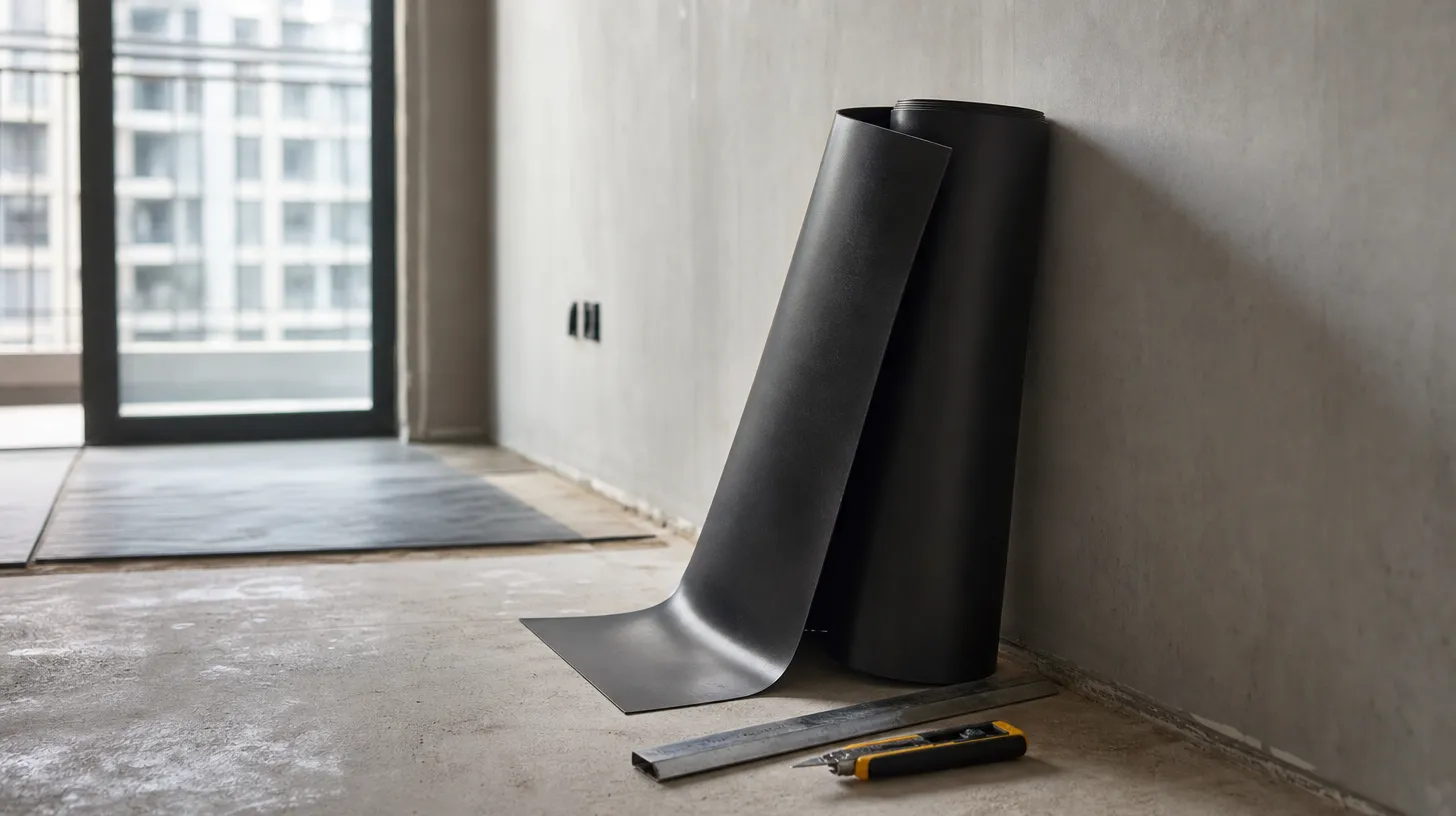
Mass loaded vinyl is exactly what the name says: vinyl that's been loaded with dense mineral filler until a sheet just an eighth of an inch thick weighs about 1 pound per square foot. It's dense, limp, and floppy — you can roll it up like a heavy rubber mat. That limpness matters, because a stiff panel rings and transmits vibration, while a limp, heavy one just sits there and refuses to move when sound hits it.
The reason it blocks sound at all comes down to a rule acousticians call the mass law. According to Aural Exchange, a barrier's sound transmission loss rises by about 6 dB for every doubling of its mass per unit area. In plain terms: to block more sound, you add more weight. MLV is a convenient, thin way to add a meaningful slug of weight to a surface that couldn't otherwise take it.
Here's where the honesty rule kicks in. On its own, that mass buys you less than the marketing implies. According to Sound Pro Solutions, the most common version — 1 lb per square foot, 1/8 inch thick — carries a standalone rating of about STC 26. The products below sit right in that band: EnviroFlex rates its roll at 26 STC, and TroyStudio rates its denser sheet at STC 28. Treat those as manufacturers' listing claims, not independent lab tests.
This is the opposite of foam. MLV is heavy and airtight; acoustic foam is light and porous, so sound passes right through it. Foam absorbs echo inside a room and does essentially nothing at a shared wall — if that surprises you, read does acoustic foam block sound before you spend another dollar. MLV is on the blocking side of the ledger. It's real mass. The question is whether a rental lets you use it properly.
Does It Work in a Rental? The Honest Answer
Yes and no, and the "no" is bigger than most product pages admit.
MLV works when it becomes part of an airtight, layered wall assembly. It struggles when it's tacked loosely over your existing drywall, which is the only version most renters can actually do. STC 26 for a single sheet is modest — for context, a basic interior wall often already rates in that range or higher (a plain single-layer partition sits around STC 27-33), so draping one layer of MLV over it doesn't transform the wall so much as nudge it.
Two rental realities blunt it further:
- Sealing. A barrier only performs when it's airtight. According to Acoustical Solutions, any gap or seam lets sound leak straight through, and it takes only a very small opening to undo a lot of mass. Sound behaves like water: it finds the crack. A sheet hung with a few staples and open edges is a leaky barrier, and a leaky barrier is barely a barrier.
- Fasteners. To hold that weight you screw MLV into studs, which means holes — and if you cover it with drywall for real performance, that's a construction project with mud, paint, and a very unhappy walk-through at move-out.
So the renter math is simple. If you can seal the perimeter and cover the sheet with drywall (owners, or renters with written permission), MLV pulls its weight. If you're going to hang it loose and reversible, you'll pay full price for a fraction of the benefit and still have holes to patch. Neither answer is "don't," but both are "know what you're buying."
If You're Going to Try It: Hanging MLV Step by Step
Decided the trade-off is worth it? Here's the honest how-to for a wall you're allowed to modify.
1. Pick your coverage. For a whole wall, a roll is the economical move. The EnviroFlex 1 lb Mass Loaded Vinyl covers 40 square feet (4 by 10 feet) at about $120 (as of July 2026). If you just want to test the material on a problem spot — a thin closet wall, a hollow door, a duct chase — start small with the TroyStudio High-Density Mass Loaded Vinyl sheet, a 1-by-8-foot piece for about $38 (as of July 2026). It's a manageable, one-person way to learn what MLV does before you commit to a full roll.
2. Cut it. MLV scores and cuts with a sharp utility knife against a straightedge. Measure the wall, add a little for overlap, and cut on the floor.
3. Hang it to the studs. Find your studs and screw the MLV through them with washers or a fender-washer setup so the fasteners don't tear through the heavy vinyl. Let sheets overlap at the seams by an inch or two rather than butting them edge to edge — an overlap you can seal is far more airtight than a tight joint you can't.
4. Plan to cover it. For MLV to reach numbers above its standalone rating, it wants to be sandwiched. According to Second Skin Audio, installers typically put a layer of 5/8-inch drywall over the sealed MLV; combining the vinyl with sheetrock and other measures is what actually lifts the assembly's STC. Loose and exposed, it's doing its weakest work.
Every one of these steps assumes you can fill and paint the holes afterward. If you can't, skip to the cheaper-mass section below.
Sealing Is Half the Job
This is the step people skip, and it's the step that decides whether your money did anything.
Because a barrier is only as good as its leaks, every seam, edge, and penetration in the MLV needs to be sealed airtight. According to Acoustical Solutions, gaps and seams let sound spill straight through no matter how much mass the rest of the wall has. Outlet cutouts, the gap at the baseboard, the overlap between sheets — each is a little open door for noise.
The fix is acoustic caulk. Run a bead along every overlap and around every penetration with a product like the TMS Acoustical Soundproofing Caulk, a latex-based sealant at about $23 (as of July 2026); one 29 oz tube covers roughly 60 linear feet. It stays flexible so the seal doesn't crack as the building shifts. This is the unglamorous half of the job — skip it and even good MLV underdelivers, because you spent on mass and then left the door open.
Cheaper Mass That Won't Cost Your Deposit
If the holes-and-drywall reality is a dealbreaker — and for a lot of renters it is — remember that MLV's whole advantage is mass, and mass comes in reversible forms too.
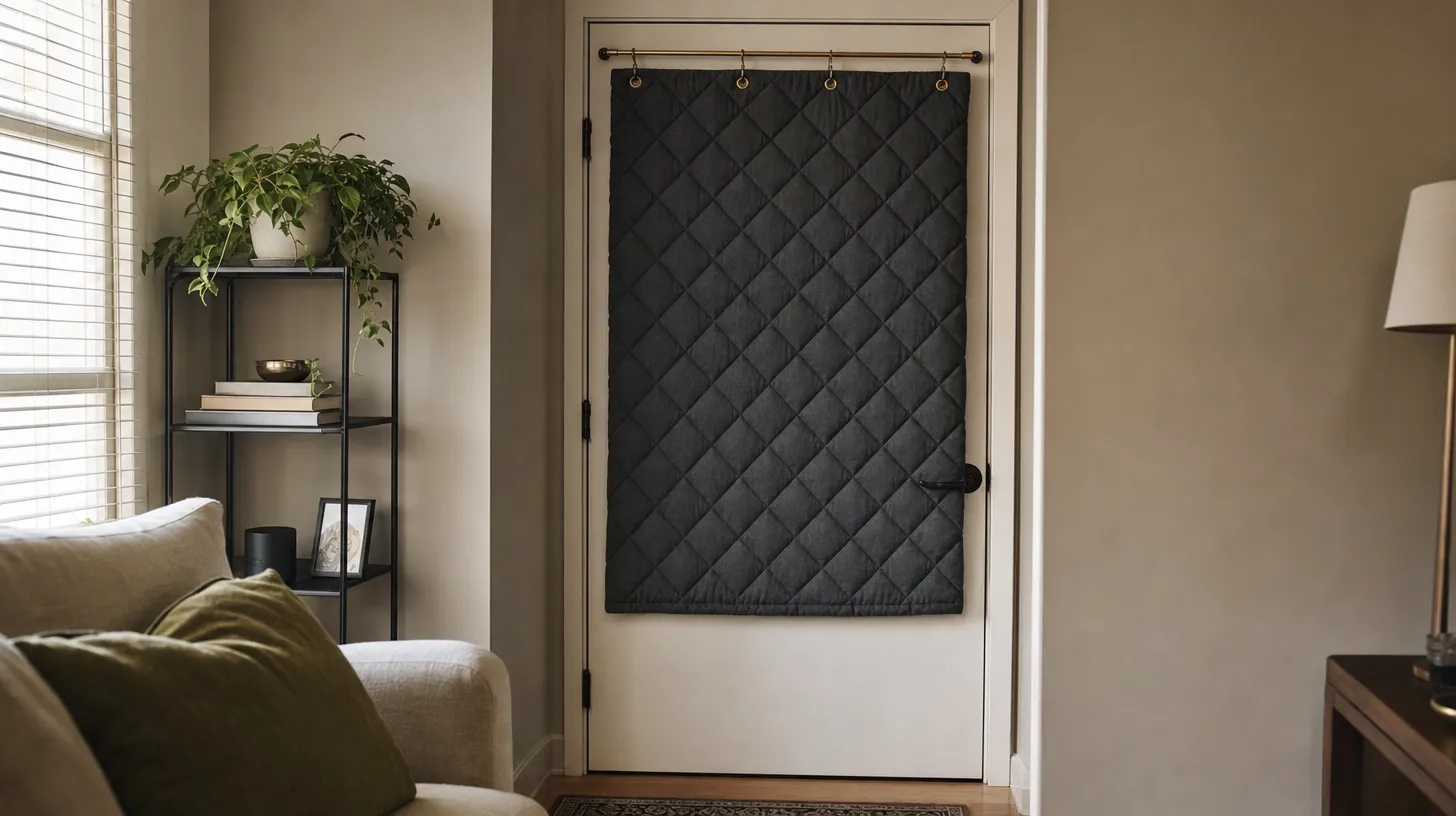
Heavy curtains, moving blankets layered on a wall, and a fully packed floor-to-ceiling bookshelf all add weight to the sound path without a single screw. They add a fraction of the mass of a proper MLV-and-drywall assembly, so keep expectations honest — this is a nudge, not a transformation. But it's a nudge with zero holes, no landlord conversation, and no patch job at move-out, which for a pure renter can be the better deal.
A dense bookshelf is the sleeper here: books are heavy, and a wall of them against a shared partition puts real mass exactly where you want it. For the full reversible playbook, see the cheapest ways to soundproof a wall, which ranks these no-damage options by how much quiet they actually buy.
MLV vs. Building the Wall Right
It's worth being clear about MLV's ceiling, so you don't over-expect. A single layer of vinyl, even sealed and covered, is not the same thing as a properly built quiet wall.
The high-STC assemblies that genuinely mute a neighbor do more than pile on mass — they also decouple the two sides of the wall so vibration can't travel straight across, often using resilient channel or isolation clips, and they add a damping layer of green glue between sheets of drywall to convert sound energy to heat. Those are real construction techniques, and they're the difference between "a bit quieter" and "I forgot the neighbor was home." MLV alone isn't a decoupled, damped assembly; it's the mass ingredient in one. Knowing that keeps your expectations — and your budget — in the right place.
What to Expect (Especially With Bass)
Set the bar honestly and you won't be disappointed. Sealed, screwed to studs, and ideally covered, MLV makes a real dent in everyday airborne noise — voices, TV, hallway chatter. Some sources report roughly 20 to 30 dB of airborne reduction depending on how carefully it's installed, though your wall, your seams, and your noise will vary.
The place mass struggles most is the low end. The mass law does its best work at higher frequencies and weakens as pitch drops. According to a sustainability-directory explainer on the mass law, a brick wall provides about 10 dB more insulation at 400 Hz than at 100 Hz — the same material simply blocks bass far less effectively than mid and high tones. That's physics, not a product flaw: long bass wavelengths pass through walls more easily, which is why a thumping subwoofer or a booming bassline is the last thing any mass barrier fully tames. If your specific problem is bass, temper your hopes and know that no single sheet of anything solves it. You can watch that slope for yourself in our mass-law calculator: stack up an MLV layer, then drop the frequency from 2 kHz down to 125 Hz and see the predicted transmission loss fall away.
The Bottom Line
Mass loaded vinyl is the real thing — genuine blocking mass in a category crowded with foam that only absorbs echo. But "real" and "right for your rental" aren't the same claim. Standalone, a sheet rates about STC 26, and it only climbs toward its potential when it's sealed airtight and covered with drywall, which is construction most renters can't do without eating their deposit.
So match the tool to your situation. Own the place or have permission to build? Hang MLV, seal every seam, cover it, and enjoy a genuinely quieter wall. Renting and reversible-only? Put your money into heavy, no-damage mass instead and skip the patch job. Either way, MLV is one honest piece of a bigger puzzle — our complete guide to soundproofing apartment walls shows how the mass, sealing, and decoupling steps fit together so you spend on what actually moves the needle.
FAQ
Does mass loaded vinyl actually work?
Yes, as a blocker — MLV adds real mass, and mass is what reduces sound transmission under the mass law. But a standalone sheet rates only about STC 26, so it works best sealed airtight and covered with drywall as part of a layered wall, not tacked loosely over your existing surface.
Can renters use mass loaded vinyl without damaging the wall?
Not really at full effect. MLV is heavy and needs screwing into studs, which means holes, and it only earns its rating when the perimeter is sealed and it's covered over. Renters wanting no-damage results are usually better served by heavy curtains, blankets, or a packed bookshelf.
What STC does mass loaded vinyl have?
The common 1 lb-per-square-foot version is rated around STC 26 as a standalone barrier, per manufacturer listings — EnviroFlex lists 26 and TroyStudio lists 28 for its denser sheet. Those are maker claims for the sheet alone; the number rises only when MLV is built into a sealed, multi-layer wall.
Does mass loaded vinyl block bass?
Less than it blocks voices or TV. The mass law weakens at low frequencies, so deep bass — a subwoofer, a heavy bassline — passes through far more easily than mid and high tones. No single mass barrier fully stops bass; managing it takes a heavier, decoupled assembly and realistic expectations.

A 1 lb-per-square-foot MLV roll covering 40 sq ft, which the maker rates at 26 STC as a standalone barrier. It cuts with a utility knife and installs with screws or adhesive. The catch for renters: that number climbs only when it's sealed airtight and covered with drywall — loose over your existing wall it does far less, and the fasteners mean holes to patch.
The right product if you own the place or have a landlord's blessing to build. For a pure renter, price in the wall repair before you commit.
*Price shown on Amazon and subject to change.

A smaller 1' x 8' sheet at 1.1 lb/sq ft that the maker rates at STC 28 — a manageable, one-person way to add mass to a problem spot (a thin closet wall, a duct, a hollow door) without committing to a full roll. Its own instructions stress sealing seams with acoustic caulk or barrier tape.
A sensible way to try MLV before buying 40 square feet. Same rules apply: it only earns its STC when the edges are sealed and it's ideally covered over.
*Price shown on Amazon and subject to change.

MLV only performs when it's airtight, and every seam, edge, and penetration is a leak. This latex-based acoustic caulk seals those joints so the mass you added isn't undone by a gap. One 29 oz tube covers about 60 linear feet.
The unglamorous half of the job. Skip it and even good MLV underdelivers; a leaky barrier is barely a barrier.
*Price shown on Amazon and subject to change.
| Pick | Product | Link | |
|---|---|---|---|
| Best Full-Wall Roll | EnviroFlex — EnviroFlex 1 lb Mass Loaded Vinyl, 4' x 10' (40 sq ft) | $119.99 | Check → |
| Best Small/Test Sheet | TroyStudio — TroyStudio High-Density Mass Loaded Vinyl, 1' x 8' (8 sq ft) | $37.99 | Check → |
| Seal the Seams | Trademark Soundproofing — TMS Acoustical Soundproofing Caulk (1 Tube, 29 oz) | $22.97 | Check → |

Lillie Metayer
Lillie Metayer is the founder of a local program that helps apartment-dwellers take action against noise pollution. Involved in environmental activism since high school, Lillie is passionate about raising awareness of the harms of noise exposure and helping people reduce noise in their communities. In her free time, Lillie enjoys playing the violin and spending time outdoors.