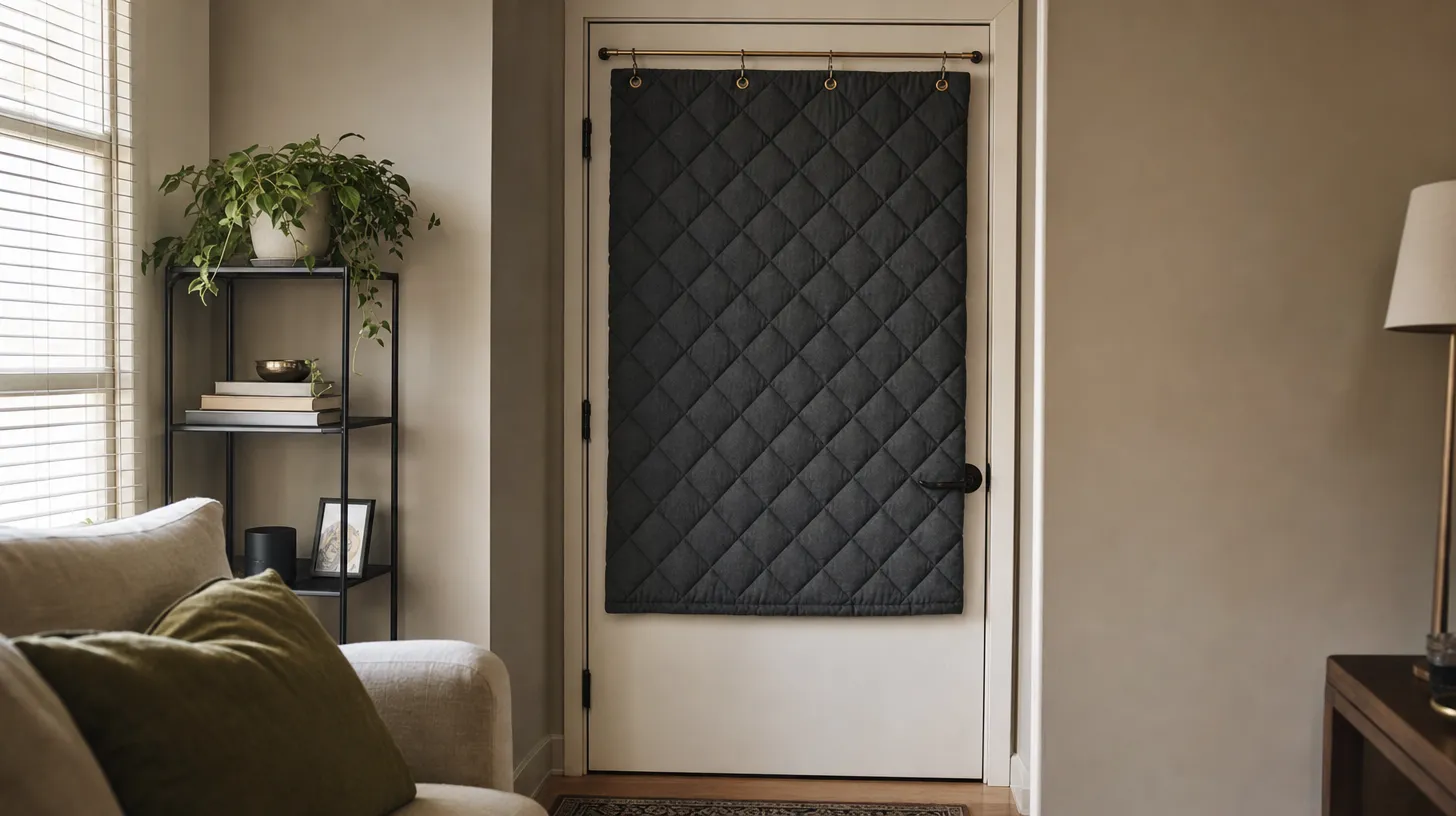
You can add mass to a door you do not own. You cannot add enough of it. Mass is the property that blocks airborne sound, the rule that governs it pays about 6 dB for every doubling of mass per unit area, and doubling a hollow-core slab means hanging another 23 pounds or so on hinges that were sized for the first 23.
That is the honest version of how to add mass to a door for soundproofing. The rest of this page is the arithmetic, the renter-safe methods, and the constraints that end most of these projects.
A door is a light panel hung in a hole with air all the way around it. The light part is a mass problem and the air part is a sealing problem, and we take the construction apart in why your door leaks sound in the first place. If you want the full sequence rather than this one lever, our guide to soundproofing an apartment door puts mass where it belongs, which is third.
The mass law, and the arithmetic nobody puts in the product listing
Airborne sound crossing a single-layer barrier follows what acousticians call the mass law. In Canadian Building Digest 239, "Factors Affecting Sound Transmission Loss," published by the National Research Council of Canada in July 1985, A.C.C. Warnock names the property that matters: "The most important physical property controlling the airborne sound transmission loss through an assembly is the mass per unit area of its component layers."
Then the exchange rate. Warnock writes that "the mass law equation predicts that each time the frequency of measurement or the mass per unit area of a single layer wall is doubled, the transmission loss increases by about 6 dB." He spells out the rest of the curve too: for 12 dB more transmission loss "the mass per unit area must be increased by a factor of 4," and "an increase of 18 dB requires an increase by a factor of 8 and so on."
Read the units, because this is where renters lose money. The quantity is mass per unit area - pounds per square foot of door - and not pounds in total. A 20 pound panel screwed to the middle of a slab does not double the door. It doubles a patch.
Now your door. The manufacturer product data sheet for one standard hollow-core molded panel door, the Cendura series, lists door weight at 1.3 lbs/sf for a 1-3/8 in. slab and 1.7 lbs/sf at 1-3/4 in. A 32 inch by 80 inch face is about 17.8 square feet, so a 1-3/8 in. hollow-core slab starts from about 1.3 pounds per square foot, which is roughly 23 pounds of door. Doubling it means adding another 1.3 pounds per square foot across the entire face - another 23 pounds of material - in exchange for a theoretical 6 dB.
For scale, mass loaded vinyl is about the densest sheet material a renter can buy. Second Skin Audio lists its 1 lb Luxury Liner roll at "1 lb per sq ft", with a nominal thickness of 1/8 in. Cover that whole door face in it and you have added roughly 18 pounds, about three quarters of what the mass law wants for its 6 dB, which the equation puts at just under 5 dB - in a sheet that then has to be held up somehow.
So the honest answer to "can I add weight to a hollow door until it is a quiet door" is no. The lever is real and far too long for the arm a renter has, and we go through what that feels like in practice in whether soundproofing a door actually works.
One caveat on the 6 dB, because it is theory and not a measurement. Warnock calls the mass law "a theoretical rule that applies to most materials in certain frequency ranges," and the digest shows three materials that share the same mass per unit area yet have "quite different STC ratings because of differing coincidence effects." Treat 6 dB per doubling as the best case the physics allows, not a result you will measure in your hallway.
Will Adding Mass Block It?
TL = 20·log₁₀(m × f) − 47 = 20·log₁₀(10.7 × 500) − 47 = 27.6 dB
The layer options there are wall materials, so use it for the pounds per square foot rather than as a model of your door. It and the rest of our free soundproofing calculators run the equation Warnock quotes.
Seal the door before you add a single pound
A leak sets the ceiling on everything else, which is the entire reason mass comes third and not first.
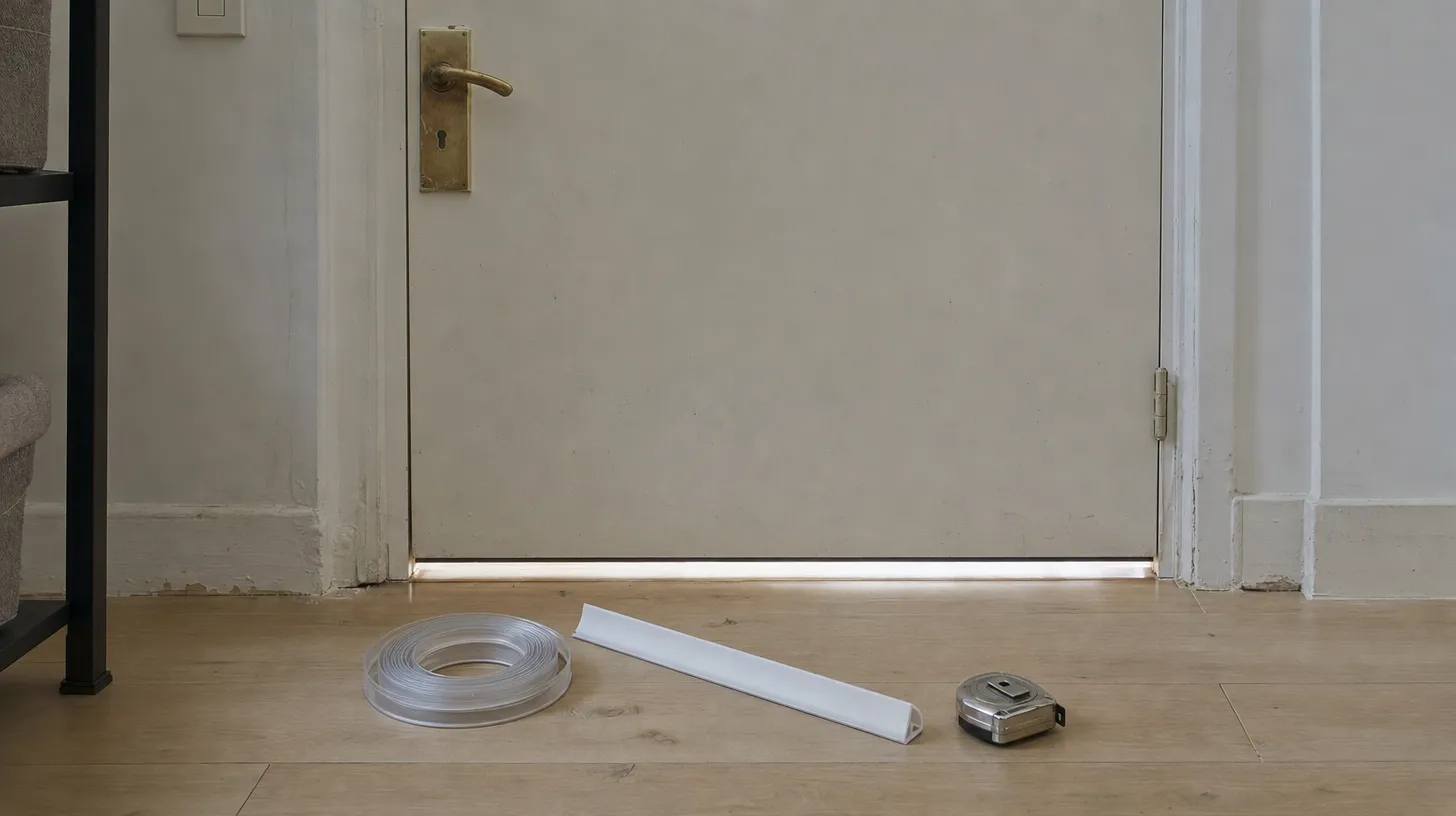
Writing in The Construction Specifier, Jerry Heid puts the gap in perspective: "a gap of less than 3 mm (1/8 in.) may only allow a small amount of air to pass through," "but it is still large enough to completely cancel out any noise-reduction benefits of an acoustic door." An eighth of an inch. Plenty of apartment doors show several times that much daylight underneath.
Heid is named in Allegion's own sound control literature as national sales manager for Zero International, which sells acoustic gasketing, so he has a commercial interest in seals. He also writes that "The key to minimizing sound transmission is mass, particularly for lower-frequency sounds," which argues against his own category rather than for it.
Mass hung on an unsealed door is the most expensive common mistake in this category. You pay for the heaviest material on the page and leave open the air path it cannot touch.
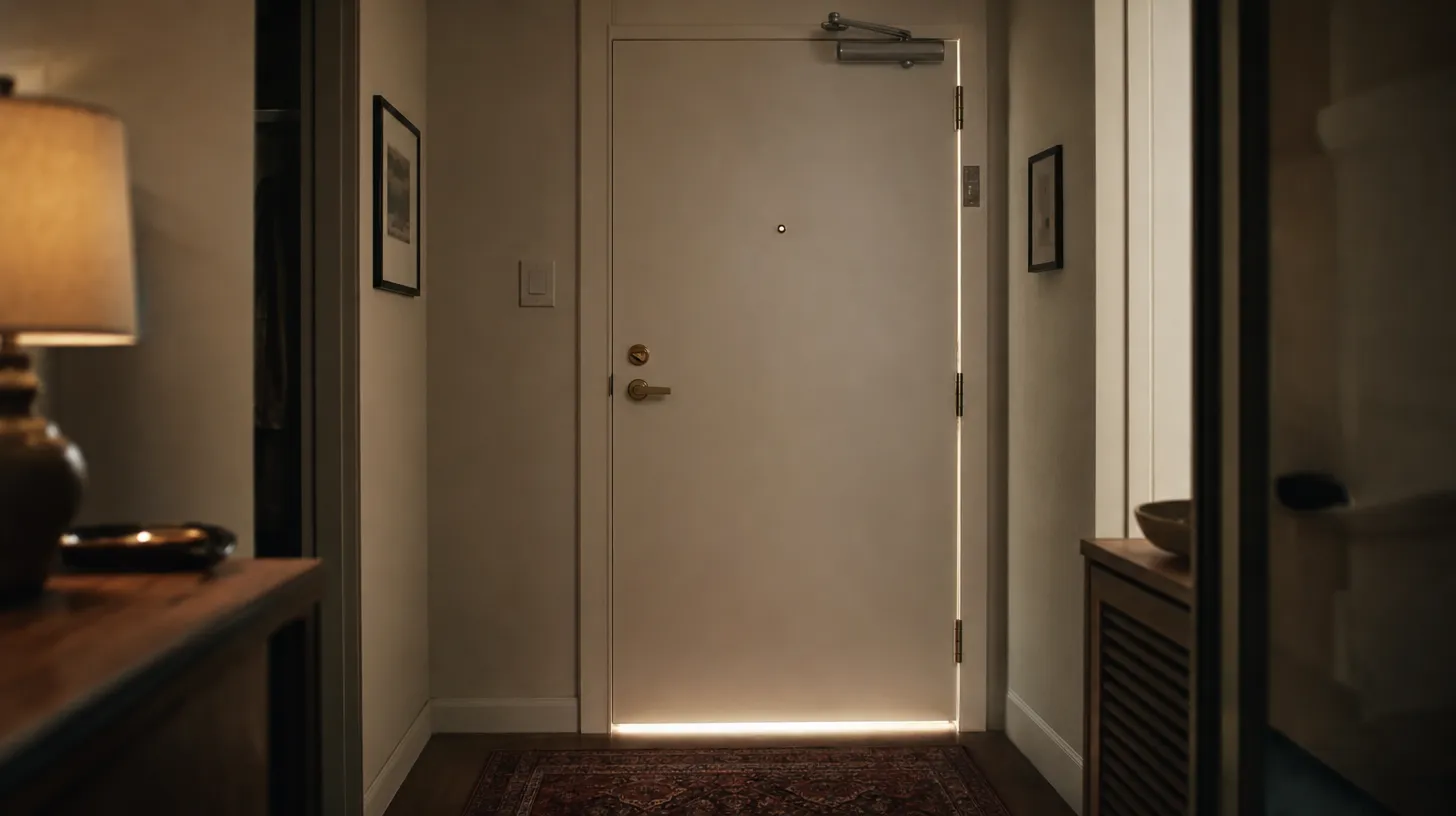
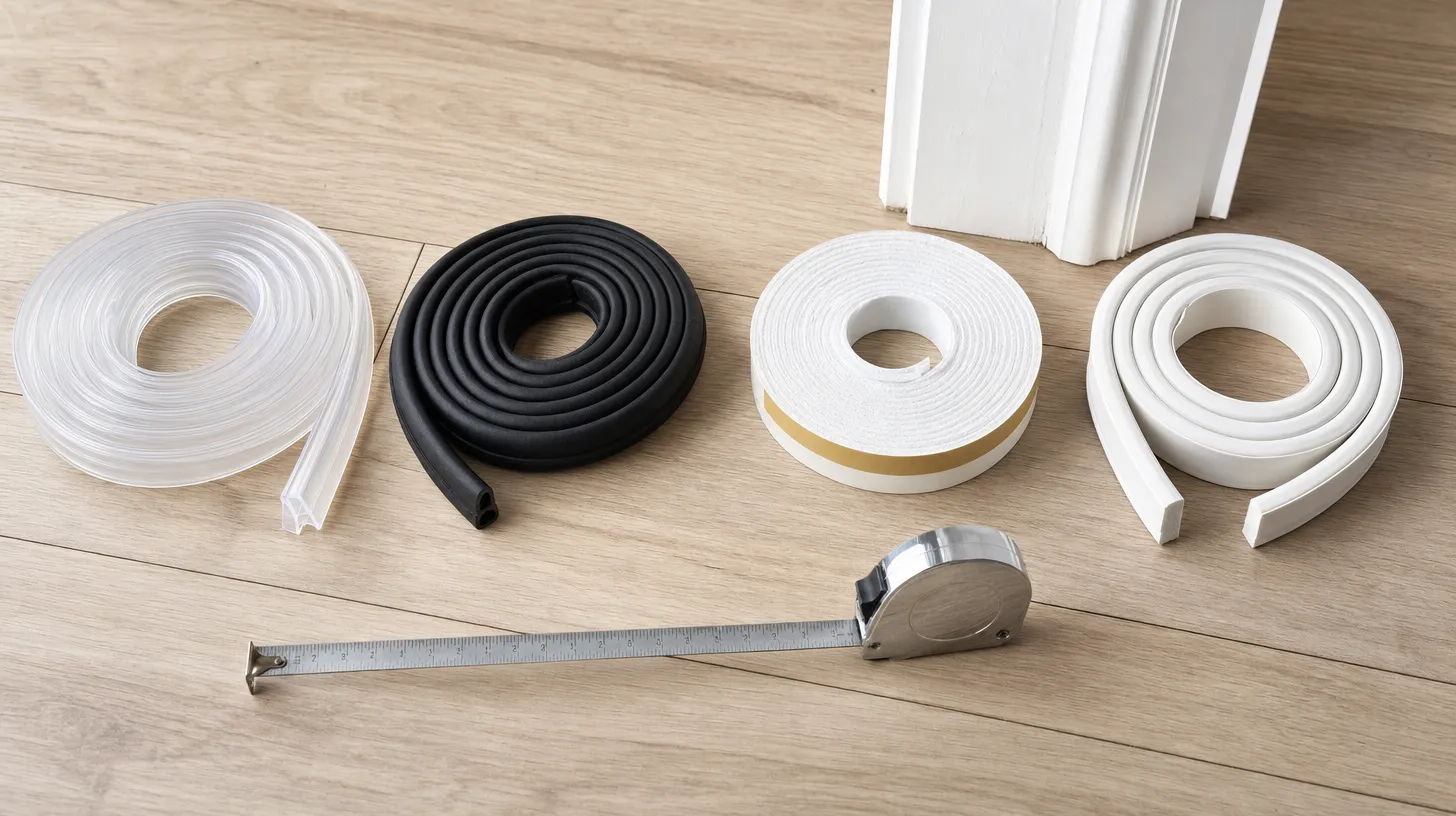
The test is free and takes ten seconds: at night, kill the lights in your room, leave the other side lit, and look at the closed door. Every line of light is an open air path. Close the perimeter and the bottom gap before you buy anything heavy - our roundup of the best door seal kits for apartments covers the perimeter and the best door sweeps and draft stoppers covers the bottom, and the pair usually costs less than one sheet of mass loaded vinyl.
How to add mass to a door for soundproofing, method by method
Five options, rated on what they weigh, whether they are renter-safe, and whether they come off without taking the door with them.
Mass loaded vinyl
The best mass per inch of thickness available to a renter, and the hardest thing on this list to mount.
Weight first. Mass loaded vinyl on a door at 1 lb per square foot and 1/8 in nominal thickness, per Second Skin's listing, works out to about 18 pounds over a 32 by 80 face. The mounting problem follows from that. Second Skin gives the "Recommended Install Method" for its roll as "staples, screws, nails, or hung with reinforced grommets," and notes, writing about walls, that "Drywall will not support the weight of MLV" and that "it must be attached to the studs or joists." It is a material that expects a mechanical fixing.
On a door you are not allowed to screw into, that leaves two routes and both have a catch. Hanging a grommeted sheet from a rod or from hooks over the top edge keeps the fixings off the slab, but then the vinyl is a loose curtain rather than part of the door - it cannot seal to the frame, and it swings. Heavy-duty adhesive puts 18 pounds of steady downward load on glue stuck to a thin veneer or MDF skin you do not own.
Our deep-dive on mass loaded vinyl covers the weight, cost and fixing reality on walls, and all of it applies here, with the extra problem that this wall swings on three hinges.
Soundproofing panels and composite mats
A broad category with worse labeling: MLV bonded to foam, dense rubber mats sold for floors, loaded composite boards sold as soundproof door panels.
Two rules hold across all of it. First, a listing that says "soundproof" with no published rating behind it is listing language, not a measurement - a maker claim and not a tested result. A figure measured on a panel in a lab wall is not a figure for that panel glued to your door. Second, mass works only as a continuous barrier, so a panel covering the middle of the door with bare slab and open gaps around it is mostly decoration.
A rigid panel also concentrates its load at a few fixing points rather than spreading it, which is harder on a light door than the same weight in a flexible sheet.
Moving blankets and acoustic blankets
The renter favorite, and almost entirely the wrong category. Blankets absorb. They do not block.
Second Skin Audio, which sells acoustic materials and therefore has a stake in the comparison, is blunt: "No, moving blankets are not good for blocking sound (soundproofing)." The same page says "They won't have an NRC rating, so it's hard to know how many you need," and that "Nobody would bother paying for an STC test on a moving blanket, because it's basically as dense as cardboard."
The weight settles it without any need to trust a vendor. Second Skin puts a typical moving blanket at "between 3 and 8 pounds." Spread that across 18 square feet of door and you have added something like a fifth to half a pound per square foot, against a slab already carrying about 1.3. A heavy blanket on the door is a small fraction of one doubling, and the mass law barely registers it.
What a blanket does do is absorb mid and high frequency reflections on your side of the door, which changes how your room sounds rather than how much gets into it. That is a real job. It is not this job, and the two get sold interchangeably.
A heavy curtain across the doorway
Not mass on the door at all, and that is the appeal: a curtain on a rod is the only method here that cannot break your door.
Fabric hung in front of the opening is partly absorption and partly leak coverage, and the second part only happens when the curtain is wider and taller than the frame and long enough to reach the floor, so it covers the air paths at the edges instead of sitting inside them. Nothing attaches to the slab, nothing loads the hinges, the door latches normally, and it all comes down in a minute. Our guide to heavy curtains goes through which products are heavy enough to be worth the rod and which are blackout curtains with an acoustic label.
Expect what you would expect from a blanket, for the same reason: fabric is light by design, which is why it drapes.
Plywood or MDF skinning
The method the internet likes best and the hardware usually rules out.
Cutting a sheet to the size of the slab and bonding it to the face is the efficient way to get pounds per square foot onto a door, and on paper the only renter-scale method that could approach a doubling. In practice the door stops working. The slab gets thicker on the room side, so it closes against a stop that is now in the wrong place, the latch still has to reach the strike, and the bottom edge still has to clear the floor and the sweep. Add half an inch to the face of a door that had an eighth of an inch of clearance and you do not have a heavier door, you have a door that does not shut.
It is also a permanent alteration bonded to someone else's property, and on a unit entry door it is not an option.
Bonding two layers with a soft compound between them, which comes up constantly in soundproofing writing, is damping - a different mechanism from mass, and one that usually needs the layers screwed together. We cover it, and why renters rarely get to use it, in damping and decoupling.
The constraints that kill these projects
These, rather than the acoustics, are what actually stops people.
- Hinge load and sag. The hinges were specified for the slab, not the slab plus 18 pounds of vinyl. A sagging door rubs the frame at one corner, opens a wider gap at the opposite one, and eventually stops latching. If yours already drops when you swing it, do not add weight to it - that is a maintenance request, not a project.
- The door has to latch. A door held loosely against its stop leaks around the latch side regardless of what is hanging on it, so a build that defeats the latch has made the noise worse and the door heavier. Fit it, close the door, check that the latch engages normally, and take it back off if not.
- Clearance, and the gap you just closed. Mass adds thickness and thickness eats clearance. Heid's eighth of an inch cuts both ways: a slab forced to sit proud of its stop, or a sweep you had to peel off because the bottom now drags, can give back more than the added weight bought.
- Fire-rated entry doors, which are not a trade-off but a no. See the box below.
- Adhesive, fixings and your deposit. Anything strong enough to hold 18 pounds on a vertical surface for a year is strong enough to take veneer, paint or skin with it on the way off. Removability is a specification, and on a rented door it is the first one.
Where to stop
Seal the perimeter and the bottom gap thoroughly. Add one modest layer of mass if, and only if, the hinges, the latch and the clearance will take it. Then stop. That is the whole renter-viable sequence for a door, and the second step is worth a great deal less than the first.
What success sounds like: speech from the other side stops arriving as words and becomes a murmur, door slams soften, a television drops to a background mumble. What does not change is bass. Low frequency energy travels around through the wall and the floor as readily as through the door, and nothing you can hang on a hollow-core slab touches it.
If that does not sound like much, that is the right reaction, and it is cheaper to have now than after the delivery arrives. A sealed, mass-loaded hollow-core door is still a hollow-core door. Our guide to how to soundproof an apartment door walks the full sequence in order with what each step costs, so you can spend the first twenty dollars where it does the most work and keep the rest.

Lillie Metayer
Lillie Metayer is the founder of a local program that helps apartment-dwellers take action against noise pollution. Involved in environmental activism since high school, Lillie is passionate about raising awareness of the harms of noise exposure and helping people reduce noise in their communities. In her free time, Lillie enjoys playing the violin and spending time outdoors.