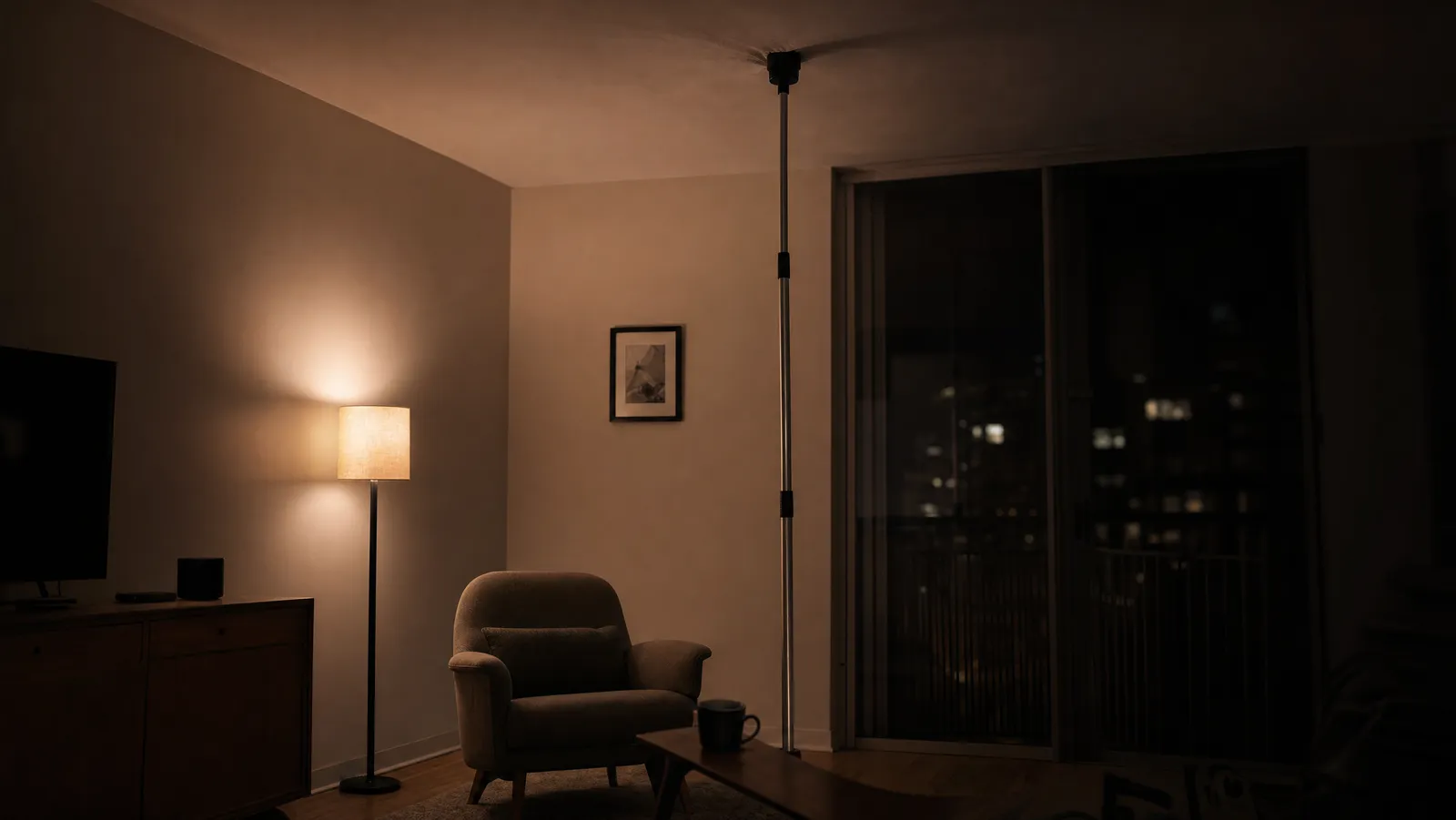
A ceiling thumper for noisy neighbors does not reduce the noise in your apartment. It adds noise to your apartment — noise that you are running, at midnight, under the same ceiling you already can't sleep beneath. And it quietly moves you from the tenant with a complaint to the tenant who is generating one. That is a worse trade than it looks.
We are not going to tell you to knock on their door and have a nice chat. You have done that. You probably did it twice, politely, then wrote the email, then lay awake at 1:40 a.m. listening to a chair scrape. The anger is proportionate. It is also the only asset you currently have, and a thumper spends it on nothing.
This is the de-escalation chapter of our pillar on how to reduce noise from upstairs neighbors: what these devices are, what actually happens when renters use them, and where that anger converts into leverage instead.
The Short Answer on a Ceiling Thumper for Noisy Neighbors
Compressed to four lines:
- It is additive, not subtractive. You now live under footsteps and over a motor you are operating. Two noise sources, one bedroom.
- It inverts the paper trail. Deliberate noise aimed at another tenant is precisely what lease nuisance language exists to catch. You hand your neighbor the record you were trying to build.
- It ends every cheap fix. A rug, felt pads, moving the treadmill off the shared wall — all of that is free and all of it stops being available the second they know you are retaliating.
- It delivers one real thing: the feeling of not being powerless. That feeling is worth naming honestly. It is not a fix.
What These Devices Actually Are
The category has three shapes.
Telescoping thumper poles. According to Soundproof Idea, these are "relatively simple machines" built around "a long adjustable rod that extends between the floor and ceiling," screwing in and out to fit your ceiling height. A motorized head at the top strikes or vibrates against the drywall.
Vibrating pads and motorized units. Same principle without the pole. According to Soundproof Nation, a ceiling vibrator "sends either vibrations or beat noise to upstairs neighbors," with the intensity selectable on a remote across nine settings. Soundproof Living traces the design to a Beijing resident identified only by his surname, Zhang, who in 2017 decided he could no longer take the noise of the children living above him.
Revenge speakers. A subwoofer aimed at the ceiling, paired with a playlist chosen for maximum irritation. Cheapest option, loudest in your own apartment by a wide margin.
None of the three sells acoustic performance. What they sell is a mechanism for transmitting your frustration upward on demand. Every review that says "it works" means the neighbor heard it — not that the buyer's apartment got quieter.
Reason 1: A Ceiling Vibrator for Noisy Neighbors Adds Noise to Your Own Apartment
Here's the physics problem nobody selling these mentions. Your ceiling is a large, thin, directly-fastened panel that radiates structural vibration into your room like a drum head — which is why a normal footstep sounds like dragged furniture. We unpack that in why are upstairs neighbors so loud.
Now press a motor against that drum head.
The device is not sending sound cleanly through the floor assembly to your neighbor. It is exciting the panel you live under. Most of what it produces goes into your room, at close range, at low frequency, toward your bed. A footstep upstairs is an impact you receive at a distance through a structure; a thumper is an impact you generate three feet from your own head.
The sleep math makes this worse. According to the World Health Organization's night noise guidance, the recommended limit outside bedrooms is below 40 dB Lnight, and community-noise guidance puts good-quality sleep at under 30 dB(A) inside the bedroom. You are already over that — it's why you're reading this. A motorized device at midnight does not move you back under the threshold. It stacks a second source on the first, and this one runs on your schedule, which means you are awake for all of it.
Honest accounting on night one: your neighbor loses some sleep, and you lose more. You were already the one being woken up. Now you are also the one staying up to operate the machine.
Reason 2: Payback Puts Your Tenancy on the Wrong Side of the Paperwork
This is the load-bearing part, so let's be precise. This is general information, not legal advice — leases and local ordinances vary enormously, and a tenant attorney or your local tenant union is the right call for your actual situation.
Start with what quiet enjoyment really is, because it gets misquoted constantly online. According to Cornell's Legal Information Institute, the covenant of quiet enjoyment is "an implied term in every lease that the tenant shall have quiet and peaceful possession of the leased premises," and it runs from the landlord to the tenant. It is not a tenant-to-tenant weapon you can point upstairs.
It still cuts both ways in the manner that matters to you. According to Azibo's overview of quiet enjoyment law, a landlord can breach that covenant by "failing to address behaviors from other tenants or nearby properties that disturb the peace and quiet of a tenant." Read that again with yourself as the other tenant. The moment you become the documented disturbance, your landlord's obligation stops pointing at your neighbor's floor and starts pointing at your ceiling.
Then there's the lease itself. According to Azibo's guide to noise complaints and eviction, lease agreements "should contain specific provisions that address noise complaints, outlining the tenant's obligations to keep their living space quiet and minimize disturbances to other tenants," and the process escalates through written notice, then formal warning, then a written eviction notice — often a three-day notice for nuisances, depending on local regulations. The same guide advises landlords to "maintain a thorough record of all noise complaints, investigations, and violation notices," because that record becomes the evidence if proceedings start.
That record is the whole game, and a thumper writes your name into it.
One further step exists. According to Local Noise Laws, noise crosses into harassment when two elements are present: intent — "the neighbor's actions are deliberate and meant to cause you distress" — and a pattern of repeated behavior. The same source notes that while laws vary by state, harassment generally means "a course of conduct that serves no legitimate purpose and is intended to alarm, annoy, or torment another person." A device marketed as a revenge tool, run nightly, illustrates both elements uncomfortably well. Whether that framing applies where you live, we can't tell you, and neither can anyone who hasn't read your ordinance.
The version without the law: a property manager holding two files sees one tenant complaining about walking and one tenant operating a machine.
Reason 3: Devices to Get Back at Noisy Upstairs Neighbors End the Negotiation
A lot of upstairs noise is fixable for under fifty dollars, and almost none of that money is yours to spend.
An area rug with a dense pad in the main walking lane. Felt pads under chair legs. The treadmill moved off the joist bay above your bedroom. House shoes after 10 p.m. Every one of those asks requires a neighbor who is mildly embarrassed and willing to help.
Retaliation converts that person into an opponent. Once they identify the thumping as deliberate, the frame flips from "sorry, I didn't realize" to "this person is attacking me in my home." Nobody buys a rug for someone who is attacking them. A maintenance problem becomes a status contest, and status contests do not have fifty-dollar resolutions.
Escalation is not a theoretical risk either. In a 2023 post for Quiet Communities' Quiet Coalition, noise researcher Arline Bronzaft collected news reports of neighbor noise complaints that ended in violence — among them a father of two stabbed to death after complaining about loud music, and a neighbor shot during a leaf-blower dispute. Bronzaft's own point is that most complainants never come close to that; these are tail-end outcomes, not typical ones. But they are documented, and they began with somebody deciding to make a point. On the tactical side, the tenant law firm Tobener Ravenscroft puts it plainly: tenants "should also never retaliate or provoke the nuisance neighbor," because doing so "makes it seem as if you are also at fault" and "unnecessarily muddies the water."
The One Thing a Thumper Genuinely Delivers
Let's not pretend the appeal is irrational. Searching "how to make noise for upstairs neighbors" at 2 a.m. is not a character flaw. It is what happens when you have been polite four times and nothing changed.
What these devices sell is agency. The specific misery of upstairs noise is that it happens to you, on someone else's schedule, in the one room where you are supposed to be safe, and there is no button. A thumper is a button. That is genuinely relieving for about ninety seconds.
It is a feeling, not a fix. The relief doesn't survive the night, and the cost lands on your lease. Two other things produce that same feeling and move the situation: a record with timestamps, and a bedroom you can sleep in regardless of what happens above it.
"But They Started It"
They did. That stays true.
It is also worth knowing that most upstairs noise is not aimed at anyone. Wood-frame floors deflect under an ordinary heel strike and radiate a low-frequency thump downward. The person above you is walking to their bathroom; the building is doing the amplifying. That doesn't make you less tired. It does mean the "they don't care" story is usually wrong and the "they have no idea" story is usually right.
Fairness isn't the question in front of you. The question is which move leaves you better off in ninety days: the one that puts a written warning in your file, or the one that puts a rug on your neighbor's floor. You don't have to forgive anyone to pick the second.
What to Do With the Anger Instead
Point it at three things, in this order.
1. Build the record. Vagueness is what kills noise complaints. According to Local Noise Laws' documentation guide, a usable noise log records exact times rather than estimates — "11:47 PM – 1:23 AM" instead of "around midnight" — plus a clinical description of the noise, a decibel reading from a phone app, the specific impact ("could not sleep, woke up three times"), any audio or video clip, and the actions you took. The same guide puts the working thresholds at 3 incidents minimum for a landlord complaint, 5 or more for code enforcement, and 10 or more for small claims. Our companion piece on how to document and record the noise walks through the whole log.
2. Make your bedroom survivable tonight. Masking is not surrender; it is one of the few interventions still available to you against low-frequency impact noise in a unit you cannot modify. Broadband sound at the sleeping position, dense soft furnishings, and a bed moved out from under the worst joist bay will do more by Thursday than anything aimed upward. Our genius ways to silence noisy neighbors playbook covers the renter-legal versions.
3. Escalate in the right order. Written notice to the neighbor, then the log to management in writing, then follow-up with dates, then code enforcement or mediation. Each rung requires the one below it to be documented. Our step-by-step on how to deal with noisy upstairs neighbors lays out the ladder and the language.
The Honest Sequence
Log it, mask it, escalate it — in that order, with your name on none of the complaints.
A ceiling thumper feels like the shortcut and functions like a detour. It puts a second noise source in your bedroom, hands the paperwork advantage to the person keeping you awake, and takes the fifty-dollar rug permanently off the table. The one thing it reliably produces is the sensation of having done something — and a timestamped log that a property manager has to act on produces that too.
You are not being asked to be the bigger person. You are being asked to be the tenant with the better file. For the rest of it, start with our guide to reducing noise from upstairs neighbors.

Lillie Metayer
Lillie Metayer is the founder of a local program that helps apartment-dwellers take action against noise pollution. Involved in environmental activism since high school, Lillie is passionate about raising awareness of the harms of noise exposure and helping people reduce noise in their communities. In her free time, Lillie enjoys playing the violin and spending time outdoors.