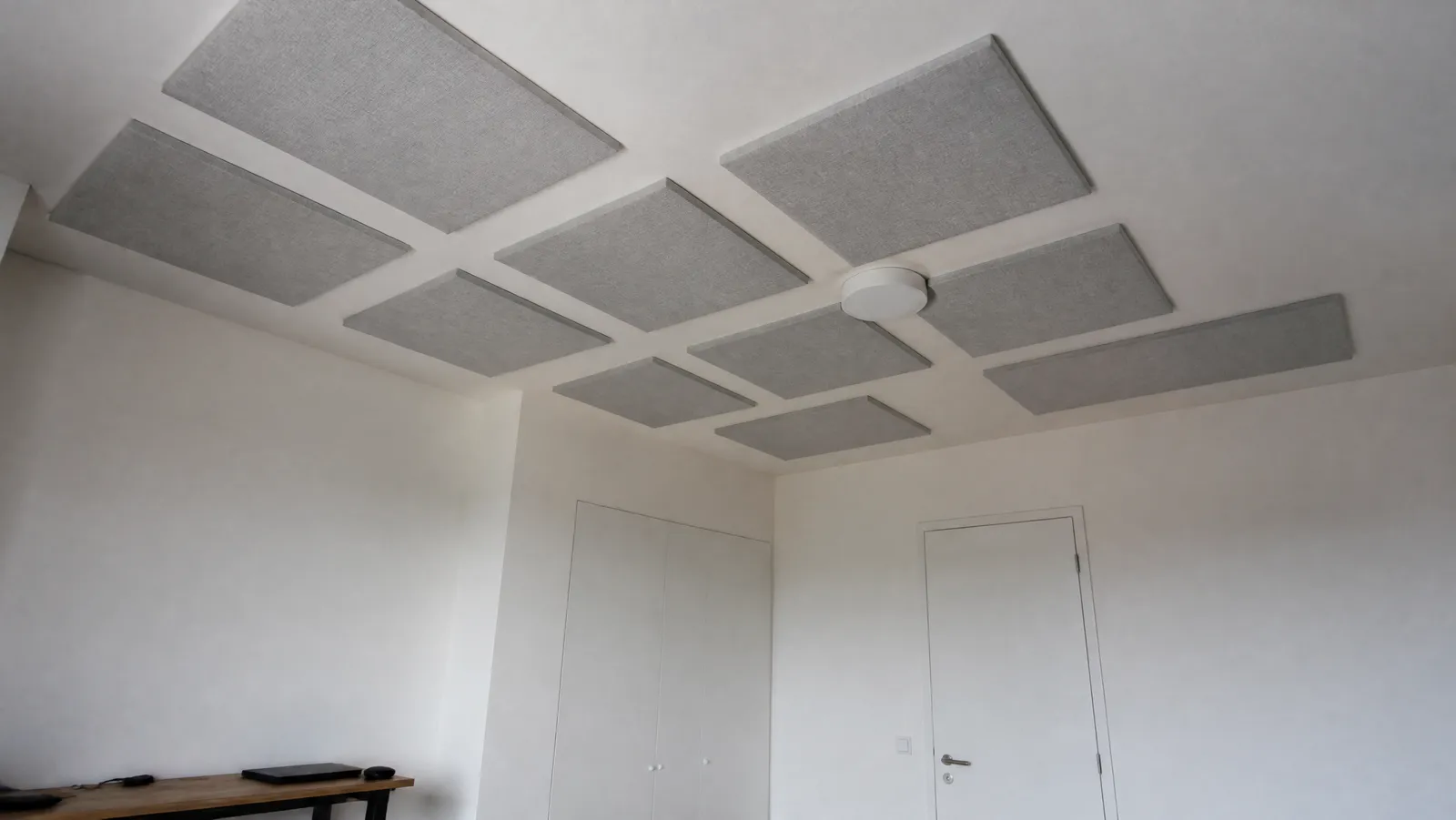
Short answer, before you spend the money: no. For footsteps from the apartment above, ceiling acoustic panels will not meaningfully help. So when people ask do ceiling acoustic panels work, the honest reply is that they work at their real job, which is absorbing echo inside your own room, and that job has almost nothing to do with the person walking around over your head.
We write this one with some sympathy, because it is one of the most expensive mistakes in renter soundproofing. Covering a bedroom ceiling in fabric or foam panels is easily a few-hundred-dollar project, it takes a weekend and a lot of adhesive, and the payoff for footfall is close to zero. Below is exactly why the physics refuses to cooperate, the one situation where ceiling panels genuinely help, and where that money goes further if what you actually want is to reduce noise from upstairs neighbors.
What Acoustic Panels Actually Do
An acoustic panel is an absorber. Sound that is already loose in your room bounces off hard surfaces, and a porous panel catches part of that energy instead of reflecting it. Less echo, less ring, less flutter. That is the entire job description.
Absorption gets scored with NRC (Noise Reduction Coefficient). According to Wikipedia's entry on the noise reduction coefficient, NRC is a single-number rating intended to describe a material's average sound absorption performance, derived from reverberation-room measurements and reported on a scale from 0.0 for very low absorption to 1.0 for very high absorption.
The critical part is what NRC is not. That same source is explicit that NRC should not be confused with STC (Sound Transmission Class), which is a separate single-number rating derived from laboratory measurements of airborne sound transmission loss through building elements such as walls, doors and windows. One number describes sound absorbed within a room. The other describes sound stopped on its way through a barrier. Panels are sold with the first number and bought by people who wanted the second.
Accommodation and accessibility guides make the same split. The Job Accommodation Network's noise-control guidance treats these as two separate problems with two separate product categories: soundproofing a party wall so that, in its words, "little or no noise from the other side will pass through," versus "absorbing sound and reducing echo or reverberation within a room." Panels are the second category. Nothing in that guidance suggests the absorption products do the blocking job.
And the cheap end of the category is weaker than most buyers assume. According to OrangePiel's comparison of acoustic panels and foam, most open-cell foam products test between NRC 0.25 and 0.50, and foam's cell structure absorbs some high-frequency energy above 1,000 Hz while performing poorly below 500 Hz. Purpose-built fabric-wrapped mineral wool and fiberglass panels land in the NRC 0.80 to 1.05 range by comparison. So even at absorbing, thin foam is the weakest tool in the box, and the low frequencies it ignores are exactly where a footstep lives.
Why Upstairs Footsteps Are a Different Problem Entirely
Here is the part that makes the ceiling case worse than the wall case.
Noise through a shared wall is usually airborne: a TV, a voice, a speaker pushes air, the wall vibrates a little, and some of that energy reappears in your room. Noise from above is usually impact: a heel, a dropped dumbbell, a chair leg dragging. That energy is injected straight into the building's structure, travels through joists and the floor slab, and your ceiling drywall vibrates and radiates it into your room as sound.
That distinction has its own rating. According to Commercial Acoustics, IIC (Impact Insulation Class) is a single-number rating of how well a floor-ceiling assembly reduces structure-borne sound such as footsteps, dropped items, and furniture movement, and the test evaluates the entire system rather than just the flooring. Building codes take it seriously: according to the Association of the Wall and Ceiling Industry, Section 1206.3 of the 2021 IBC requires floor-ceiling assemblies between dwelling units and sleeping units to have an impact insulation class rating of not less than 50 when tested in accordance with ASTM E492, or a Normalized Impact Sound Rating of not less than 45 if field tested to ASTM E1007.
Notice what that rating applies to. The assembly: subfloor, joists, cavity, ceiling board. Not a decoration glued to the bottom of it.
So picture the mechanism honestly. Your ceiling is the loudspeaker. It is being driven from the other side by structural vibration. A porous panel stuck to its underside is a blanket draped over a speaker cone, not a wall between you and the sound. There is no wave in flight for the panel to intercept, because the sound is being created at the surface the panel is attached to. If that framing is new to you, the full version is in our breakdown of impact noise vs airborne noise, and the building-specific reasons your particular unit is so bad are in why upstairs neighbors are so loud.
The industry says the same thing in blunter terms. According to TM Soundproofing, impact noise should be dealt with at its source, and the same basic principle applies to any soundproofing product applied only to a ceiling: it is not nearly as effective as treating the noise at its source. That firm also notes plainly that soundproofing an existing structure against impact noise is quite difficult and usually not very effective.
The Mass Problem: What Would Actually Have to Change
Blocking sound is a weight problem, and this is where panels lose on arithmetic.
The governing rule is the mass law. According to ASA Standards, mass-law sound transmission loss is the phenomenon whereby doubling the mass per unit area of a panel, or doubling the frequency for a given mass per unit area, increases the sound transmission loss by six decibels.
Read that carefully. To buy yourself 6 dB, you have to double the weight of the whole barrier, per square foot. Your ceiling is drywall plus the floor structure above it. A foam tile or a fabric-wrapped fiberglass panel adds a rounding error to that total. You could tile the entire ceiling and not come close to doubling anything.
For scale, look at what real barrier mass costs you. According to Sound Pro Solutions, the standard general-purpose grade of mass-loaded vinyl weighs 1 pound per square foot at 1/8 inch thick and carries a stand-alone STC of 26, while the 2 pound per square foot version is 1/4 inch thick and reaches STC 31. That is a genuinely heavy, genuinely dense material, and on its own it still only rates in the twenties. A 12-by-12-foot ceiling covered in the 1-pound grade is about 144 pounds hanging over your bed, which is a structural and lease question, not a weekend project.
Two honest conclusions follow. First, no absorber you can hang is going to add meaningful mass. Second, even the products that do add mass are landlord territory on a ceiling, not renter territory. This is the same lesson we walked through for walls in does acoustic foam actually block sound, except the ceiling version is harder, because there you were at least fighting airborne sound.
"But My Room Sounds Quieter Since I Put Panels Up"
We believe you, and this is the trap worth naming.
When you absorb reflections in a room, the room's decay time drops. Sounds stop lingering. Everything gets a little tighter and duller, and your brain reads "duller" as "quieter." Voices sound closer, the TV sounds cleaner, and the room feels calmer. That is a real, measurable change to the acoustics inside your unit.
What did not change is the level of the footfall energy your ceiling is radiating. The thump arrives with the same force. It just arrives into a room that no longer smears it into a half-second of reverb, so it sounds shorter and less boomy while being exactly as loud at the moment of impact.
That perceptual gain is worth something. If a panel makes your bedroom feel less cavernous, that is a genuine quality-of-life improvement and we are not going to sneer at it. Just do not confuse it with isolation, and above all do not buy a second round of panels expecting the first round's effect to compound. It will not. You are refining the acoustics of your own room, and the neighbor's footsteps are not in your room's acoustics, they are entering through the boundary.
The Narrow Cases Where Ceiling Panels Are Worth It
Two situations, both real:
- Your complaint is airborne, not impact. If what you hear from above is voices, a TV, bass from a speaker, or a barking dog, absorption in your own room does slightly reduce how much that sound builds up once it gets in. It is a modest effect, not a fix, but it is not nothing. Impact noise is the case where it truly is nothing.
- Your complaint is really about your own room. Hardwood floors, bare walls, high ceilings, a home office where every call sounds like a parking garage. Ceiling panels are excellent at this, especially over a desk or a dining table. Rigid mineral wool or fabric-wrapped fiberglass, in the NRC 0.80-plus class, will transform how a hard-surfaced room sounds.
Both of those are absorption problems, and absorption is what you are buying. Buy panels for those. Do not buy them for the guy in 4B.
What to Do Instead, in Order of Actual Effect
If footsteps are the enemy, here is where the same money and effort go further. Roughly in order of payoff:
- Get soft flooring upstairs, if you possibly can. This is the single highest-leverage move and it is why we lead with it despite being the awkward one. According to the Association of the Wall and Ceiling Industry, soft floorcoverings do a great job of improving IIC because they stop the sound at the source, and tapping on carpet and pad is much harder to hear through the structure than tapping on a solid floor. According to DDS Acoustical Specialties, acoustical floor underlayments are designed to mitigate that noise at the source, serving as a resilient buffer that absorbs impact energy before it becomes airborne noise. A friendly note or a landlord-mediated ask about area rugs beats anything you can install on your side. If it is your own floor that is bothering someone below, start with the best rug pads for footstep noise.
- Seal the flanking paths in your own unit. Gaps around ceiling light fixtures, vents, the tops of shared walls, and old plumbing penetrations leak airborne sound freely. Sealing is cheap, renter-safe, and it is real transmission loss rather than absorption.
- Attack the perceived loudness, not the source. Broadband masking (a fan, a good sound machine) does more for sleep at 2 a.m. than any panel will, because it lowers the contrast between the quiet room and the thump. This feels like a consolation prize. In practice it is the thing that most often gets people sleeping again.
- Then, and only then, consider actual ceiling work. There are renter-tolerable and landlord-approved options with genuinely different mechanisms, and we walk through them honestly in how to soundproof an apartment ceiling, including which ones are worth the disruption.
Notice that absorption panels do not appear anywhere on that list. That is not an accident.
The Landlord Conversation, If You Want the Real Fix
The fixes that actually move impact noise all live on the other side of your ceiling: resilient decoupling, added mass on the assembly, insulation in the cavity, or soft floorcovering in the unit above. Every one of those is the building's decision, not yours.
That is worth a conversation rather than a complaint. Two things make it land. First, bring the standard as a benchmark, not as a legal club: Section 1206.3 of the 2021 IBC, as cited by the Association of the Wall and Ceiling Industry, calls for an IIC of at least 50 for floor-ceiling assemblies between dwelling and sleeping units. That is a model code for new construction, adopted (and amended) state by state, so it is not automatically an obligation your existing building is breaking. It is still a useful reference point, and a unit that was recently re-floored in hardwood may no longer perform the way the assembly was originally designed to. Second, bring the cheap ask first. Requesting a rug-and-pad arrangement for the unit above, which many leases already handle with a percentage-of-floor-coverage clause, costs a landlord almost nothing and delivers more than a ceiling retrofit would.
Ask for the underlayment, not for the demolition. You will get a yes more often.
The Honest Bottom Line
Ceiling acoustic panels are a good product being sold into the wrong problem. They are absorbers, rated by NRC, and they act on sound already in your room. Upstairs footsteps are impact noise: structure-borne, radiated by the ceiling itself, and unmoved by anything light enough for you to glue overhead. Expect the room to sound duller and the footsteps to keep landing at the same volume.
If your room echoes, buy the panels and enjoy them. If your ceiling thumps, keep the money, seal your flanking paths, work the rug conversation upstairs, and mask what is left. And for the whole sequence in one place, from diagnosing what you are actually hearing to the fixes that survive a lease, start with The Soundproof Apartment's guide to upstairs noise.

Lillie Metayer
Lillie Metayer is the founder of a local program that helps apartment-dwellers take action against noise pollution. Involved in environmental activism since high school, Lillie is passionate about raising awareness of the harms of noise exposure and helping people reduce noise in their communities. In her free time, Lillie enjoys playing the violin and spending time outdoors.