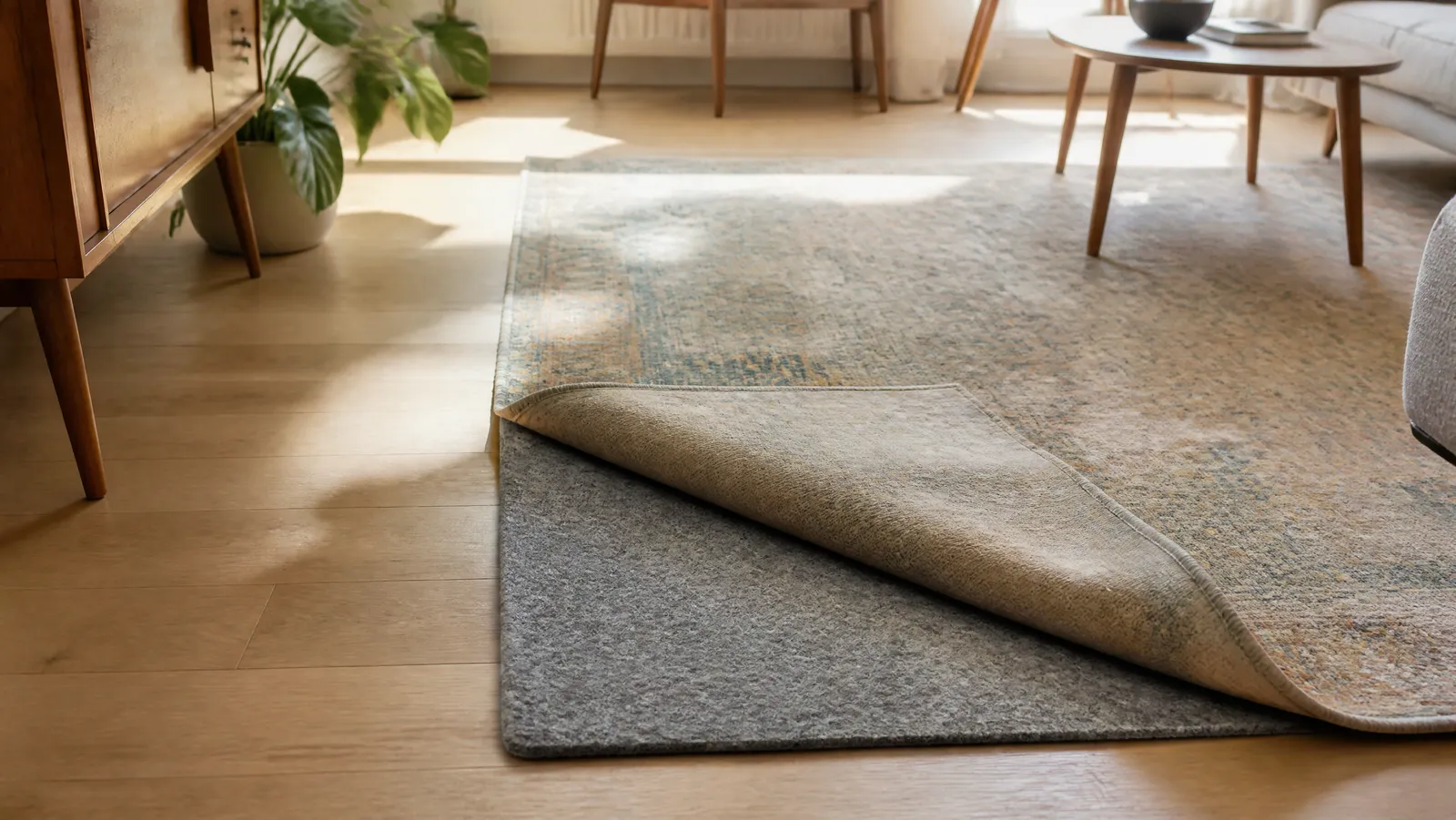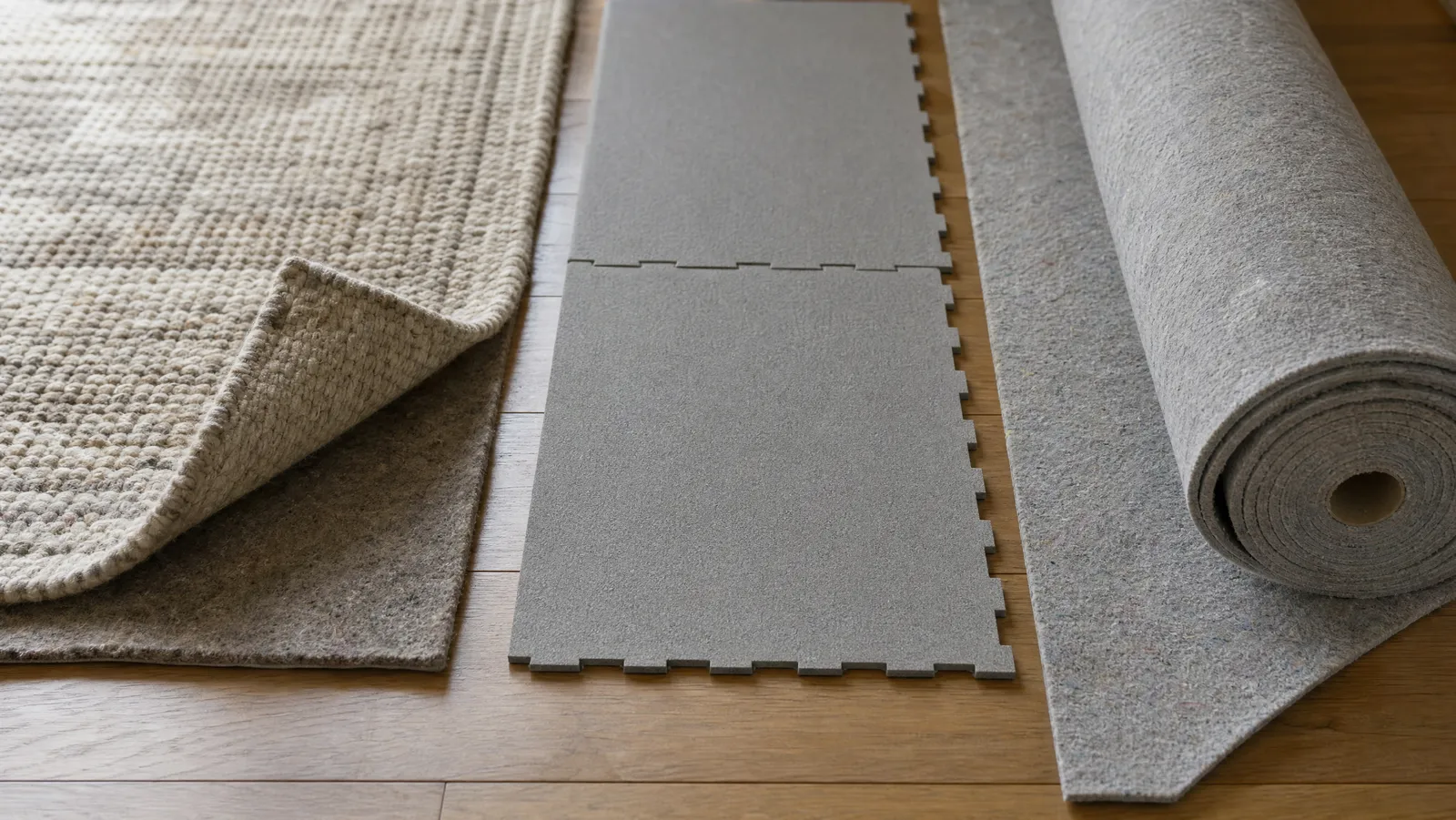
Buy the rug and a dense pad. In the rugs vs mats vs underlayment soundproofing question, a large area rug over a thick felt pad is the right first purchase for almost every renter: it is the cheapest of the three, it is the only one your lease ignores completely, and it is the one with real impact-isolation test data behind it. Mats and underlayment are for specific jobs a rug cannot do.
That is the answer; the rest of this page is the justification. These three get compared as though they were the good, better and best versions of one product. They are not. They are three different jobs. A rug and pad cover the path you actually walk on. A mat covers one small patch of concentrated abuse. Underlayment goes inside the floor assembly. Where each one sits relative to the sole of your shoe decides what it can do - and whether you are allowed to install it at all. For the full order of operations on a rental floor, start with soundproofing your apartment floor and treat this page as the how-do-I-choose chapter.
The one measurement distinction that makes this comparison make sense
Two ratings get printed on floor products, and they answer completely different questions.
NRC tells you what your own room sounds like. According to Wikipedia's entry on the noise reduction coefficient, NRC is a single-number rating intended to describe a material's average sound absorption performance, derived from reverberation-room measurements and reported on a scale from 0.0 for very low absorption to 1.0 for very high, averaged over the 250, 500, 1,000 and 2,000 Hz bands and measured by the reverberation room method in ASTM C423. That same source states plainly that NRC relates to sound absorbed within a room by surfaces and treatments, to dampen echoes and reverberation, and should not be confused with a transmission rating such as STC.
IIC tells you what the neighbour below hears. According to Wikipedia's entry on impact insulation class, IIC is an integer rating of how well a building floor attenuates impact sounds such as footsteps, derived from ASTM method E989, which in turn uses a tapping machine specified in ASTM method E492. A larger number means more attenuation, and like the decibel scale it is logarithmic.
Different quantities, different machines, different rooms. An NRC figure on a box is never evidence that the person downstairs hears less - a sentence that disqualifies most of the marketing in this category. We set the distinction out at length in impact noise and airborne noise are different problems.
There is a second trap. An IIC number describes a whole floor, not a product. The test listens through a complete floor-ceiling assembly, so no sheet of foam, cork or felt "has" an IIC on its own. The honest per-product number is delta IIC, the improvement a layer adds to a reference floor. According to Commercial Acoustics, delta IIC is measured per ASTM E2179: test a bare six-inch concrete reference slab, retest the same slab with the material installed, and the difference between the two IIC results is the delta IIC. According to Intertek, ASTM E2179 measures the effectiveness of floor coverings in reducing impact sound transmission through concrete floors - a bonded layer on a slab, not a loose mat on a wood-framed apartment floor.
One caveat on the rating system itself. According to that same impact insulation class entry, the IIC number comes from sixteen standard frequencies from 100 to 3150 Hz, and real-world footstep noise is also generated below 100 Hz, so the IIC value may not accurately describe the complete noise attenuation profile of a floor. The deepest part of a footfall sits below the bottom of the test.
Rugs vs mats vs underlayment: the comparison table
| What it actually does | Impact noise downstairs | Echo in your room | Rough cost | Lease risk | Install effort | Best for | |
|---|---|---|---|---|---|---|---|
| Rug + dense pad | Soft absorbent surface over a resilient cushion, covering the path you walk on | The best result available to a renter; the mechanism has lab data behind it | Large improvement - carpet plus cushion is a genuine absorber | Rug price plus a pad; the pad is the cheap half | None. Nothing is fixed to anything | An afternoon, two people for a big rug | Almost everyone. The default first purchase |
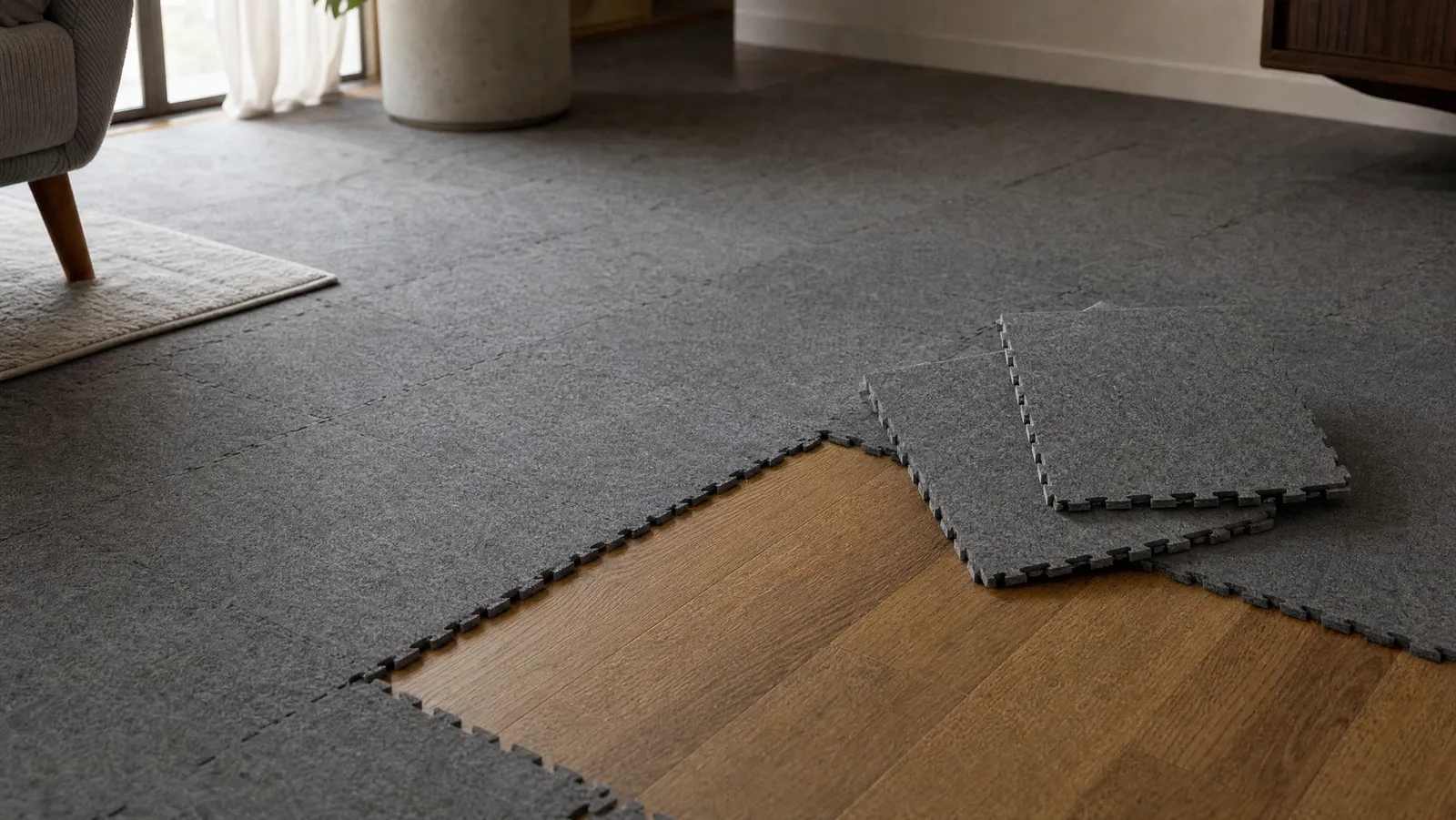
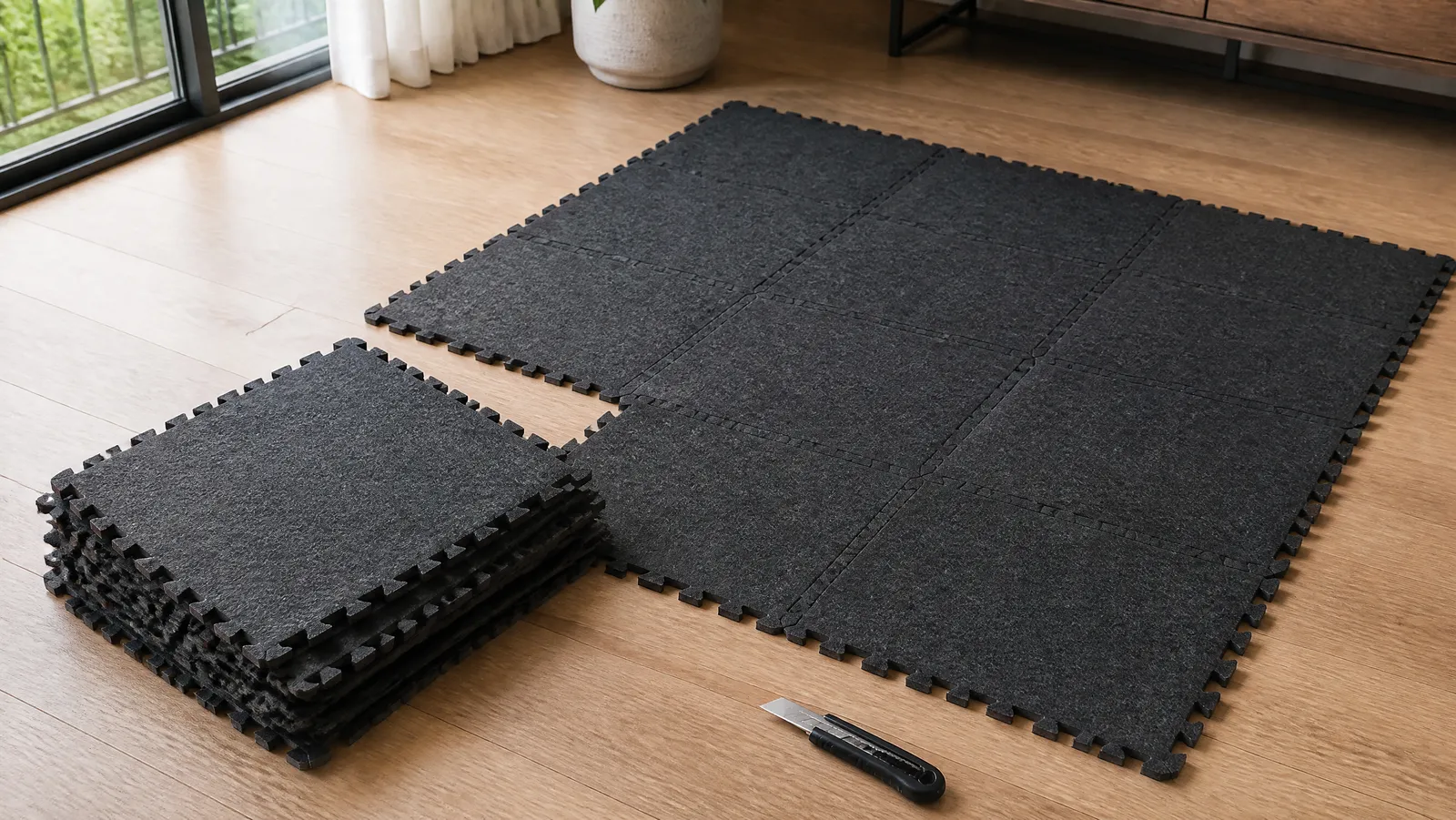
| Acoustic mats / interlocking tiles | Dense, thin, modular tiles you place exactly where the abuse happens | Modest, and mostly on the sharp top end of a footstep rather than the thump | Real but local - a patch of felt is a small absorber | About $2 to $2.50 per sq ft, per our own mat roundup | Very low; removable tape at most | Twenty minutes per zone, cuts with a knife | Desk chairs, treadmills, weights, a washer, a drum kit |
| Acoustic underlayment | A resilient layer inside the floor assembly, under a floating or glued floor | The highest performing of the three, and the only one measured this way as standard | Little on its own - it is buried under a hard surface | $0.30-$0.50 per sq ft for basic foam and about $0.50 for vinyl, per Acoustical Surfaces; $3.40-$5.30 installed | High. You are taking the floor up | A flooring job, not a weekend project | Owners, and renters mid-renovation with written permission |
Read the lease-risk column and the ranking sorts itself out: the best performer is the one you are least likely to be allowed to touch.
Are rugs good for soundproofing? With a dense pad under them, yes
A rug on its own is a mediocre acoustic product. A rug on a thick, dense pad is a two-layer system: an absorbent surface over a resilient cushion, which is the same arrangement every acoustic floor assembly uses.
The numbers here are the best available to a renter, with one caveat we will not bury. In acoustical research sponsored by the Alliance for Flexible Polyurethane Foam and the Carpet Cushion Council and conducted by Intertek Testing Services, reported by FMLink, a bare concrete slab rated IIC 19 improved to 58 with direct-glue carpet, and to 69 when the same carpet was installed over bonded commercial polyurethane carpet cushion. That is industry-funded testing on glued-down commercial carpet over concrete, not an area rug in a rental - but it is the mechanism you are buying, and the cushion did a large share of the work.
The absorption side improves too, which is why your own room gets quieter as well. According to the Carpet and Rug Institute's technical bulletin on the acoustical characteristics of carpet, many of the carpets tested over a 40 oz/sy hair-jute cushion had NRCs from 0.50 to 0.60 - equal, the bulletin says, to many acceptable special absorption materials. In its cushion-type series the same control carpet measured NRC 0.35 on a bare floor against 0.50 to 0.65 over hair and hair-jute cushions, and the bulletin is blunt that permeability is what does it: a sponge rubber cushion bonded to the carpet managed only 0.30, below the bare-floor control. This is the only one of the three that meaningfully improves both numbers at once.
What makes a pad dense enough to matter is mass and thickness, not brand: felt or a felt-rubber composite rather than thin waffle foam, at the thick end of a maker's range - RugPadUSA, for example, tops its felt line out at a half inch. The specific picks live in rug pads that reduce footstep noise.
Where this disappoints: a rug cannot cover a kitchen, a bathroom or an entryway, and those hard-floor zones are often where the loudest footsteps happen. It does nothing for a washing machine on spin, because that vibration enters the building through four small feet rather than through the surface. And the low-frequency part of a footfall - the below-100 Hz energy the IIC test does not even measure - still gets into the joists.
Rug pad vs acoustic mat: mats win on placement, not performance
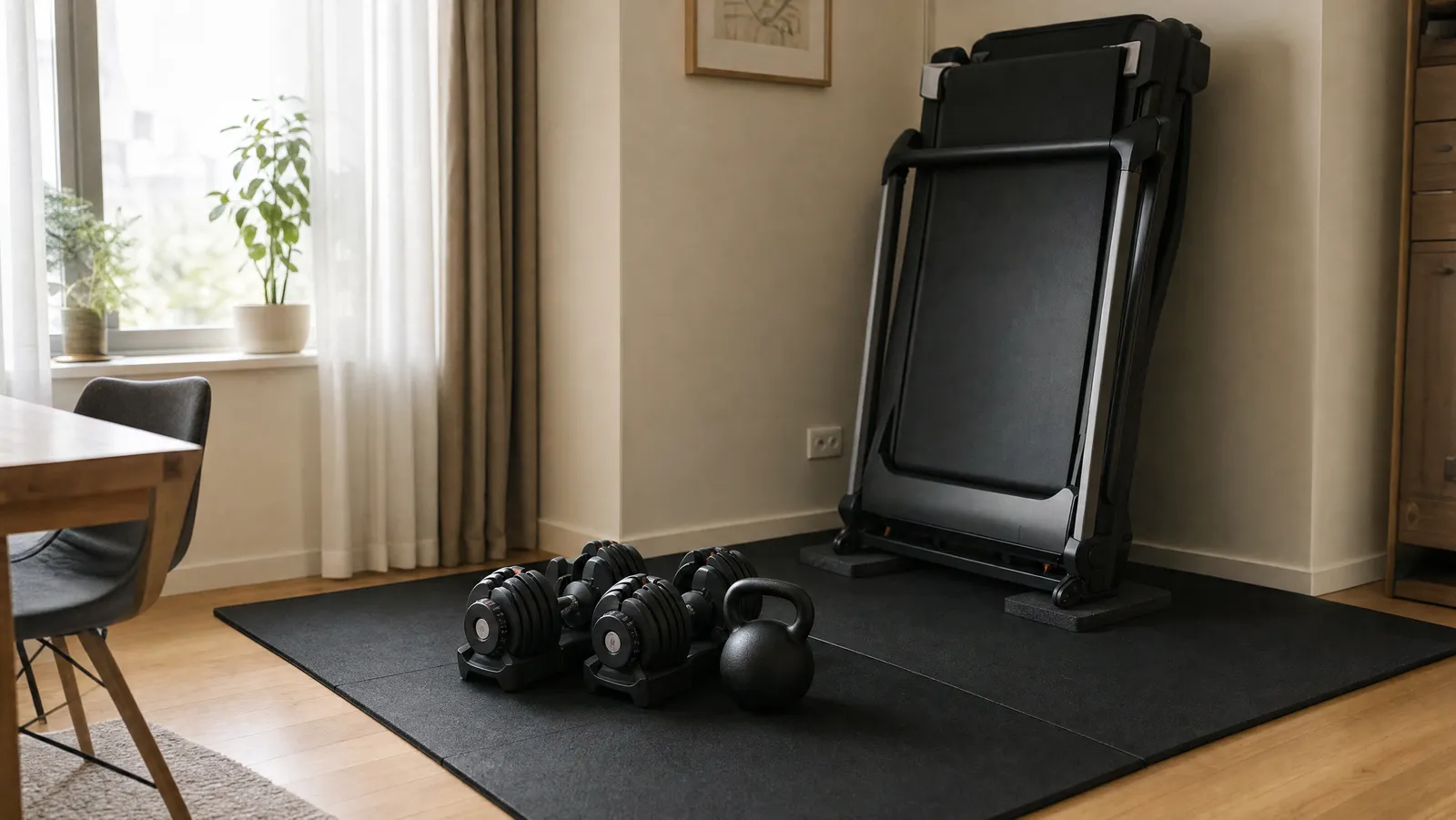
Acoustic floor mats and interlocking tiles are denser and thinner than a rug pad, sold by the tile, and their real advantage is where you can put them. You can drop a dense mat exactly under the desk chair, the treadmill, the weight area or the washing machine without carpeting the flat. A rug cannot do that - a rug is a room-sized commitment in a shape the room dictates.
That is a genuine advantage and we buy them for it. It is just not a performance advantage, and the honest version of the question people actually type - do soundproof floor mats actually work - is that they work at the top of a footstep and not at the bottom of it. A mat softens the contact itself: the heel slap, the chair castor, the clatter. The dull thump travelling down through the structure is largely untouched. Our picks are in the best soundproof floor mats.
Be careful transferring industry delta IIC figures onto taped-down tiles. Commercial Acoustics' delta IIC chart lists a 3 mm recycled fibre or felt mat at delta IIC 16 to 20, which looks like excellent news for felt until you remember what E2179 tests: a bonded layer under a hard floor on a concrete slab. Loose tiles on a wood-frame floor are a different installation, and nobody in the consumer mat category publishes an isolation figure for their own product.
Where this disappoints: coverage and arithmetic. These sets are patches, and by the time you have bought enough tiles to cover a bedroom you are well into rug-and-pad money for a floor of felt squares you still have to lift at move-out. Scale them into the places a rug cannot go and stop there.
Acoustic underlayment: the best performer you probably cannot install
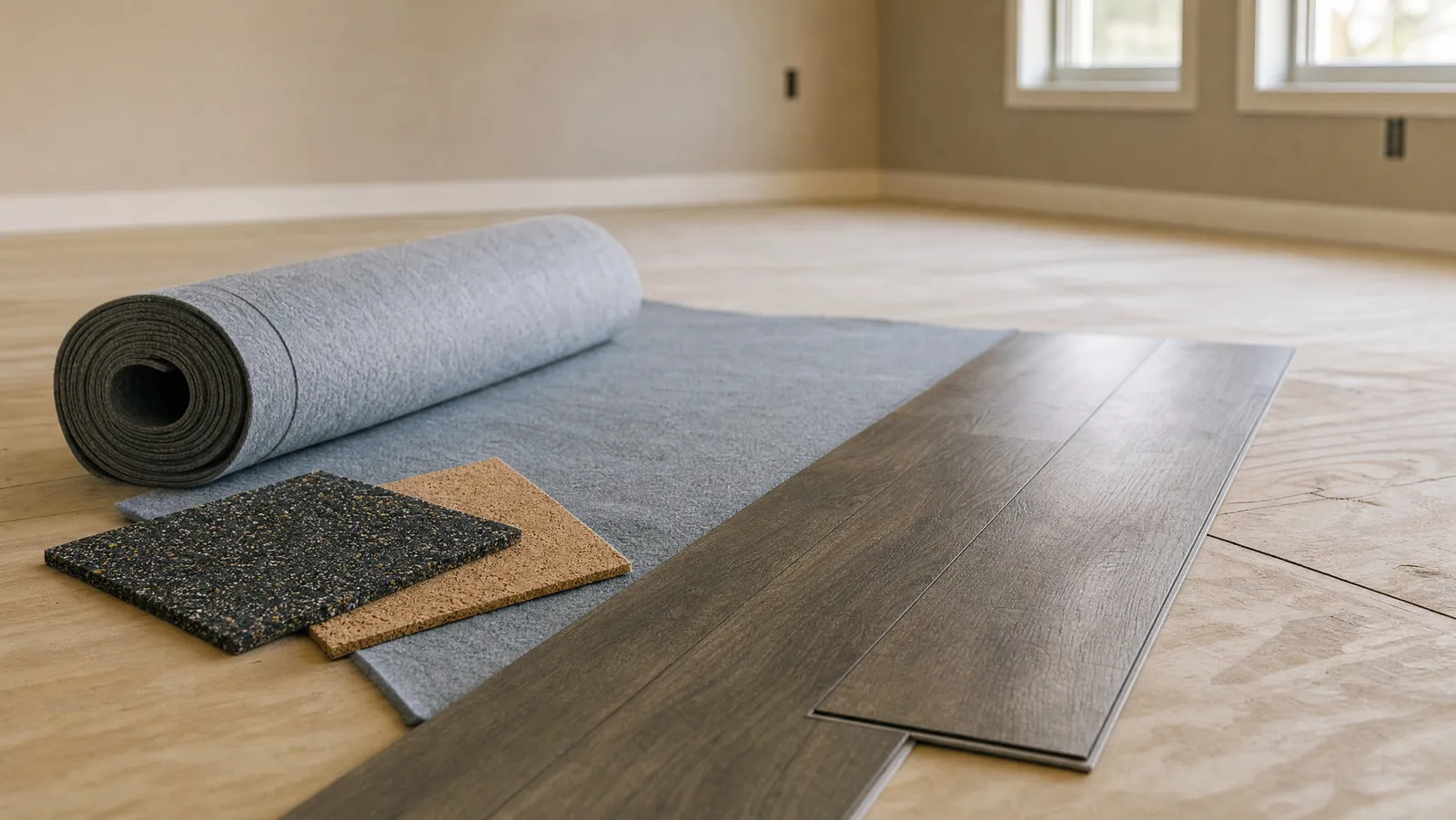
Acoustic underlayment is the highest-performing option of the three, and the reason is structural rather than material. It is the only one that sits inside the floor assembly, bonded under the finished surface, where an impact has to pass through it rather than around it.
The data reflects that. According to Commercial Acoustics' delta IIC chart, 2 mm closed-cell PE foam posts delta IIC 15 to 18, 3 mm natural cork 18 to 21, 5 mm recycled rubber 21 to 25, 10 mm recycled rubber 25 to 29, and engineered sound mats 27 to 32 - with the summary that thickness and density drive most of the difference, that delta IIC 22 to 25 is a strong, well-specified acoustic underlayment, and that 26 and up is premium.
It is also cheap as a material and expensive as a project. According to Acoustical Surfaces' acoustic flooring cost guide, basic foam underlayment runs roughly $0.30 to $0.50 per square foot and some vinyl underlay options around $0.50, with cork put no more precisely than mid-range - but for multifamily remodels the installed underlayment portion often lands in the $3.40 to $5.30 per square foot range, with the rest driven by prep and demolition.
Where this disappoints: it is off the table for most renters, and we would rather say that than rank it first. Installing it means lifting the finished floor - landlord territory, a written-permission conversation, and a cost you do not recover at move-out. It also does little for echo inside your room, because it is buried under a hard surface. If you own the place, or you are mid-renovation with permission in writing, then acoustic floor underlayment is the correct answer and the rug is the finishing touch.
The combinations that are actually worth it
None of these three excludes the others, and two of the stacks are worth real money.
- A dense pad under a rug is already the combination. Do not treat the pad as an accessory. In the Intertek carpet-cushion results above, the cushion accounted for the jump from IIC 58 to 69.
- Mats under the rug, in the traffic strip. If one four-foot path takes twenty crossings a day, dense tiles under that strip of the rug add mass and a second resilient layer exactly where the impacts land - and nobody sees them.
- Underlayment plus a rug, if you are genuinely laying a floor. Underlayment handles the impact path, the rug handles the echo and the top-end clatter. It is the only combination that scores well on both ratings.
What we would not do is tile a whole room, or buy a thin foam pad and expect the rug to carry it.
What none of these three fix
Two problems look like floor problems and are not. Neither of them responds to anything in this comparison.
Airborne sound through the floor. A television, a conversation or a subwoofer downstairs pushes air, that energy loads the floor-ceiling assembly, and it reappears in your unit. That is a transmission-loss problem, measured a different way again. According to AcousPlan's summary of the IBC acoustic requirements, assemblies separating dwelling units must have a sound transmission class of not less than 50 when tested to ASTM E90. The code text itself, as published by UpCodes, separately requires floor-ceiling assemblies between dwelling units to carry an IIC rating of 50 based on laboratory tests to ASTM E492 and E989, or a field impact insulation class of 45 to ASTM E1007. The code treats them as two requirements because they are two different problems - and all three products here are aimed at the second one.
Noise arriving from below. If the sound is coming up, covering your own floor is the wrong side of the assembly - you are treating a surface the sound has already passed. That is a receiving-side problem, and noise coming up from the apartment below is the honest starting point.
Which one should you buy?
- If you are trying to stop your own footsteps reaching the flat below: rug plus a thick felt pad, over the walkway and the main living area. This is the default, and the whole plan is in stop your footsteps bothering the downstairs neighbors.
- If the problem is one machine or one chair: mats in that one zone, and vibration pads under any appliance feet. Do not buy a rug for this.
- If you own the floor, or the floor is already coming up with permission in writing: underlayment first, then a rug on top. You will never have a cheaper chance to fix the assembly.
- If what you hear comes from below, or it is a television rather than footsteps: none of the three. Stop shopping and read the airborne article.
Where we would start
The ranking that matters is not performance, it is performance you are allowed to install. Underlayment wins the lab and loses the lease. Mats win on placement and publish no isolation data. A large rug over a genuinely dense pad is the only one of the three that is cheap, reversible, well-evidenced and good at both jobs at once - and it is what we would buy first, every time.
Get the rug down, put the machines on pads, add tiles only where the rug cannot reach, and judge from there. The full sequence, from working out what you are actually hearing to the fixes that survive a move-out inspection, is in our renter's guide to floor noise.

Lillie Metayer
Lillie Metayer is the founder of a local program that helps apartment-dwellers take action against noise pollution. Involved in environmental activism since high school, Lillie is passionate about raising awareness of the harms of noise exposure and helping people reduce noise in their communities. In her free time, Lillie enjoys playing the violin and spending time outdoors.