Partly. A soundproof floor mat absorbs a little sound inside your own room, and it softens the sharp edge of a footstep in the few square feet where you actually laid it. It will not stop the neighbour below hearing your TV. That is the honest answer to do soundproof floor mats work, and the rest of this page is why.
Three different questions get mashed into that one search, they have three different answers, and they are settled by three different laboratory tests that share no physical quantity. Work out which one is yours and the category stops being mysterious. For the full order of operations on a rental floor, start with how to soundproof an apartment floor and treat this page as the reality check on mats.
Three questions, three different answers
| What you are really asking | Honest answer | What actually measures it |
|---|---|---|
| Does a mat make my own room sound better? | Yes, a little | Sound absorption, rated NRC |
| Does a mat stop the neighbour below hearing my footsteps? | Somewhat, and only where you laid it | Impact isolation, rated IIC and delta IIC |
| Does a mat stop the neighbour below hearing my TV or my voice? | Essentially no | Airborne transmission loss, rated STC |
Question one is the job mats were designed for. A felt or foam tile is porous, so it catches part of the sound already loose in your room instead of reflecting it: hard-floor slap, chair scrape, the flutter echo you hear when you clap in an empty room. Real effect, modest size, entirely inside your four walls.
Question two is what most buyers actually mean. This is impact noise - the energy a heel, a dropped dumbbell or a chair leg injects straight into the structure. A mat does help here, because a resilient layer between a hard shoe and a hard floor cuts how much of that energy gets in. But it sits on top of the floor rather than inside the assembly, so the gain is smaller than the box implies.
Question three is where the answer is no. Voices, television and bass cross a floor as airborne sound, and stopping airborne sound is a mass problem. A few millimetres of soft material adds no meaningful mass.
What a soundproof floor mat physically is
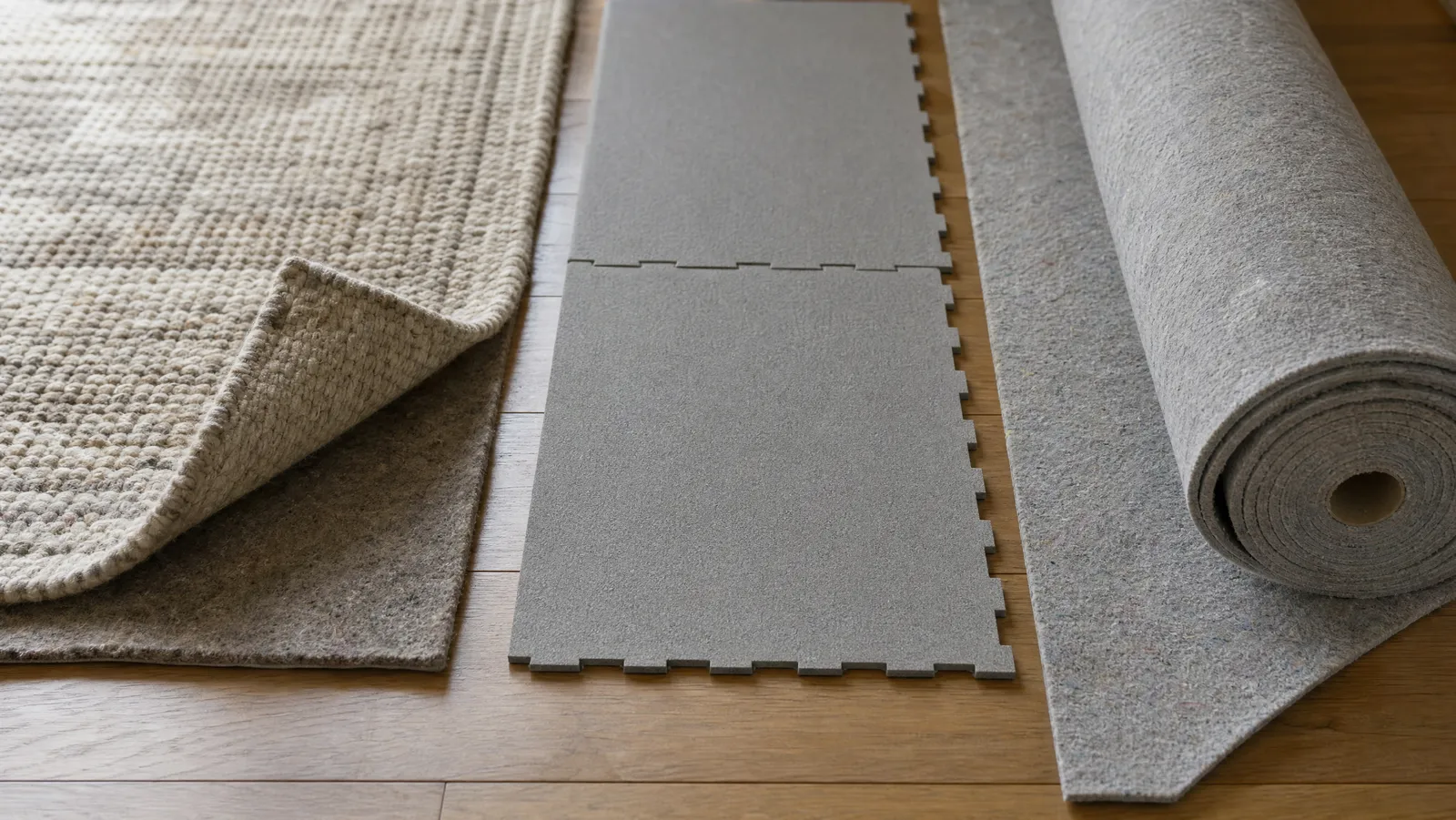
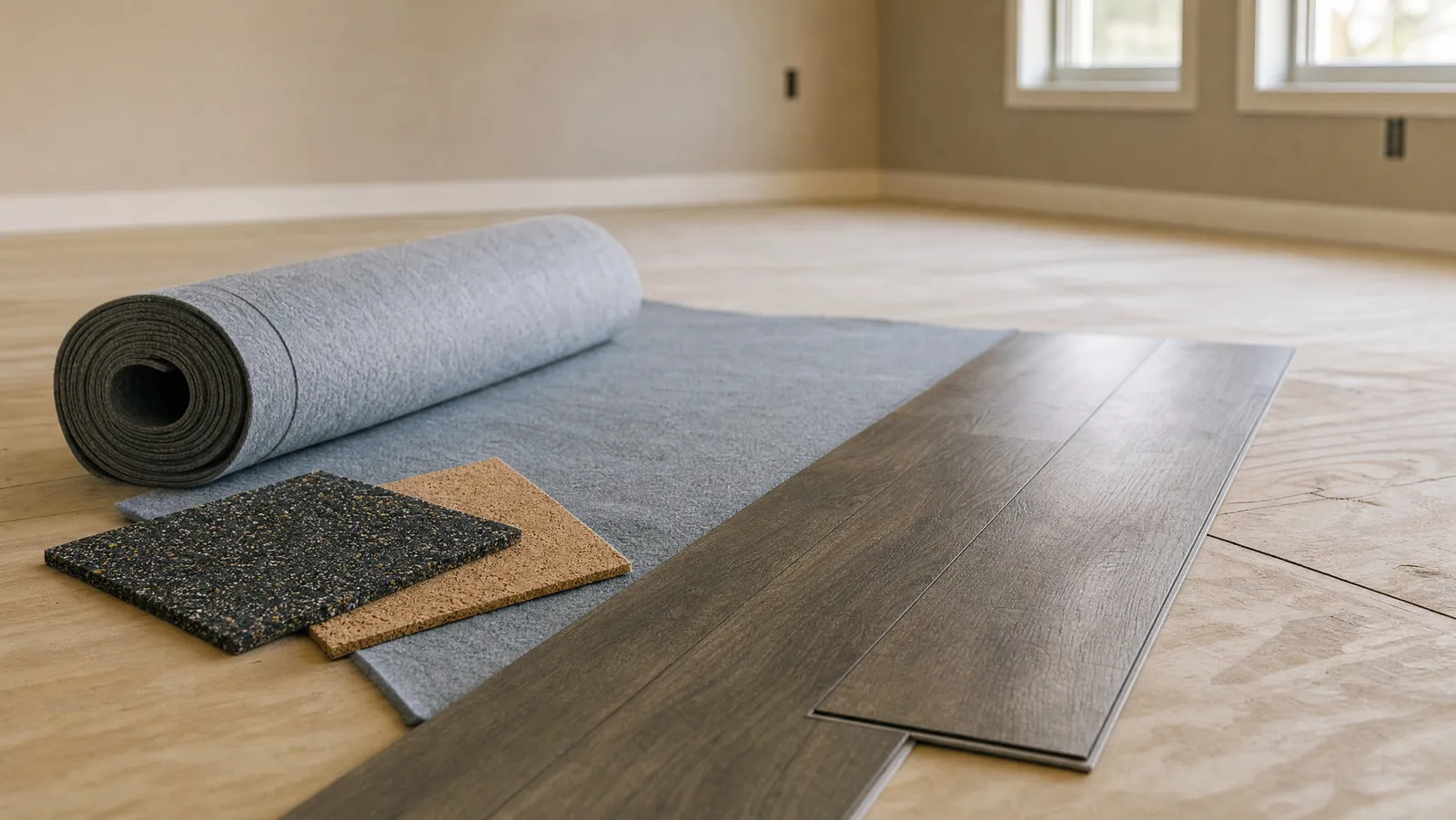
Four materials cover almost everything sold under the name:
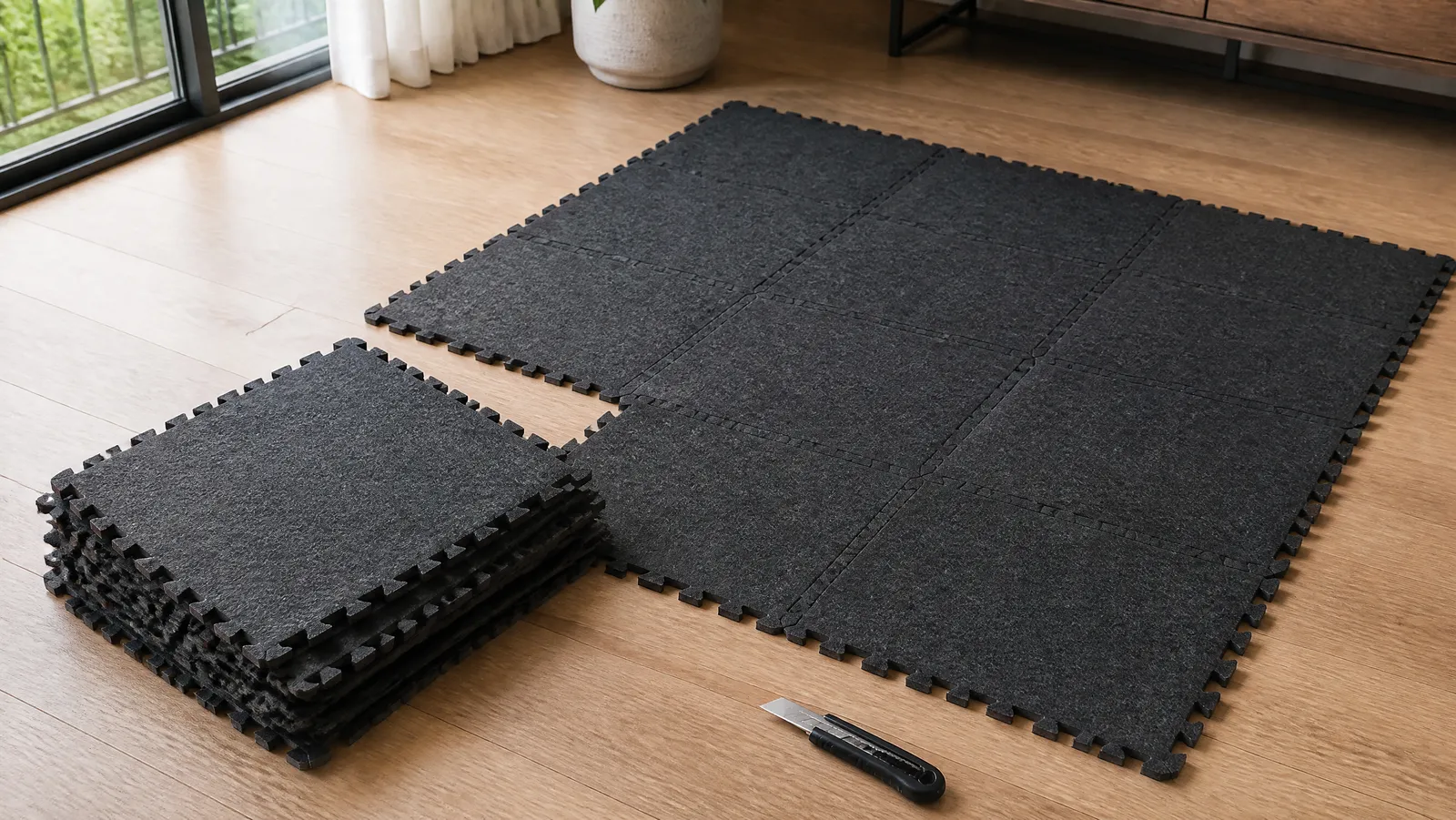
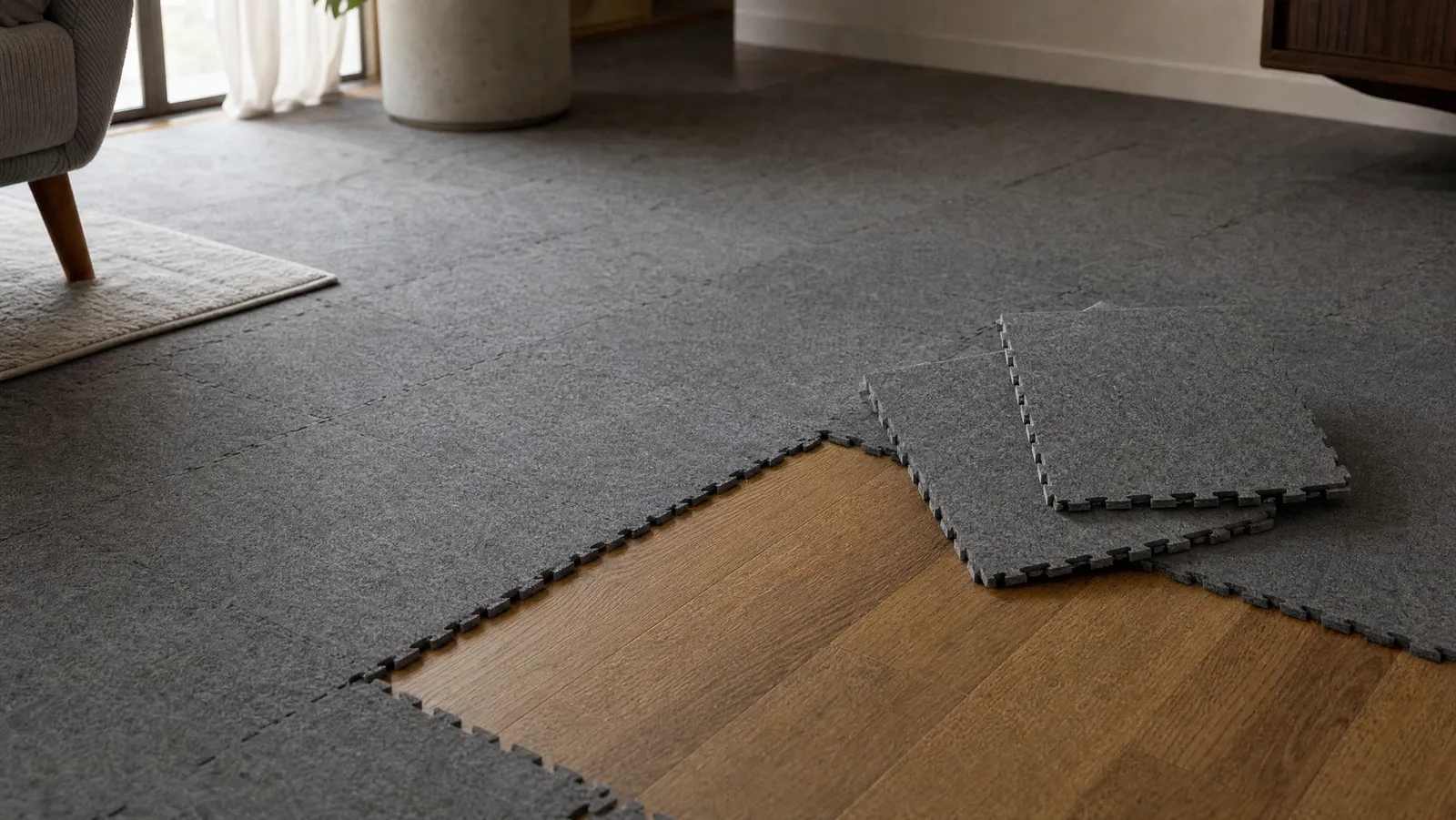
- Polyester fibre felt tiles. Interlocking squares about a foot across and a third of an inch thick, cut with a utility knife, taped down with removable strips. The dominant consumer format.
- EVA foam puzzle tiles. The play-mat and gym-mat material: lighter, springier, cheaper, and the weakest of the four at impact.
- Rubber mats. Crumb rubber, or a rubber and cork composite. Heavy, the best of these at impact, the dearest, and the most awkward to move.
- Rolled acoustic underlayment. Foam or rubber sheet made to go beneath a floating floor. Not a mat, and rarely available to you in a rental.
All of them are renter-safe - nothing nails, glues or touches the subfloor. And most of them were designed for musicians: drum kits, uprights, studio monitors, treadmills. That is the use case they were engineered around, not "the downstairs neighbour complained."
The number on the box measures the wrong thing
NRC is an absorption rating. According to Wikipedia's entry on the noise reduction coefficient, NRC is a single-number rating intended to describe the average sound absorption performance of a material, derived from reverberation-room measurements and reported from 0.0 for very low absorption to 1.0 for very high. The same source explains that it comes from ASTM C423 reverberation-room testing and averages the absorption coefficients at 250, 500, 1,000 and 2,000 Hz to the nearest 0.05. Every measurement in that test happens in one room, with the material and the microphone on the same side.
IIC is an isolation rating, and it is the one your neighbour experiences. According to Wikipedia's entry on impact insulation class, IIC is an integer-number rating of how well a building floor attenuates impact sounds such as footsteps, derived from ASTM E989, which in turn uses a tapping machine specified in ASTM E492. According to Wikipedia's entry on the tapping machine, the standard machine has five hammers in a line, each lifted and dropped in turn for ten impacts per second; and according to Intertek's description of ASTM E492, the resulting sound pressure is measured in the sixteen third-octave bands from 100 to 3150 Hz in a reverberation room below the floor under test.
Put them side by side. One test never leaves the room. The other is defined by a microphone in the apartment downstairs. An NRC figure is never evidence that the neighbour below hears less - not weaker evidence, but a measurement of a different physical quantity. That source is explicit that NRC should not be confused with STC, which is derived from laboratory measurements of airborne sound transmission loss through building elements. The same trap on a wall is why acoustic foam does not block sound either, and the split itself is laid out in impact noise and airborne noise are different problems.
One more term, because it is the honest one. Assembly ratings are not product ratings. An IIC number describes a complete tested floor and ceiling: finish floor, subfloor, joists or slab, cavity, ceiling board. No sheet of felt, foam or rubber has an IIC by itself, so a mat advertised at "IIC 70" is quoting a figure that belongs to a whole building system. The number that does describe one layer is delta IIC: according to Intertek, ASTM E2179 measures how effective floor coverings are at reducing impact sound transmission through concrete floors, comparing a bare concrete reference slab with the same slab once the covering is installed. Delta IIC is the improvement, in points, that the layer added. When a seller will not give you one, the silence is information.
Do soundproof floor mats work on footsteps? Somewhat
Here is where the published numbers land. According to Commercial Acoustics' delta IIC chart for floor underlayments, measured on a standard 6-inch concrete reference slab to ASTM E2179:
| Material | Delta IIC |
|---|---|
| Closed-cell PE foam, 2 mm | 15 to 18 |
| Recycled fibre or felt mat, 3 mm | 16 to 20 |
| Natural cork, 3 mm | 18 to 21 |
| Recycled rubber, 5 mm | 21 to 25 |
| Recycled rubber, 10 mm | 25 to 29 |
That source's summary of the table is the part to remember: thickness and density drive most of the difference, and thicker, denser rubber generally posts the highest values. A rubber mat and a thin foam puzzle tile are not interchangeable, whatever the listings suggest.
The caveats are large. The chart warns that delta IIC is measured only on a standard concrete slab, so it does not predict performance on wood-framed floors or under different finish floors. Those are bonded underlayments beneath a hard floor on concrete, not loose tiles taped on top of a wood-frame apartment floor - we would not transfer the numbers across.
Frequency matters too. According to the impact insulation class entry, the IIC number comes from attenuation values tested at sixteen standard frequencies from 100 to 3150 Hz, and real-world footstep noise is also generated below 100 Hz, so the IIC value may not accurately describe the complete noise attenuation profile of a floor. The low thump that travels furthest through a building is the part a third of an inch of felt is least able to touch. That entry also notes a field-measured FIIC runs typically several points lower than the laboratory IIC, because real buildings have flanking paths laboratories do not.
A mat takes the edge off the click, the slap and the castor rattle. It barely touches the boom.
Why a mat will never stop a television
Blocking airborne sound is a weight problem, and weight is the one thing a mat does not have. The governing rule is the mass law: according to ASA Standards, mass-law sound transmission loss is the phenomenon whereby doubling the mass per unit area of a panel, or doubling the frequency for a given mass per unit area, increases the sound transmission loss by six decibels.
Sit with what that demands. Six decibels costs a doubling of the whole barrier's weight, per square foot. Your barrier is a finish floor, a subfloor, joists or a slab, and the ceiling below. A felt tile weighs a couple of ounces per square foot. Cover every inch of the room and you have not moved that total by more than a percent or two. So if your neighbour hears your TV or your conversations, no mat changes it, and no quantity of mats changes it either.
Where mats genuinely earn their money
Targeted beats wall-to-wall. Treat the places where a lot of force enters the floor through a small contact patch, or where one impact repeats a hundred times a day:
- Under the desk chair. Castors on hardwood are a continuous impact source and the most improvable square metre in most home offices.
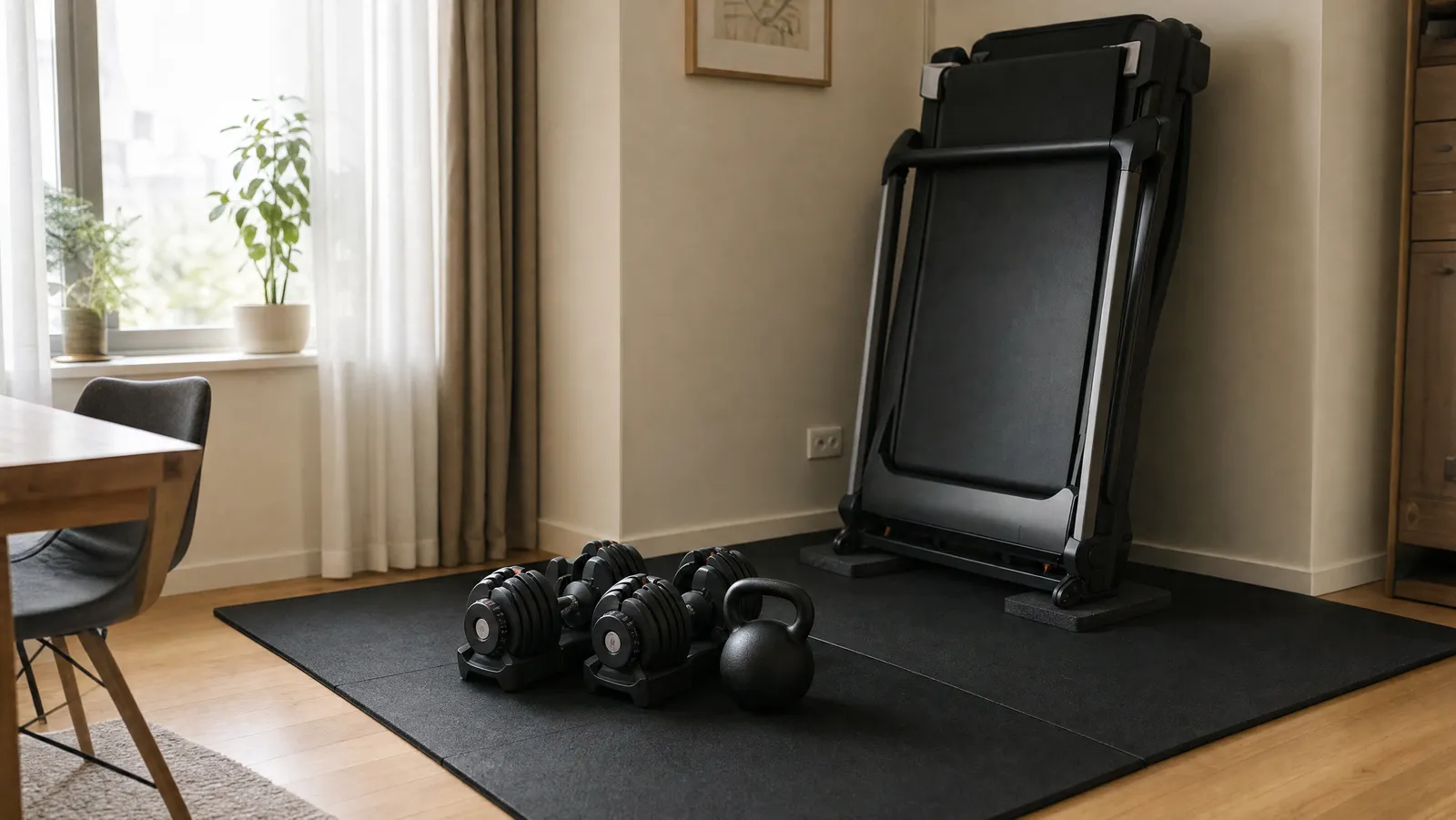
- Under a treadmill, a rower or a weight area. Dropped plates and machine feet are the strongest case for a dense rubber mat that exists, and the reason a quiet home gym in an apartment is built from the floor up rather than from the walls in.
- The walkway. The five steps between bed and bathroom, twenty times a day, is the path the neighbour below has memorised.
- Under the washer, the dryer or a speaker stand. Vibration enters the building through four small hard feet, and isolating pads under those feet do more per dollar than any floor covering.
- Under the kit or the piano. The job the category was designed for.
For which products suit those zones, we went through the category in the best soundproof floor mats. Choose on thickness, density, coverage and price, because nobody at the consumer end of this market publishes a delta IIC.
Where mats disappoint
- Whole-room coverage bought to silence a TV downstairs. Wrong physics, and expensive with it - felt tiles by the dozen reach rug money quickly.
- Thin EVA foam expected to do a rubber mat's job. The delta IIC spread between 2 mm foam and 10 mm rubber above is about ten points, and in our experience the price gap is smaller than the performance gap.
- Anyone trying to fix noise coming up from below. A mat on your floor is on the wrong side of the problem. If the noise is above you, it is a ceiling question, and nothing you lay on your own floor helps.
- Expecting a number nobody published. A listing that quotes NRC and mentions neighbours in one breath is copywriting, not data.
Coverage honesty: sound takes every path
Treating 40 percent of a floor does not get you 40 percent of the way to quiet. Impact energy goes in wherever the floor is still bare. Your heel lands on board on the other 60 percent, and every one of those steps arrives downstairs at full strength. What a neighbour notices is the loudest event, not the average one, so their experience is set by your worst step. Covering the walkway works if you keep to the walkway; covering half a room and walking everywhere gets you closer to nothing than to half.
What to do instead, or as well
Ranked by what it returns for a renter:
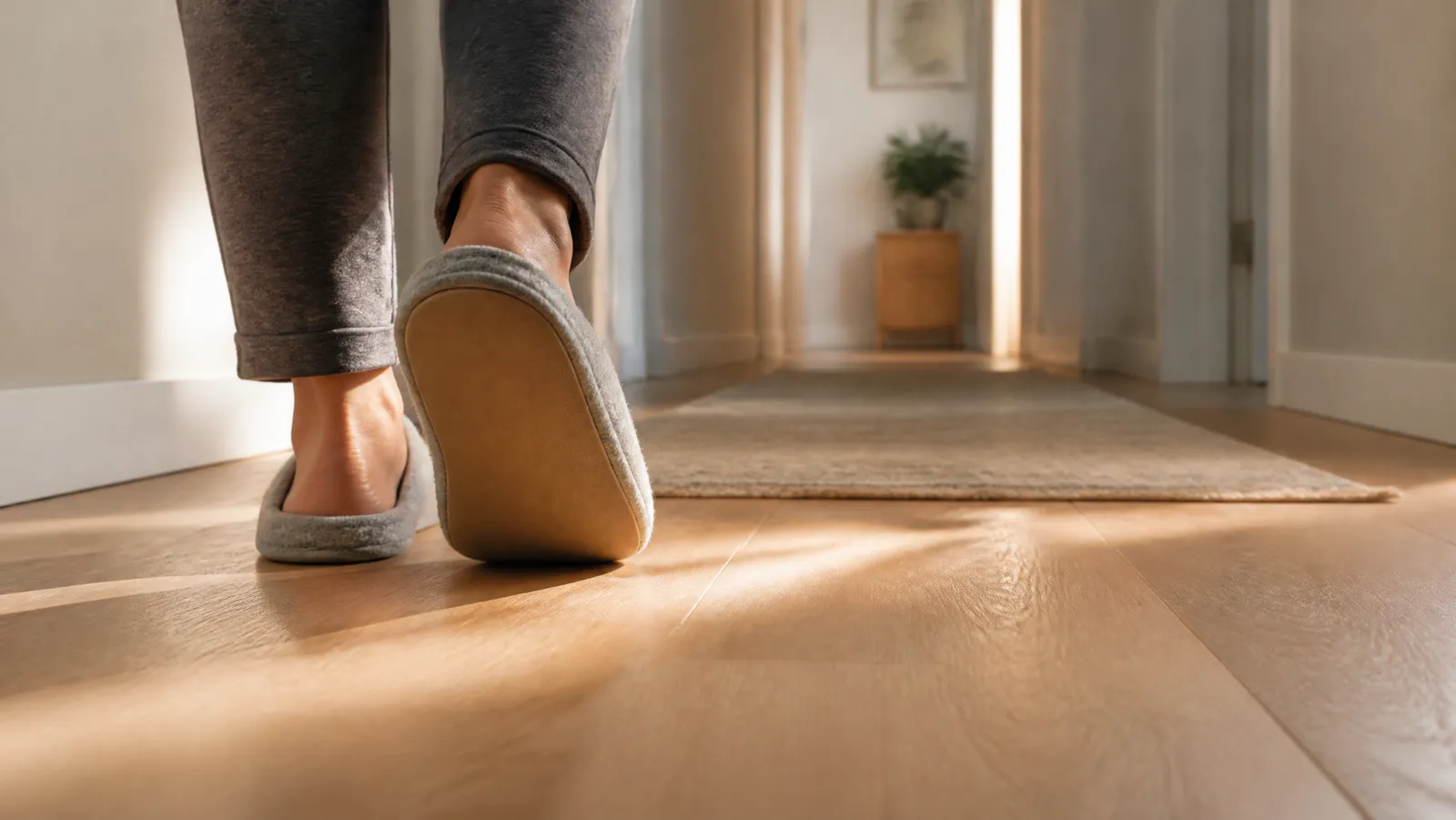
- Change how you move. Slippers indoors, no shoes on hard floors, lift the chair instead of dragging it, keep the treadmill out of the small hours. Free, applies to the whole floor, and it reliably outperforms a taped-down patch of felt. That is the substance of stop your footsteps bothering the downstairs neighbors, and where we would start before spending anything.
- Isolate the machines. Rubber and cork pads under a washer, dryer, treadmill or subwoofer break the four hard contacts where vibration enters the structure directly. The cheapest mechanism-correct fix in the category.
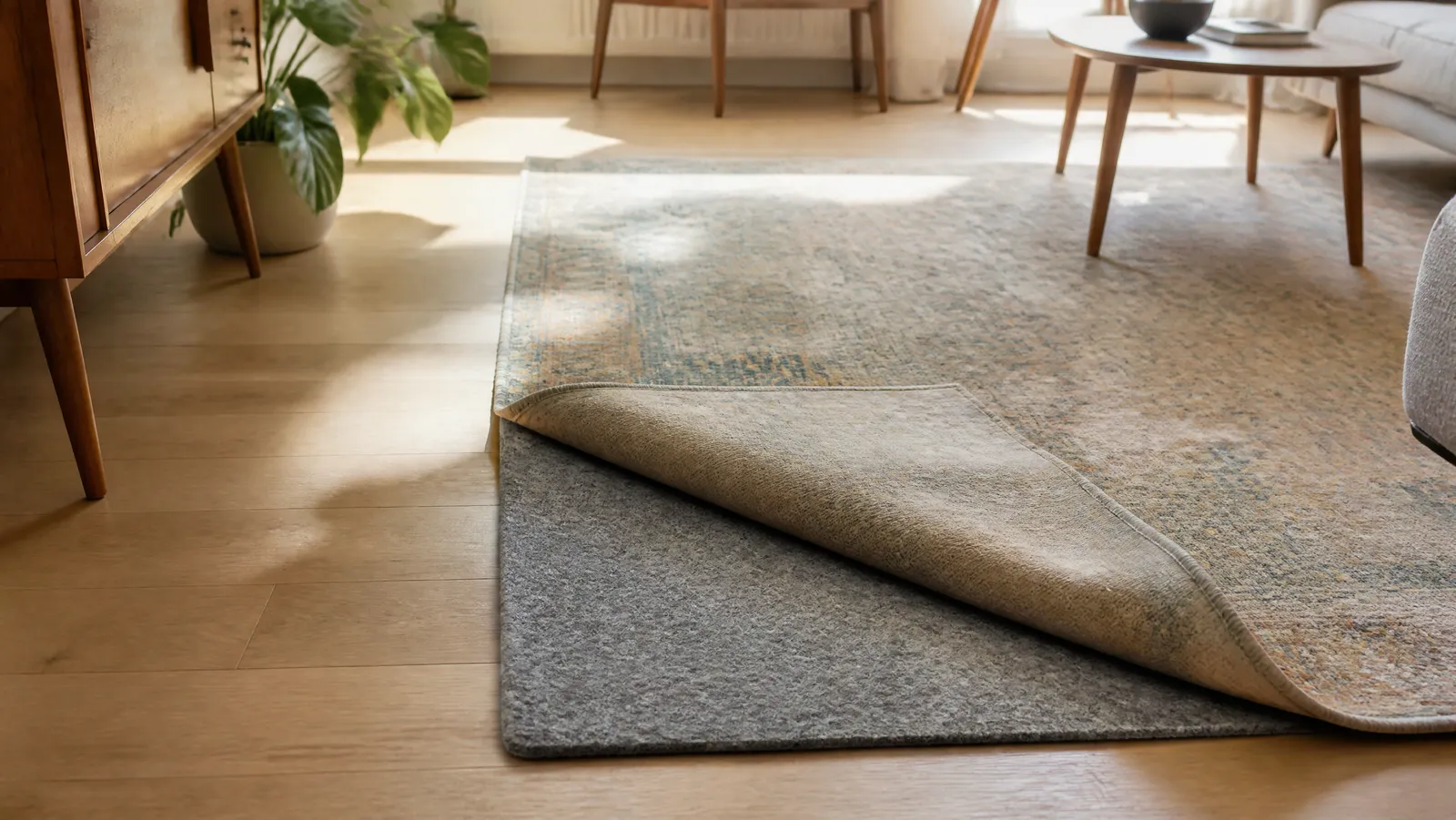
- Buy the rug and a dense pad before you buy more mats. This is the step with real measurement behind it. In acoustical research sponsored by the Alliance for Flexible Polyurethane Foam and the Carpet Cushion Council and conducted by Intertek Testing Services, as reported by FMLink, a bare concrete slab rated IIC 19 improved to 58 with direct-glue carpet, and to 69 when the same carpet was installed over a bonded commercial polyurethane cushion. The same test put the carpet alone at approximately NRC 0.25, rising to 0.55 with the cushion. Two caveats we will not bury: it is industry-funded testing, and it describes glued-down commercial carpet on concrete, not an area rug in a rental. The mechanism is still the one you want, and rug pads that reduce footstep noise is the renter-sized version of it.
- Then use mats where a rug cannot go. Under the machine, under the kit, in the entryway, under the chair.
For scale on what quiet would even require: according to the International Building Code's sound-transmission provisions (sections 1206.2 and 1206.3), floor and ceiling assemblies between dwelling units must reach an STC of not less than 50 and an impact insulation class of not less than 50 when tested in the laboratory to ASTM E492 - or not less than 45 if field tested to ASTM E1007. That is a model code for new construction, adopted and amended state by state, so treat it as a benchmark rather than a promise about your building. Those are numbers for complete assemblies, and no surface-laid mat moves a floor from one band into another.
The verdict
Do soundproof floor mats work? Partly, one zone at a time, for one of the three things people buy them for.
- For echo in your own room: yes, modestly. That is what NRC measures and what the product was built to do.
- For footsteps reaching the neighbour below, on the patch you covered: somewhat. Denser and thicker is genuinely better, and rubber beats felt beats thin foam.
- For a TV, music, voices or bass through the floor: no. Not at any coverage, not in any quantity.
Buy one small set, put it under the chair, the treadmill or the walkway, and judge it on that alone. Do not tile a bedroom hoping it becomes a different floor. And if the person below you is still unhappy, the things that move the needle are how you move, a rug over a dense pad, and pads under the machines - in that order, which is how we lay out the whole sequence in our apartment floor guide.

Lillie Metayer
Lillie Metayer is the founder of a local program that helps apartment-dwellers take action against noise pollution. Involved in environmental activism since high school, Lillie is passionate about raising awareness of the harms of noise exposure and helping people reduce noise in their communities. In her free time, Lillie enjoys playing the violin and spending time outdoors.