Let's be honest, because the marketing won't be. The honest answer to does soundproofing paint work is: barely, and only for the mildest problems. A thick acoustic coating can shave a sliver off faint, high-pitched noise and slightly deaden echo inside the room you paint. Against a loud TV, a subwoofer, or footsteps overhead, it does essentially nothing. Treat it as a minor bonus, never a real fix.
If you found this page hoping a can of paint would silence a noisy neighbor, we're going to save you the money. The reason soundproof paint disappoints comes down to the one idea this whole site is built on: there's a difference between absorbing sound (softening echo inside a room) and blocking it (stopping noise from crossing a wall). Paint is an absorber, and a weak one. If your real goal is a quieter shared wall, start with how to soundproof apartment walls and treat this article as the "why paint isn't the shortcut" companion.
What Soundproof Paint Actually Is
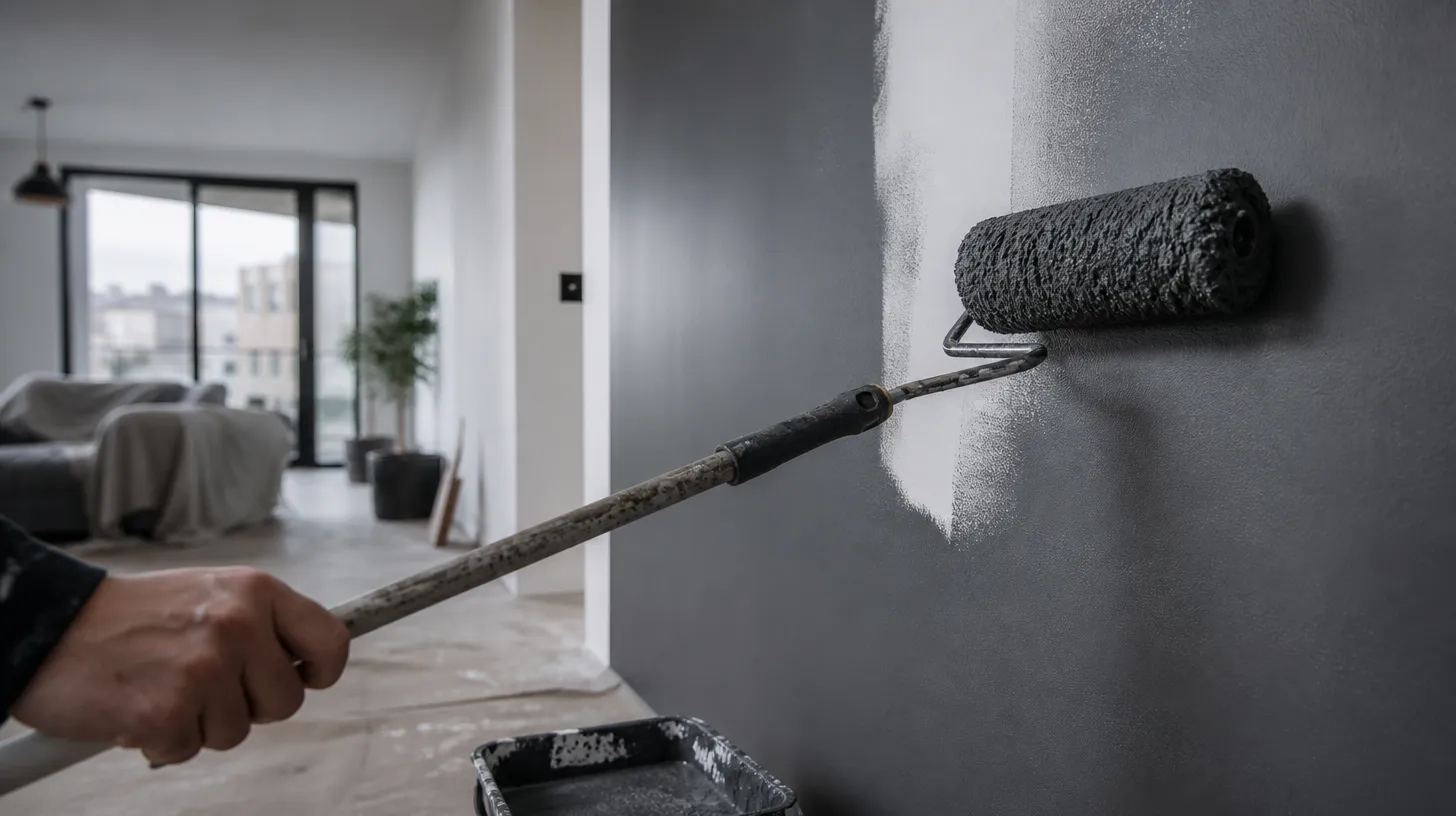
Soundproof paint isn't really paint in the ordinary sense, and it definitely isn't a soundproofing material. It's a thick, water-based coating loaded with sound-dampening fillers, often ceramic microspheres and latex-like compounds, that you roll onto a wall like any other paint, just in heavier coats. Once it dries, it forms a soft, slightly spongy film a fraction of a millimeter thick.
That film works by damping and absorption, not by acting as a barrier. It converts a small amount of vibrating sound energy into heat inside the coating, which can trim some high-frequency reflections in the room. According to Acoustical Solutions, soundproof paint absorbs sound to reduce echo and reverberation rather than blocking sound from passing between rooms. In other words, acoustic paint lives on the absorbing side of the ledger, not the blocking side, and that single fact predicts almost everything it can and can't do. A barrier stops sound; a soft coating just takes a faint edge off it.
What the Numbers Really Say
So how much does it actually do? Less than the label implies, but not quite zero. Here are the figures that get quoted, with the honest caveats attached.
Two to four decibels per coat. According to Soundproof Guide, a single coat of soundproof paint may cut noise by roughly 2 to 4 dB, and three coats might stack up to a 6 to 12 dB reduction. That sounds meaningful until you remember how loudness is perceived: a drop of about 10 dB is heard as only half as loud, a well-established rule of loudness perception. So even a best-case, three-coat job is a modest change, and only under favorable conditions.
A 3 to 7 point STC bump, at best. STC (Sound Transmission Class) is the scorecard for blocking. A standard interior wall, two sheets of half-inch drywall on wood studs with an empty cavity, rates only about STC 33, and according to Commercial Acoustics normal speech is clearly audible through it. The maker of one well-known product, Coat of Silence, claims its coating can raise a wall's STC by 3 to 7 points depending on construction, per Acoustical Surfaces. Take that as a manufacturer's best case. Even if you got the full seven, you'd move from STC 33 to 40, still short of the roughly STC 45 that Commercial Acoustics says is needed before normal conversation becomes inaudible in the next room.
Middle and high frequencies only. Every honest source agrees the effect is limited to higher-pitched sound. Some sellers claim a coat can soak up a share of the mid-range waves between about 500 and 2,000 Hz, the whisper-to-conversation band, but that's absorption happening inside the painted room, not transmission stopped through the wall, and it does little for the low end.
Where It Might Help a Little
There is a narrow slice of real life where a thick coating earns a sliver of its price. If your problem is faint, high-pitched background noise, a bit of hallway chatter bleeding through, or a slightly echoey home office that sounds harsh on calls, a heavy coat can take a small edge off. Because the film absorbs some mid- and high-frequency energy, a densely painted room can sound marginally softer and less live than a bare one.
Keep the expectation microscopic. As a rule of thumb, soundproof paint won't hold back noise much louder than about 60 dB, roughly the level of a normal conversation, so anything with real volume walks right past it. What you're buying is a faint improvement to an already-quiet situation, not silence. If a room already sounds fine and you just want to shave a hair of harshness off it, sound-dampening paint is a low-effort, low-reward option. If a neighbor is actually keeping you awake, it isn't the answer.
Where It Definitely Won't Help
Now the part the ads gloss over. Soundproof paint does essentially nothing against the noises renters actually complain about: a loud TV through the wall, a subwoofer's bass, music with a beat, or footsteps and thumps from upstairs. Those sounds are either low-frequency, simply loud, or both, and paint fails on every count.
The reason is the mass law. According to Aural Exchange, a barrier's transmission loss rises by about 6 dB every time you double its mass per unit area, so blocking sound is fundamentally about weight. A coat of paint adds almost no mass, which is why it adds almost no blocking. And it fails worst exactly where you need it most: as ScienceDirect's overview of the mass law notes, mass is least effective at low frequencies, where stiffness and resonance take over, so bass is the hardest sound of all to stop, and a paper-thin film has no chance against it.
This is the same overselling that surrounds acoustic foam, another absorber marketed as if it were a blocker. If you've read does acoustic foam block sound, you already know the pattern: a lightweight, soft product that softens echo inside a room gets sold as a barrier it can never be. Paint is the paint-can version of that same mistake.
Contrast paint with something that actually adds weight. A dense, limp barrier like mass loaded vinyl on a wall can weigh on the order of a pound per square foot, enough to meaningfully raise transmission loss the way the mass law predicts. A film of paint weighs almost nothing per square foot by comparison. That weight gap is the entire story of why one blocks sound and the other doesn't.
The Renter Catch
Here's the twist that makes soundproof paint a bad deal specifically for renters. It behaves like a semi-permanent wall change. It goes on thick, in multiple heavy coats, often in a limited range of colors, and it's harder to cover than ordinary paint if you ever want to change it. On move-out, a landlord who wants the original finish back may expect you to prime and repaint, or quietly take it out of your deposit.
So you'd be taking on a permanent-ish modification, plus real labor and cost, in exchange for a benefit you can barely measure on a meter. Compare that with genuinely renter-friendly fixes that come down cleanly and follow you to the next apartment. When the trade is "change the wall for good in return for a 2-to-4-dB maybe," the math rarely works for someone who doesn't own the place.
Spend Your Money Here Instead
If you've got a budget you were about to sink into paint, here's where the same dollars do far more. The order of operations for a quieter wall is always the same: seal the gaps first, then add real mass.
Seal the leaks. Sound pours through the small openings a coating can't fix, gaps around outlet boxes, the seam where the wall meets the floor, and the edges of a shared wall. A bead of acoustic caulk on those paths is cheap and often does more than any surface treatment, because a wall is only as quiet as its worst leak.
Add soft mass, not a coat of film. This is where weight earns its keep. According to Commercial Acoustics, adding mineral-wool insulation inside a standard wall can lift it from STC 33 to roughly 37 to 39, and each added layer of five-eighths-inch drywall is worth about another 3 to 5 STC points, real gains a thin coating simply can't touch. Renters who can't open a wall can lean on removable dense barriers and heavy soft furnishings for the same reason: they add mass.
For the full menu ranked by cost and effort, see the cheapest ways to soundproof a wall, which puts your money where it will actually move the needle.
The Bottom Line
Soundproof paint isn't quite a scam, it's just badly named. It's an absorber that trims a little high-frequency echo and, in the best case, nudges a wall's STC up a few points. For faint, high-pitched noise, that's a minor bonus. For the loud TV, the bass, and the footsteps that drive renters up the wall, it does essentially nothing, because stopping those takes mass and an airtight seal, and a film of paint has neither.
Put the money toward the things that genuinely block: seal the gaps, add soft mass, and manage expectations. When you're ready to do it properly, our complete guide to soundproofing your apartment walls walks through the methods that actually move the needle, none of which come in a can.

Lillie Metayer
Lillie Metayer is the founder of a local program that helps apartment-dwellers take action against noise pollution. Involved in environmental activism since high school, Lillie is passionate about raising awareness of the harms of noise exposure and helping people reduce noise in their communities. In her free time, Lillie enjoys playing the violin and spending time outdoors.