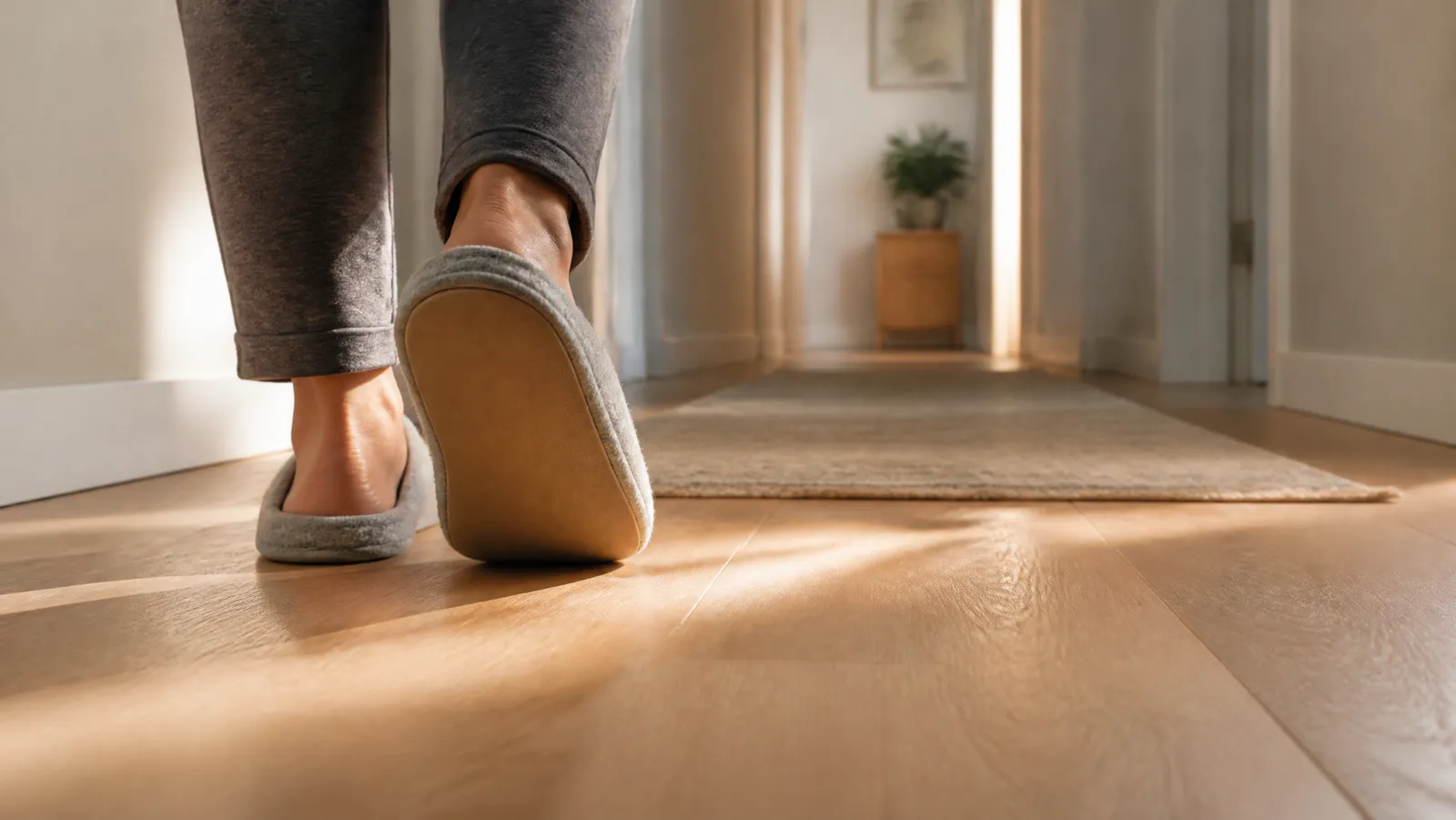
Take your shoes off indoors, put felt pads under every chair and table leg, and lay a rug with a dense pad along the route you walk most. That is the honest short answer to how to stop footsteps bothering downstairs neighbors, and the first of those three costs nothing at all while the second costs a few dollars.
Now the part that should make you feel better, because you are probably reading this after an awkward hallway conversation or a note under the door. Your footsteps are loud downstairs because of how your building was assembled, not because you stomp. Ordinary walking, in socks, at a normal pace, is audible through a great many apartment floors. That is a construction fact, not a character flaw. Below is what a renter can actually change, in order of how much it buys you. If you want the whole sequence including the parts a landlord would have to approve, that lives in our guide to soundproofing an apartment floor.
Why footsteps carry: your floor is the top of someone's drum
When your heel lands, almost none of that energy travels as sound through the air of your apartment and pushes down through their ceiling. The energy goes straight into the structure. The joists carry it sideways and down, their ceiling is screwed to those joists, and the whole ceiling plane below you vibrates and radiates into their room like a badly designed speaker cone.
According to the acoustics consultancy BKL, "footstep or impact noise is generated by the striking of a hard object (the shoe, the dragged chair, the dropped book, etc) on a hard surface." Notice what is missing from that sentence: any mention of how hard you tread. It is about hardness meeting hardness.
Two things make it worse than you would expect.
- Lightweight framing is the bad case. BKL describes wood-frame construction as having a floor system that "is less massive and stiff," so "the impact from the footstep tends to cause the floor to deflect and produces a low frequency 'thump', even when quality carpet and underlay is used." Concrete does better — BKL says that in concrete buildings with carpet, "footstep impacts are generally attenuated adequately for most occupants" — but concrete still carries energy sideways into walls and columns, so a neighbor can hear you along a path that has nothing to do with the slab directly above their head.
- It gets bassier on the way down. Soundproofist puts it plainly: "a noise that doesn't sound very loud in your own home can get louder (with more bass) as it travels through the building structure," and calls the whole situation "a by-product of the construction methods in most wood-framed structures."
That is why this feels unfair from your side of the ceiling. You hear a soft tap. They hear a thump with low end in it. For the physics in full, impact noise and airborne noise are different problems, and it is genuinely worth reading their side of it in why upstairs neighbours sound so loud before the next conversation.
Absorption is not isolation: what NRC and IIC actually measure
This is the most expensive misunderstanding in apartment soundproofing, and it takes ninety seconds to fix.
NRC — Noise Reduction Coefficient — measures absorption. Per Intertek's description of ASTM C423, the standard "covers the measurement of the sound absorptive properties of a product in a reverberation room," and NRC is "the average of the absorption coefficients at 250, 500, 1000 and 2000 hertz, rounded to the nearest multiple .05." Absorption describes what happens to sound inside one room: echo, reverberation, the boxy ring of an empty apartment. It is a room-comfort number.
IIC — Impact Insulation Class — measures isolation between floors. According to Commercial Acoustics, IIC "rates how well a floor-ceiling assembly blocks impact noise — footsteps, dropped objects, dragged chairs — from passing into the space below," tested under ASTM E492 in the lab and ASTM E1007 in the field. The test is as literal as it sounds. Under ASTM E492 a standard tapping machine drops five 500 g steel hammers from 40 mm — about 4 cm — onto the floor at ten impacts per second, and the transmitted sound is measured in the room below. Wikipedia's summary notes the rating is derived from sixteen standard third-octave frequencies from 100 to 3150 Hz.
Different physical quantity, different test, different room. A product with a great NRC has told you nothing about whether the person below you will hear your feet. Hold onto that, because it disqualifies a large share of the advice you will find on this topic.
For scale on the IIC side: Commercial Acoustics puts code minimum at IIC 50 and says most professionals target 55 to 60. BKL sets the bar for actual human satisfaction far higher, reporting that "IIC ratings of over 70 are generally required for most occupants below to find the impact noise isolation acceptable," with ratings under 60 "often rated as Unacceptable." Your floor was built to the code number, not the satisfaction number. That gap is the argument you are living inside.
The free fixes first, because they are the biggest single win
These cost nothing or next to nothing, they work immediately, and no purchase replaces them. Do them this week.
Shoes off, properly off. BKL's own list of what residents can do starts with "the removal of hard soled shoes or boots in favour of slippers or stocking feet." A hard sole on a hard floor is precisely the collision the entire problem is made of. This change is free, it takes effect immediately, and it is among the largest levers you have.
Then wear soft-soled house shoes, not hard ones. A slipper with a molded rubber or thick EVA sole behaves more like a shoe than most people assume. You want felt, wool or a soft flexible foam — something that deforms on contact instead of handing the whole impulse to the floor.
Fix the heel strike. Soundproofist notes that "pounding heels can sound like a marching band when you hear it from your apartment," and that soft open-backed slippers help partly because in them "it's nearly impossible to walk with your heel bones first." Indoors, land closer to the ball of the foot and roll back onto the heel instead of dropping heel-first. It feels deliberate for about two days and then it is just how you walk.
Slow down on the main routes. Speed is force. Crossing the apartment at a jog at 7am is a different noise event from walking it, even in the same socks.
Watch the two habits nobody counts as noise: landing on the floor after a jump, and setting something heavy down rather than placing it. BKL lists "control of heavy impacts resulting from rapid movement through the unit or from dragged or dropped furniture" in the same breath as footwear, which tells you how much of the complaint is not walking at all.
Furniture and casters are often louder than your feet
Here is the part most people miss entirely. The loudest repeated noise in an apartment is frequently not a person walking. It is a desk chair rolling across a hard floor, a dining chair dragged back from the table, or a bed frame that shifts when someone sits down.
The fix list is short, cheap and entirely renter-safe:
- Felt pads under every leg that touches the floor — dining chairs, sofa, side tables, bed frame. Buy thick felt, not the thin stick-on discs that peel off within a month. Check them seasonally; they collect grit and fall off without you noticing.
- Caster cups or a mat under the desk chair. A hard caster on a hard floor is a rolling, continuous impact source. A dense mat under the chair stops it, and swapping hard casters for soft rubber ones does the same job permanently.
- Lift, do not drag. Dragging a chair leg is a long, loud, structure-borne event at exactly the frequencies that travel best.
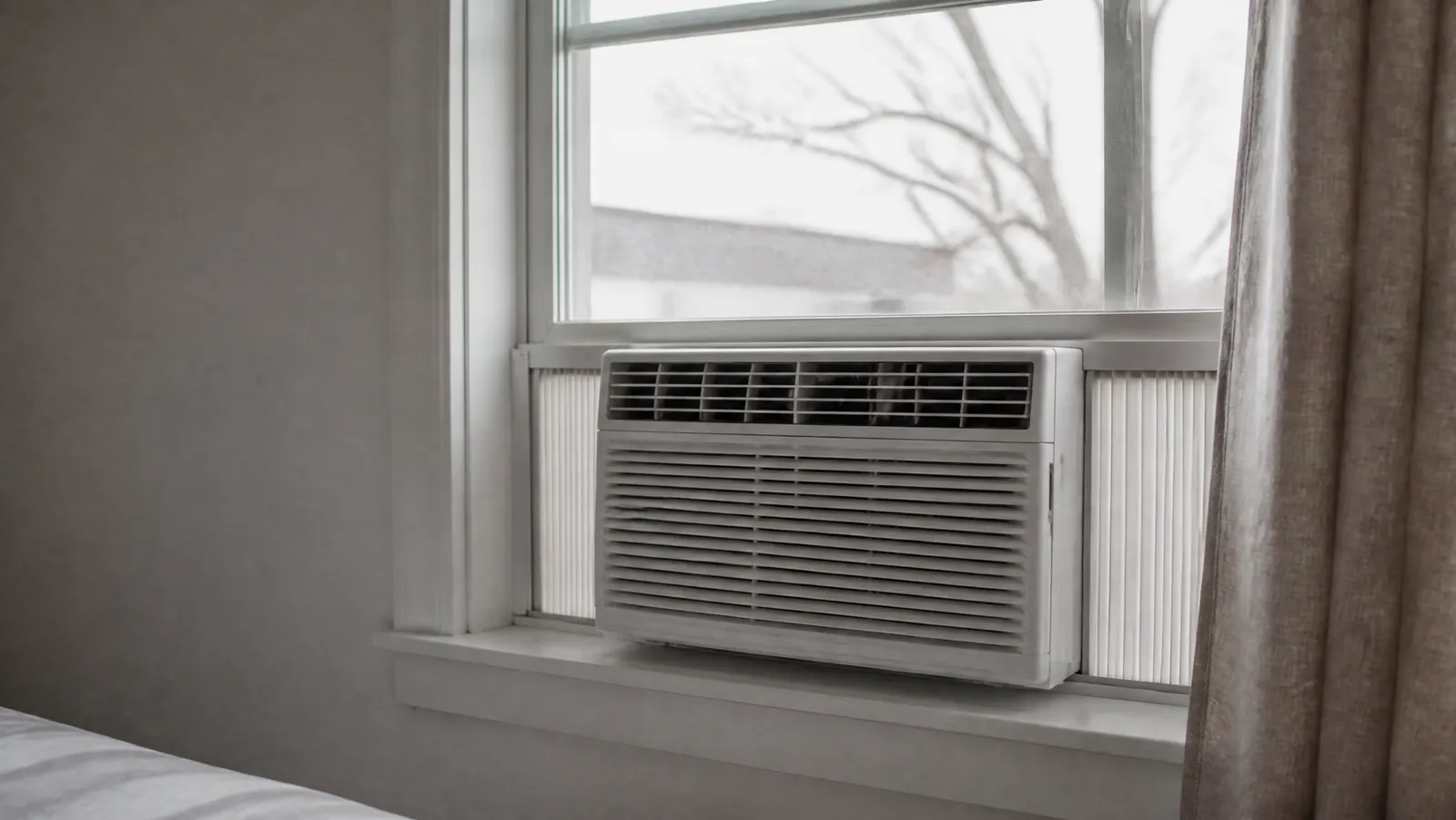
- Decouple anything with a motor sitting on the floor — a floor fan, air purifier, humidifier, portable AC. It vibrates into the structure continuously, and a scrap of dense foam or rubber underneath it breaks that path.
None of this needs permission, and none of it is visible at move-out.
Put soft covering where you actually walk
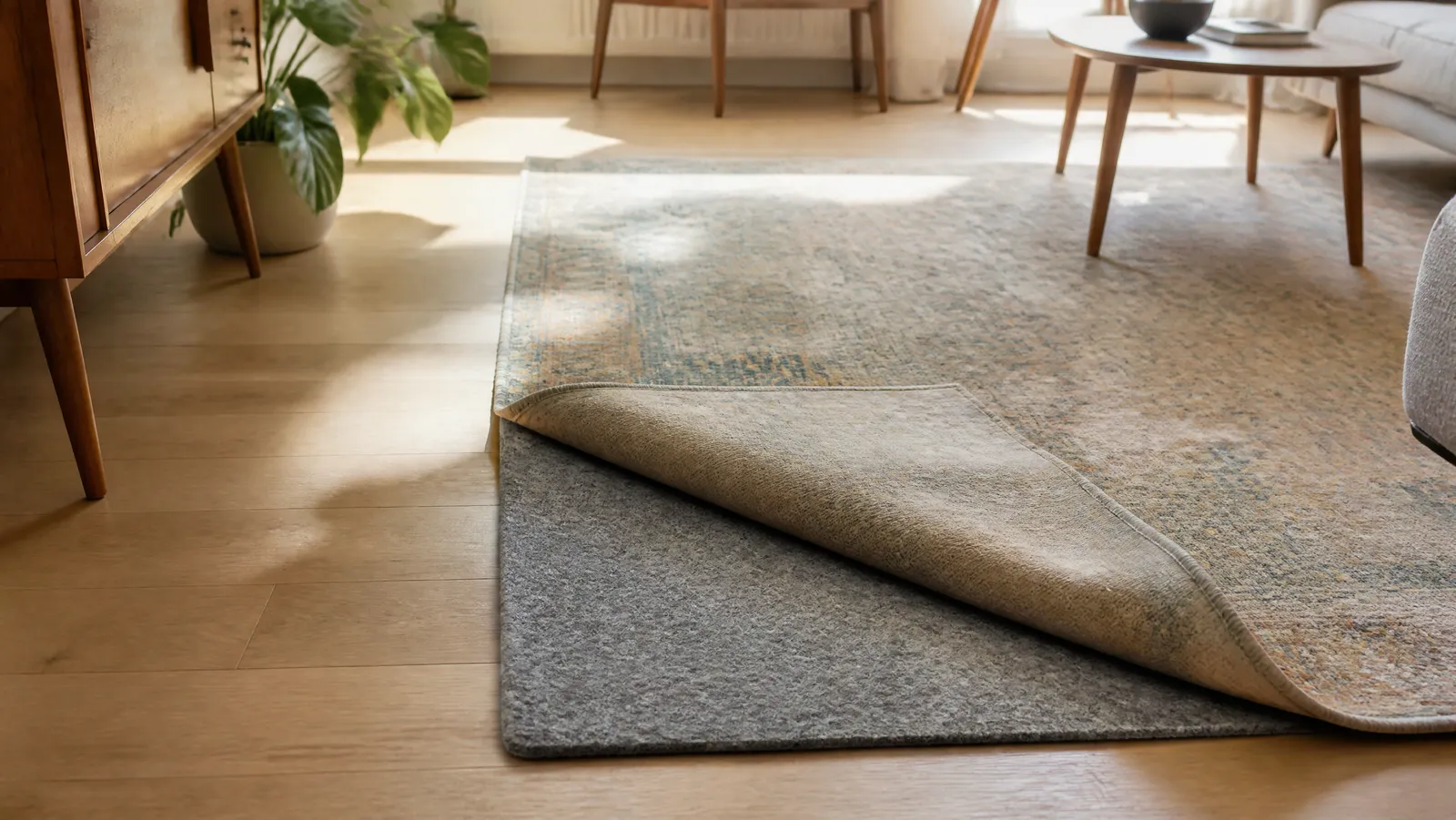
A rug is the most effective purchase available to you here, and the pad underneath it does most of the work.
According to BKL, "in terms of loudness, footsteps would be 4 to 8 times louder with a hardwood floor than with a carpeted floor for similar constructions." Read that figure carefully: BKL is comparing a carpeted floor to a hardwood one, not an area rug to a bare room, so a rug only buys you that change on the strip of floor it actually covers. On that strip, though, the mechanism is the same — and it rolls up and moves with you. Commercial Acoustics makes the same point from the other direction, noting that "hard finishes can drop IIC by 10-25 points without an underlayment."
Two rules for spending the money well:
- Follow your traffic path, not your décor. Map the route you genuinely walk — bed to bathroom, front door to kitchen, desk to fridge — and cover that. A beautiful rug under a coffee table nobody walks past does nothing for the person below.
- Take the pad seriously. A thin foam pad under a thin rug is close to nothing. You want thickness and density, and dense felt or rubber beats cheap open-cell foam every time. Our guide to rug pads that reduce footstep noise works through what to look for and what to skip.
Be honest about the ceiling on this, though. BKL's warning about lightweight floors — that low-frequency thump arriving "even when quality carpet and underlay is used" — means a rug reliably removes the sharp click and clack at the top of the impact, while the deflection thump of a bouncy joist floor survives it. That part is a property of the building, not a shopping problem.
Targeted mats for the zones that take the most abuse
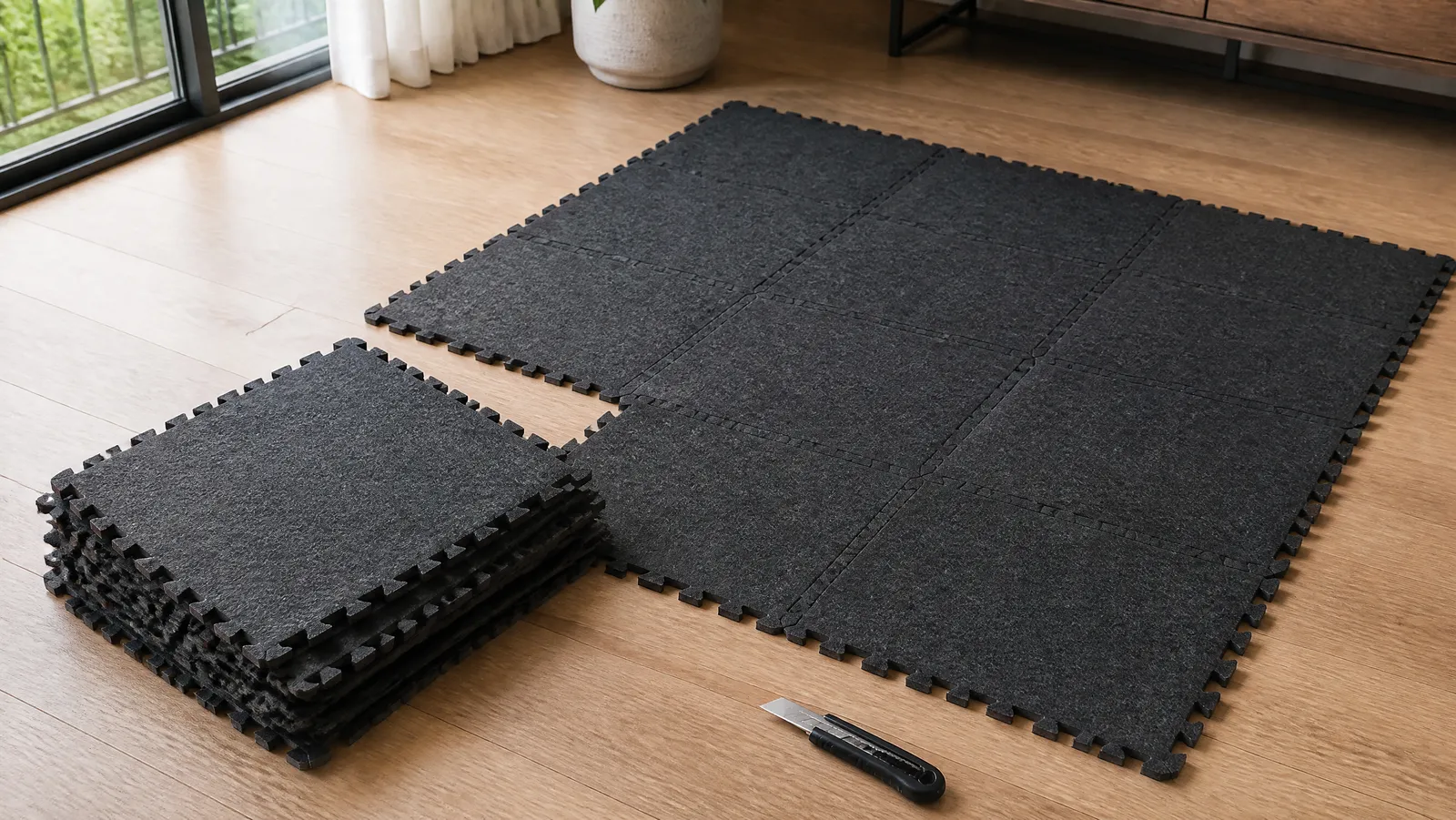
Some square footage in an apartment absorbs far more impact per square foot than the rest, and it is usually obvious where: the spot where you work out, the landing at the foot of the bed, the two feet in front of the kitchen sink, the patch under a rolling desk chair.
Those zones deserve a dedicated dense mat rather than a rug. Rubber gym flooring, a thick rubber anti-fatigue mat or a purpose-made impact mat will take a dropped dumbbell in a way a wool rug simply will not. Our roundup of the best soundproof floor mats works through what the felt tiles sold for this job can and cannot do, and why thickness and coverage matter more than the number printed on the box.
Keep the expectation calibrated, though. This is why the honest answer to do soundproof floor mats actually work is "at the point of impact, yes; as a whole-floor soundproofing system, no." A mat under a squat rack is excellent. A mat is not a substitute for an assembly rated by ASTM E492. Commercial Acoustics reports that among underlayments tested for Delta IIC under ASTM E2179, "thin builder-grade foams land around ΔIIC 15-18" while "premium engineered mats post ΔIIC 26+" — and those figures come from material installed under a finished floor on a standardized concrete reference slab, not a mat thrown on top of one.
How to talk to the neighbor below
Short version: go first, and go before they are angry.
- Lead with the building, not with blame. Soundproofist's advice is to "talk to your neighbors with a no-blame approach" and to help them "understand the noise issue that's caused by the building, and how it amplifies their movements." Coming from the person upstairs, that reads as generous rather than defensive.
- Ask for specifics. What time, which room, what does it sound like? "Between 6 and 7am, in the bedroom, sharp clicks" points at shoes on the path to the closet. "A boom around 11pm" points at something being set down.
- Offer something concrete and small. House shoes by the door, a runner down the hallway, felt pads this weekend. A specific commitment lands better than a broad apology.
- Ask them to tell you when it happens. One week of texts will teach you more about your own noise than a month of guessing.
- Involve the building last, and calmly. If the noise is structural and you have already done the cheap fixes, a joint note to management from both of you carries far more weight than a complaint from one side. We are not going to give you legal advice about your lease, but it helps to understand the other chair in the room — how to deal with noisy upstairs neighbors is the escalation path your neighbor is probably reading.
What will not work
Two things, said plainly, because renters spend real money on both.
Acoustic foam on your walls does nothing for their ceiling. Foam panels are an absorption product, rated by NRC, which is the reverberation-room number described above. They change how your room sounds to you. They do not change how much impact energy your floor delivers into the joists. That is the whole do acoustic foam panels block sound story, and it applies twice over here, because your problem is not even airborne to begin with.
Absorption panels or extra insulation on their ceiling will disappoint too, which is worth knowing before anyone proposes splitting the cost. Soundproofist is blunt about it: "insulation helps to muffle airborne noise, but it doesn't block impact noise." By the time the energy reaches a stuck-on ceiling treatment it is already inside the structure. The one ceiling measure that does move the impact number is decoupling the ceiling from the joists with resilient channels or isolation clips — but that is a rebuild of their ceiling, a landlord-and-contractor job rather than anything either of you can stick up in an afternoon.
The bottom line
- It is the building, not your character. BKL attributes the low-frequency thump to lightweight floor systems that deflect, even under quality carpet and underlay.
- Shoes off is the biggest free lever. BKL lists it first among the actions residents can take.
- Your furniture is probably louder than you are. Felt pads, caster cups, lift rather than drag.
- A rug plus a dense pad on the traffic path is the best purchase. BKL puts footsteps on hardwood at 4 to 8 times the loudness of carpet in comparable construction.
- NRC is absorption; IIC is isolation. If a product is being sold to you on NRC, it is not addressing the person downstairs.
- Have the conversation before it becomes a complaint, and lead with the structure rather than an apology.
None of that requires a drill, a lease amendment or a landlord's blessing, and all of it comes with you when you move. For the full order of operations on floors, including the things worth asking the building to do, see our guide to soundproofing the floor under you.

Lillie Metayer
Lillie Metayer is the founder of a local program that helps apartment-dwellers take action against noise pollution. Involved in environmental activism since high school, Lillie is passionate about raising awareness of the harms of noise exposure and helping people reduce noise in their communities. In her free time, Lillie enjoys playing the violin and spending time outdoors.