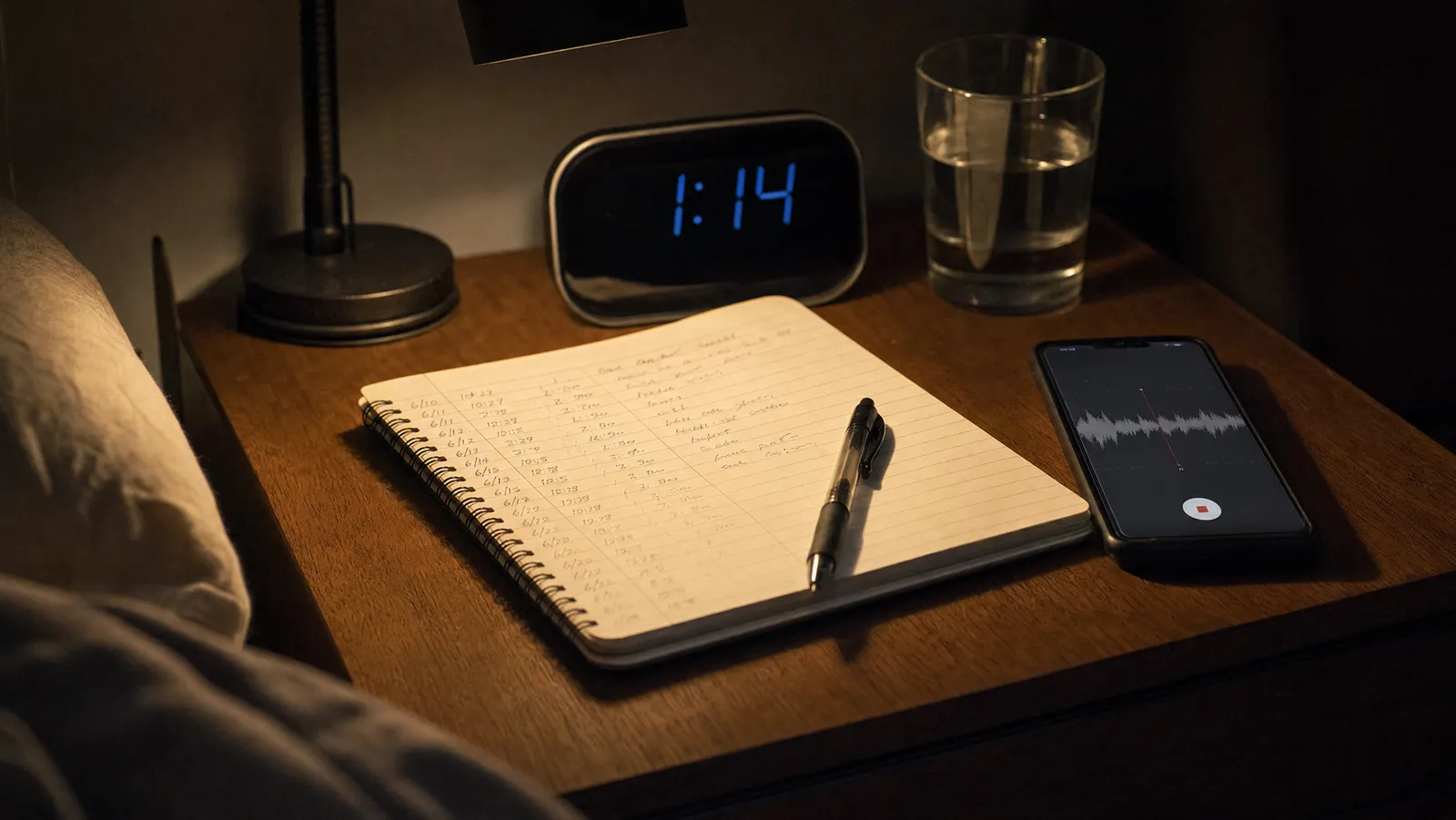
Record it from inside your own apartment. Log every incident with the date, the start and stop time, what you heard, and what it interrupted. Then send the pattern — not the anger — to your property manager in writing. That is the entire answer to how to record noise from an upstairs neighbor in a way that produces a response.
Plenty of renters do the opposite. They absorb it for four months, then send one furious 400-word email at 1:40 a.m. about "constant stomping." That email gets filed. Two weeks of dated entries showing noise every weeknight between 11:40 p.m. and 1:00 a.m. gets a phone call made upstairs.
The work is boring, and it is the only thing that reliably moves a property manager. If you have not tried the conversation, do that first — our guide to how to deal with noisy upstairs neighbors covers what to say, and a documented failed conversation is a stronger opening than none. Weighing this against physical fixes? The full menu is in our guide to how to reduce noise from upstairs neighbors.
One note before we start: this is general information, not legal advice, and recording law varies by state.
Why Documentation Beats Complaining
A property manager cannot act on your feelings. They can act on three things: a pattern with dates behind it, a lease clause they can point at, and specifics they can repeat to the other tenant. They have to knock on a door and say something. "Your downstairs neighbor is upset" gets a shrug. "There is furniture being dragged after 11 p.m. on weeknights" gets a rug.
According to LawInfo, tenants have a right to quiet enjoyment and landlords have a duty to investigate a noise complaint and determine whether it is valid. Its guidance for landlords says a tenant should document the dates, times, locations, nature and source of the disruptions, keep a log that establishes a pattern — one barking-dog incident, one night of loud music or one walk across the floor in heels is not enough — and report it in writing, with the log, with evidence, and with an account of how it has affected their daily life. That is the standard you are writing to. Not persuasion. Inventory.
You are not building a case against your neighbor. You are building a document that lets a busy person act without taking your word for anything.
The Noise Log: The Exact Fields
One line per incident, in one running document. A phone note, a spreadsheet, an email you keep replying to yourself — consistency matters more than format. Copy these fields:
- Date, including the day of the week — weeknight patterns are the most persuasive kind
- Start time and end time (not "late" — 11:42 p.m. to 12:20 a.m.)
- Duration in minutes
- Type of noise, described physically and neutrally: repeated heavy footfall, an object dropped, furniture dragged, bass from a speaker, a dog
- Where you were and what it interrupted: in bed, asleep, woke me; on a work call; feeding an infant
- Any measurement, if you took one
- Any action you took: knocked, texted, emailed management, called the non-emergency line
- Whether you have a recording, and the file name
A worked example:
Tue 2026-08-11, 11:42 p.m. – 12:20 a.m. — 38 min. Repeated heavy footfall across the bedroom ceiling plus what sounded like a chair dragged twice. In bed, asleep; woke me and I did not get back to sleep before 1:30 a.m. Peak reading 58 dBA at the pillow. No action taken. Audio file 2026-08-11-2347.m4a, 40 sec.
Three rules decide whether the log is useful:
- Write it the same night, even if it is three words on your phone at 12:21 a.m. Reconstructed logs read as reconstructed.
- Log the quiet nights too. "Wed 8/12 — nothing after 10 p.m." is what makes the loud entries read as a record instead of a vendetta.
- Strip every adjective. No "insane," no "unbelievable," no "again." A manager who reads emotion in a log starts wondering whether you are the difficult tenant. Put one clean sentence of feeling in the email instead.
How Long to Log Before You Escalate
No law we can find sets a minimum, and anyone quoting you one is guessing. Our rule of thumb is two weeks, or ten logged incidents, whichever comes first — sooner if there is a safety issue or you are losing sleep nightly. Two weeks is enough to show shape, and a persuasive pattern usually looks like one of these:
- Same window, most nights. Six of nine weeknights between 11:30 p.m. and 1:00 a.m.
- Same event, repeating. A treadmill at 5:50 a.m. every weekday. A speaker every Friday after midnight.
- Escalating. Two incidents the first week, six the second.
What is not persuasive is four scattered incidents over three months; a manager reads that as normal apartment living. If two weeks of logging produces four entries, masking may beat escalation, and our genius ways to silence noisy neighbors playbook is a better use of your evening.
Recording Audio and Video, and What a Phone Mic Really Captures
Audio does one job well: it proves the sound has a character and a timing a written line cannot convey. A 40-second clip with eleven distinct footfalls beats a paragraph of description.
Here is the honest part, and you should say it out loud in your email: your recording will almost always sound less bad than your night actually was. Phone microphones are small, uncalibrated and tuned for speech, so they tend to under-represent the low-frequency thud that is the entire problem with upstairs noise. According to NIOSH, smartphone microphones are designed primarily for voice communication, no smartphone or app has met the IEC or ANSI standards for a sound level meter, and frequency response differs widely between devices and manufacturers; its follow-up evaluation found that adding an external, calibrated microphone brought measurements to within about 1 dB of a reference system — a direct measure of what the built-in mic was costing.
Practically:
- Record from where you sleep, phone on the nightstand, not held toward the ceiling.
- Keep clips to 30 to 60 seconds, and start each one with your voice quietly stating the date and time. Nobody plays a four-hour file, and speaking the timestamp puts it inside the file.
- Video beats audio for one thing: a light fixture or a glass of water that visibly shakes. That shows structure-borne impact in a way a waveform never will.
- Never edit or amplify a clip. Boost the gain and it becomes an argument instead of evidence.
The Legal Line: Your Apartment Versus Their Conversation
Recording the sound in your own apartment is generally treated as a different act from recording a conversation. Sound arriving through your ceiling is part of your environment. A neighbor's speech, captured deliberately, is the kind of private communication wiretap law is written about — and that is where the risk lives.
According to the Reporters Committee for Freedom of the Press, federal law requires the consent of at least one party before recording in-person, telephone or electronic conversations, and about eleven states primarily require all-party consent — the Committee lists California, Delaware, Florida, Illinois, Maryland, Massachusetts, Michigan, Montana, New Hampshire, Pennsylvania and Washington, notes that several more require it for specific kinds of conversation, and puts Hawaii and Maine in a separate bucket for particularly private locations. Commercial trackers routinely publish a count of twelve and a slightly different list, which is exactly why you should check your own state's law rather than trust any single number, including ours.
Two practical rules follow:
- Do not press a microphone, a glass or a contact device against a wall or ceiling to capture speech. According to LegalClarity's summary of US eavesdropping law, courts apply a reasonable-expectation-of-privacy test, and using a device specifically to capture a private conversation through a shared wall is treated very differently from incidentally overhearing something loud. That summary also notes the federal Wiretap Act carries penalties of up to five years in federal prison, a fine, or both, and a civil claim for statutory damages of 100 dollars per day of violation or 10,000 dollars, whichever is greater.
- If speech lands in your clip incidentally, do not build your complaint on it. Delete it, or say in your email that you have not kept it. Your case is footsteps and thuds.
We are being conservative because the downside is asymmetric — and nothing in a noise log requires you to record a word anyone says.
Where a Decibel Reading Helps, and Where It Oversells
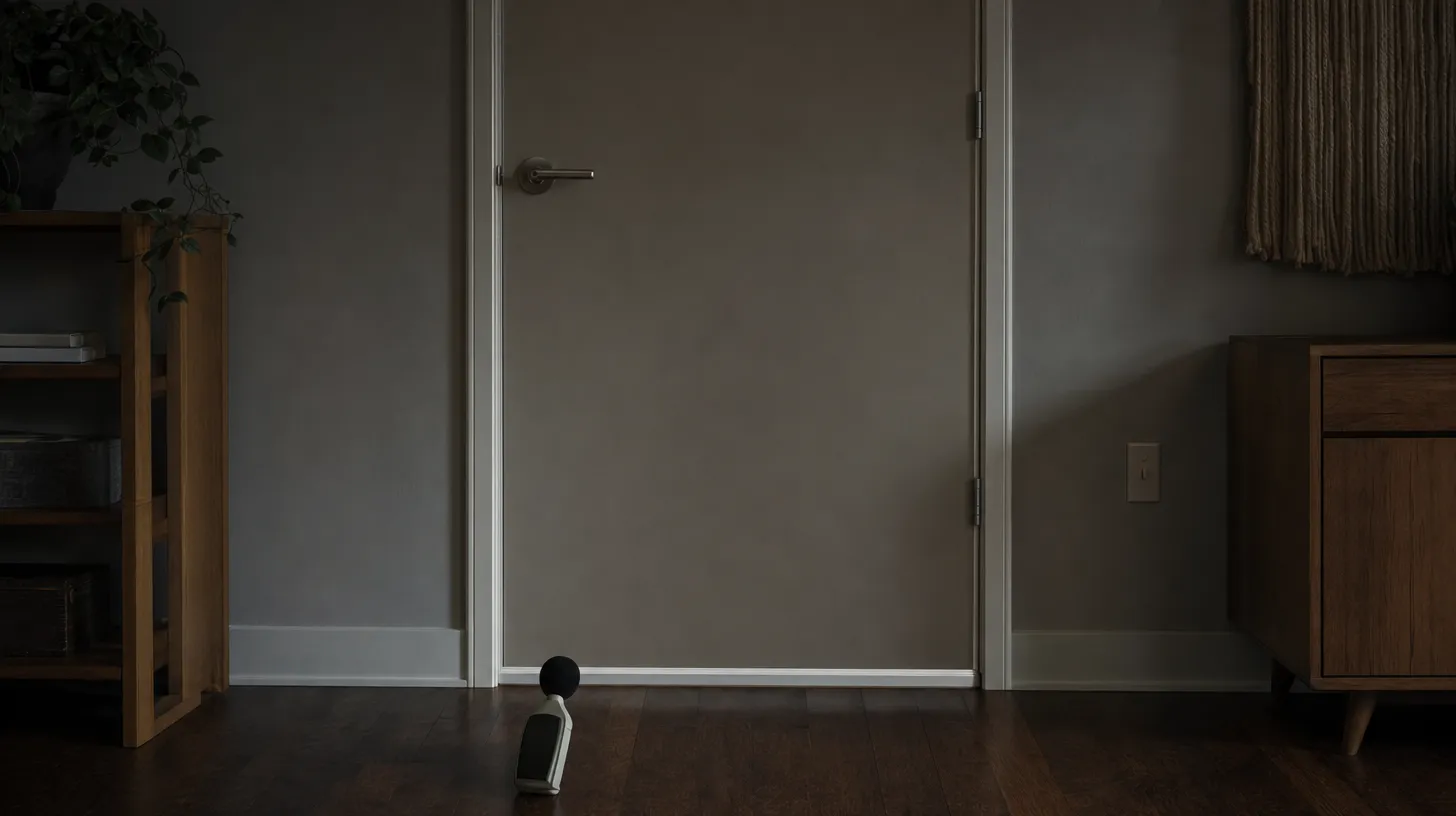
"It peaks at 58 dBA at my pillow at 12:30 a.m." reads as a measurement. "It is so loud" reads as a mood. But be careful how much weight you put on the number. According to NIOSH, an evaluation of 192 sound measurement apps for iOS and Android found only four — all of them iOS apps — met the accuracy criterion of within 2 dB(A) of a professional reference meter. An app reading is an estimate, not a fact.
So report it as your own reading, never an official figure, and do not lead with the number — lead with the pattern. A manager who catches you leaning on a shaky measurement discounts the whole log. If you want a reading to carry weight, a cheap standalone meter is more defensible than an app; we compare the options in our guide to a decibel meter.
Quiet hours are the other number worth citing. According to Local Noise Laws, most US cities set quiet hours from 10 p.m. to 7 a.m. on weekdays and 11 p.m. to 8 a.m. on weekends, though times vary by city. There is no national standard: the EPA's federal noise-abatement office lost its funding in the early 1980s, and primary responsibility for noise control has sat with state and local government ever since — so look up your own city code and quote the section number.
The Escalation Email
Email, not a phone call, so there is a timestamp. Attach the log. Address it to the property manager, not the leasing agent. Keep it under 250 words, and include your unit and the unit above, the date range, the number of incidents, the time window, when you spoke to the neighbor, one specific remedy, and a date for a written reply.
What remedy to ask for. Not "please make them stop." Ask for what a manager can deliver: that they ask the upstairs tenant for an area rug with a thick pad in the walking lane and felt pads under the dining chairs. Cheap, finite, and the only ask a manager can put in a letter without threatening anyone's tenancy. A version you can lift and edit:
Subject — Unit 2B, ongoing nighttime noise from Unit 3B, log attached
Hi Dana,
I am writing to document an ongoing noise issue and ask for your help. Between August 1 and August 14 I logged eleven incidents of heavy footfall and furniture movement from Unit 3B, nine of them between 11:30 p.m. and 1:00 a.m. on weeknights. The full log with dates, times and durations is attached. I also have two short audio clips from my bedroom — though I will say plainly that a phone microphone under-represents low-frequency impact, and they sound milder than the room does.
I spoke with the tenant in 3B in person on July 26 and asked politely. The pattern has not changed.
What I am asking for is small and specific — would you ask the tenant in 3B to put an area rug with a thick pad in the hallway and bedroom walking lanes, and felt pads under the dining chairs. I am not asking for anyone to be penalized.
Could you let me know in writing by August 22 what step you plan to take. I will keep logging and send an updated record at month end.
Thanks — Sam Ortiz, Unit 2B, 555-0142
The tone is the point. Calm, dated, specific, asking for one small thing. That email is hard to file and ignore, which is the whole objective.
If Management Does Nothing
Send a second email. Not a new complaint — an update to the existing record, with the additional incidents and one line noting you have not had a written response to your message of the 15th. A documented non-response is worth owning.
After that, in order: request the lease's nuisance and quiet-enjoyment clauses in writing; ask whether the building offers mediation; contact your local tenants union or housing counseling office, which knows your jurisdiction far better than any national article; and file with your city's non-emergency line during quiet hours so a municipal record exists too.
Do not retaliate. A ceiling thumper feels like justice and destroys the position you spent two weeks building — the tenant with the documented log is in a strong spot, the tenant with the vibration device is the one who now has a complaint against them. We lay out why in our piece on ceiling thumpers and payback devices. Do not post about your neighbor online, and do not send them the log. It reads as surveillance to anyone but management.
The Honest Sequence
Try the conversation. When it fails, start the log that night. Two weeks of boring, dated, adjective-free entries. A short clip or two from inside your own apartment, nothing pressed against a wall. One calm email with a cheap, finite ask and a date for a reply. An update if there is silence. Outside help only once the paper trail exists.
None of it is satisfying, and none of it gets you a quiet night this week. What it does is convert private misery into something a stranger with a keyring can act on — the only mechanism a renter controls. For where documentation sits alongside the physical fixes and masking, start with The Soundproof Apartment's complete upstairs-noise guide.
Open a note on your phone tonight and title it with the date. That is the whole first step.

Lillie Metayer
Lillie Metayer is the founder of a local program that helps apartment-dwellers take action against noise pollution. Involved in environmental activism since high school, Lillie is passionate about raising awareness of the harms of noise exposure and helping people reduce noise in their communities. In her free time, Lillie enjoys playing the violin and spending time outdoors.