Here's the honest read: low frequency noise from an upstairs neighbor is the one apartment noise problem you cannot buy your way out of. Nothing you hang, stick, or stack on your side of the ceiling will meaningfully reduce it. The entire lever is upstairs, and it is getting whatever makes the bass off the floor.
We know that is not what you wanted to hear at 11:40 p.m.
First, though: you are not exaggerating. If you can feel it in your chest, your mattress, or your bed frame, that is a real, diagnostic observation. According to a psychophysical survey in the Journal on Multimodal User Interfaces, the physical properties of airborne vibration have direct counterparts in skin vibration, and in the range where hearing and touch overlap, vibrations mainly stimulate the Meissner and Pacinian mechanoreceptors. Those receptors sit right where bass lives: per the NIH's StatPearls reference, Meissner corpuscles detect frequencies between 30 and 50 Hz, and Pacinian corpuscles cover roughly 100 to 400 Hz. When you say you feel it more than you hear it, you are describing the frequency range accurately.
This is the last article in our upstairs-noise series, and it's the hardest case. If your problem is thumping and footfall rather than bass, start with the pillar guide on reducing noise from upstairs neighbors instead — most of the wins live there.
The Short Answer, Stated Plainly
Four things are true at once, and together they close off almost every option you have:
- Bass has wavelengths tens of feet long, so it doesn't behave like a beam you can block, aim, or absorb with anything room-sized.
- Barriers get only about 6 dB per doubling of mass, and they perform worst at exactly the frequencies you care about.
- Your ceiling assembly resonates in the bass range, so it doesn't just leak sound — it re-radiates it.
- The sub is mechanically coupled to the floor above, which bypasses air entirely.
That fourth one is also your only real hope, and it's the useful asymmetry in this whole article: nothing works on your side, but one cheap thing works on theirs.
Bass From an Upstairs Neighbor vs. Footsteps: Tell Them Apart First
The distinction changes everything you should do, so get it right before you spend a dollar.
Footsteps and impact noise are transient. Discrete thumps that follow a path across the ceiling and stop when the upstairs unit goes to bed. Our explainer on impact noise vs airborne noise is the full breakdown, and the fixes for that problem are real.
Low-frequency noise from a sound system is continuous and rhythmic. It has pitch even when you can't make out a melody. No vocals, no dialogue, no treble — just a pulsing drone with a beat you could tap along to. It often rattles one specific object at one particular moment in a song, which is a strong tell.
If it's the second one, everything marketed for footfall noise is aimed at the wrong problem — and everything marketed for airborne noise, at the wrong frequency band.
Reason 1: Wavelength — A 37-Foot Wave Ignores Your Curtain
According to Acoustic Fields, "a 30 Hz. wave is approximately 37′ long." Your entire apartment is probably not 37 feet in any dimension. That single fact does more damage to your options than anything else here, because acoustic treatment works by being an appreciable fraction of the wavelength it handles.
Acoustic Fields puts the requirement bluntly: to absorb that frequency you need a device that completely absorbs at least 25 percent of the wavelength, which is "a distance of a little over 9′." Nine feet of absorber. Not a two-inch panel, not a curtain, not a corner wedge.
High frequencies behave like light: they reflect, they cast shadows, you can block them. Bass behaves more like weather. It bends around, fills the volume, and arrives from the whole ceiling plane at once. That's why people say bass comes from everywhere. It does.
Reason 2: Mass Law — The Arithmetic of Why Nothing You Can Hang Is Heavy Enough
The one lever that works on airborne sound is mass, and the exchange rate is terrible.
According to the Acoustical Society of America's standards terminology, mass-law sound transmission loss is the "phenomenon whereby doubling the mass per unit area of a panel, or doubling the frequency for a given mass per unit area, increases the sound transmission loss by six decibels."
Read the second half again, because it ends the conversation. Transmission loss falls by 6 dB every time frequency halves. A barrier that performs well at 500 Hz gives 6 dB less at 250 Hz, 12 dB less at 125 Hz, 18 dB less at 63 Hz, 24 dB less at 31 Hz. Barriers are structurally worst at exactly the frequencies bass lives in.
Now the mass side. To buy back 6 dB you must double the mass per square foot of the entire surface, then double it again for the next 6. A one-pound-per-square-foot barrier across your whole ceiling would be a landlord-alarming, physically hazardous project — and it would still start from a 20-plus dB deficit against a 30 Hz tone. Same arithmetic we walk through in mass loaded vinyl for apartment walls. You can run the numbers yourself with our free soundproofing calculators. Against bass, hanging mass isn't a compromise. It's a rounding error.
Reason 3: Resonance — Your Ceiling Becomes the Second Speaker
Every floor-ceiling assembly has a resonant frequency — where the two leaves and the trapped air between them swing in sympathy, and where the assembly leaks most. A worked example from an isolation build documented by Soundproof Your Studio: a 4.4 psf hung ceiling, a 5.0 psf floor above, and an 11¼-inch air gap in the joist bay produce a resonance of approximately 33 Hz — a frequency their write-up calls "the point where the assembly performs at its worst."
Thirty-three hertz is not a footnote frequency. That's the kick drum and the low end of a movie soundtrack. That is precisely what's coming through your ceiling. And in the same example, adding a substantial amount of drywall to the upper leaf — from 5.0 to 9.4 psf — moved the resonance only from about 33 Hz to about 31 Hz. Enormous mass, tiny shift.
Hush Acoustics describes the mechanism generally, noting that low-frequency sound and vibration travel through structures by causing "diaphragmatic resonance in floors, walls and ceilings," and that they "cause structural components to vibrate, which often re-radiates as noise in rooms" a relatively long distance from the source. This is what renters are describing when they report ceiling vibration and bass in the same apartment complaint. Your ceiling is not a wall the bass sneaks past. It is a large, thin, joist-mounted panel being driven at its resonance, re-emitting the bass into your bedroom. Our guide to how to soundproof an apartment ceiling covers what renters can and can't do overhead — low frequency is where that answer bottoms out.
Reason 4: Structure-Borne Coupling — The Sub Is Playing the Building
Now the path that makes all of the above almost irrelevant.
A subwoofer sitting on a hard floor is not only pushing air. According to audioXpress, "when a speaker emits sound, the reactive force from the driver's motion causes vibrations to be transferred to the supporting surface." Every time that cone pushes air one way, the cabinet is shoved the other way — and if the cabinet rests on the subfloor, that force goes straight into the joists.
That's a mechanical path. It skips the airspace and any barrier logic entirely, and per Hush Acoustics, structure-borne vibrations "lose less energy, penetrate denser materials, travel faster through solids." A subwoofer on a laminate floor is, functionally, a small shaker bolted to your building's frame — which is one reason the bass can feel disproportionately strong in your apartment relative to how loud the system actually sounds in theirs.
What Does Not Work: Named Honestly
Save your money:
- Acoustic foam and fabric panels. According to Sound on Sound, a porous absorber "needs to be at least a 10th of a wavelength thick" to be effective, and for a 52 Hz sound "a layer of porous absorbent 65cm thick is needed" — covering a large surface area, not a few corner pieces. Two-inch foam is off by an order of magnitude, and the same publication states plainly that porous absorbers "are not good for treating bass effects such as the ringing of room-mode resonances."
- Heavy curtains. Same physics, less mass, hung nowhere near the transmission path.
- Ceiling tiles and peel-and-stick anything. Trivial mass added to a resonating panel. See the 33 Hz math.
- Rugs on your own floor. Right treatment, wrong apartment. Soft flooring helps the unit below an impact, not the unit below a sub.
- Most white-noise masking. Masking lays broadband sound over a competing sound, but you are partly feeling this, and the small drivers in a sleep machine put out very little energy down at 30 to 60 Hz. If a machine still helps you sleep, keep it — just know it's treating your nervous system, not the bass.
Sound on Sound is explicit that low-frequency room acoustics are "best done with resonant absorption using a device such as a membrane absorber." That, plus tuned traps, real structural mass and decoupling, is what professional bass control looks like — and none of it is renter-viable or reversible.
How to Block Bass Noise in an Apartment: The Four Asks That Actually Work
Because the dominant path is mechanical, decoupling the source is disproportionately effective compared to anything done in the receiving room. Everything below happens upstairs, costs your neighbor little to nothing, and is the kind of request people say yes to. Lead with the first one.
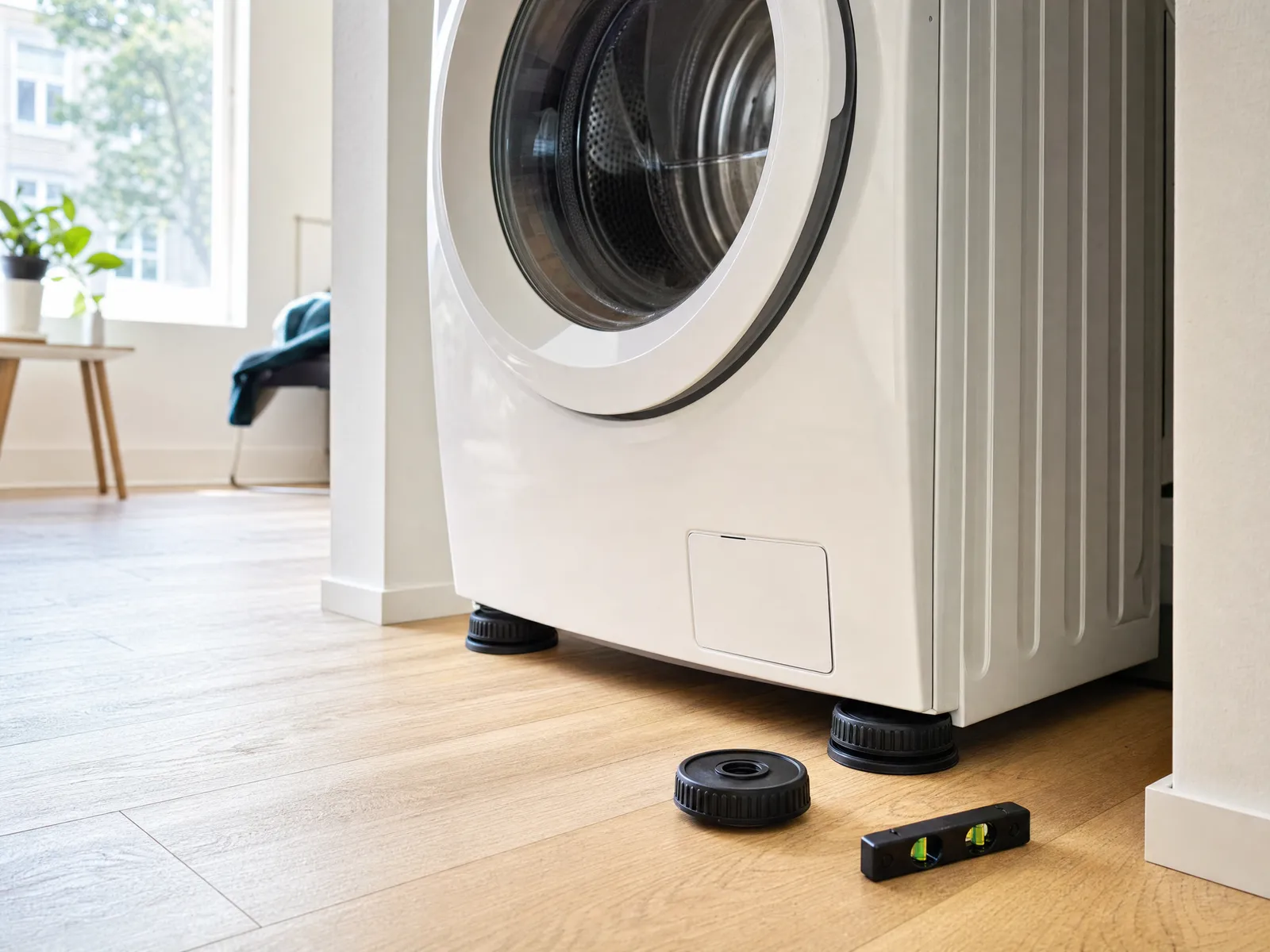
1. Get the sub off the floor. This is the whole ballgame. Ask them to set the subwoofer on an isolation stand or a thick, dense compliant pad — the class of object sold as a subwoofer isolation platform. As audioXpress puts it, isolation products "are designed to decouple the speaker from the surface using materials like foam, rubber, sorbothane, or damping compounds," and Hush Acoustics frames the building-wide principle identically: decouple the vibration source from the receiving structure using resilient materials or mechanical breaks. Keep expectations honest — audioXpress also notes isolator effectiveness "is limited to certain frequency ranges for a given weight load." A real improvement, not a mute button, and still the highest-value move either of you has.
2. Move it out of the corner. A corner is a free bass amplifier. Subwoofer manufacturer SVS notes that corner placement "excites all possible room modes," and that it "can increase bass output, but it may also exaggerate peaks and nulls." Pulling the sub a couple of feet out of the corner gives up some of that free amplification and smooths the worst peaks, so less low-frequency energy gets dumped into the structure at exactly the frequencies that ring. Your neighbor may nudge the volume up slightly to compensate — but it costs nothing to try, and in most rooms the bass sounds tighter upstairs for it.
3. Ask for the sub's level and crossover down — not the whole system. Most people don't know those are separate controls. A sub trimmed a few dB with a lower crossover sounds nearly identical upstairs and noticeably better downstairs. Usually the easiest yes.
4. Agree a bass curfew, not a noise curfew. "Please be quiet" is an accusation. "Could the sub go off after 10 p.m., and the rest of the system stays however you like it?" is a schedule. Specific, limited, and it leaves them their movies.
On delivery: bring the physics, not the grievance. "Your sub is coupled to the joists" lands very differently than "you're too loud." Then ask for a test — let them stand in your apartment while something plays.
If They Won't Cooperate: Measure, Log, Escalate
If the conversation fails, stop treating this as an acoustics problem and start treating it as a documentation problem.
Log it. Date, start and end time, description, whether it woke you. Weeks of that persuades a property manager far more than one complaint.
Measure it. Phone apps and consumer meters are A-weighted by default, which systematically under-reads exactly this problem — Leventhall's 2004 review in Noise & Health concluded that the A-weighted level underestimates the effects of low frequency noise, and that conventional A-weighted assessment methods are inadequate for it. So take the C-weighted reading if your device offers one, and write down what you felt. Our roundup of how to measure it with a decibel meter covers which tools give renters a defensible number.
Cite the right nuisance. Leventhall's review also notes that low frequency noise, roughly 10 to 200 Hz, has long been recognized as a special environmental noise problem, particularly for sensitive people in their homes, and that annoyance from low frequencies increases rapidly with level. In writing to a landlord, frame this as a recognized acoustic category rather than a personal complaint.
Then escalate in order: neighbor, building management in writing, then whatever your lease says about quiet enjoyment (many US residential leases include some version of that clause — read yours, and check your state's landlord-tenant rules), then your local noise ordinance, which varies city to city. Keep the health language honest — the World Health Organization's Guidelines for Community Noise note that low-frequency noise can disturb rest and sleep even at low sound pressure levels. Anything stronger weakens your case.
The Honest Sequence
- Confirm it's bass, not footfall. Continuous, rhythmic, no treble, felt as much as heard.
- Stop shopping. Foam, panels, curtains and ceiling treatments will not touch a 30 Hz tone. Wavelength, mass law and your ceiling's own resonance all say no.
- Spend your effort upstairs. Sub off the floor onto an isolation stand or dense pad, out of the corner, trimmed a few dB, off after 10 p.m.
- If that fails, document and escalate — dated log, a measured reading, low-frequency framing in writing.
That's the whole playbook for the hardest case. Shorter than we'd like — but we'd rather hand you a short honest list than a long one that empties your wallet.
This closes our series on noise from upstairs. If your problem is broader than bass — footsteps, dragged furniture, a treadmill at 6 a.m. — go back to The Soundproof Apartment's upstairs noise playbook, where the odds are considerably better than they are here.

Lillie Metayer
Lillie Metayer is the founder of a local program that helps apartment-dwellers take action against noise pollution. Involved in environmental activism since high school, Lillie is passionate about raising awareness of the harms of noise exposure and helping people reduce noise in their communities. In her free time, Lillie enjoys playing the violin and spending time outdoors.