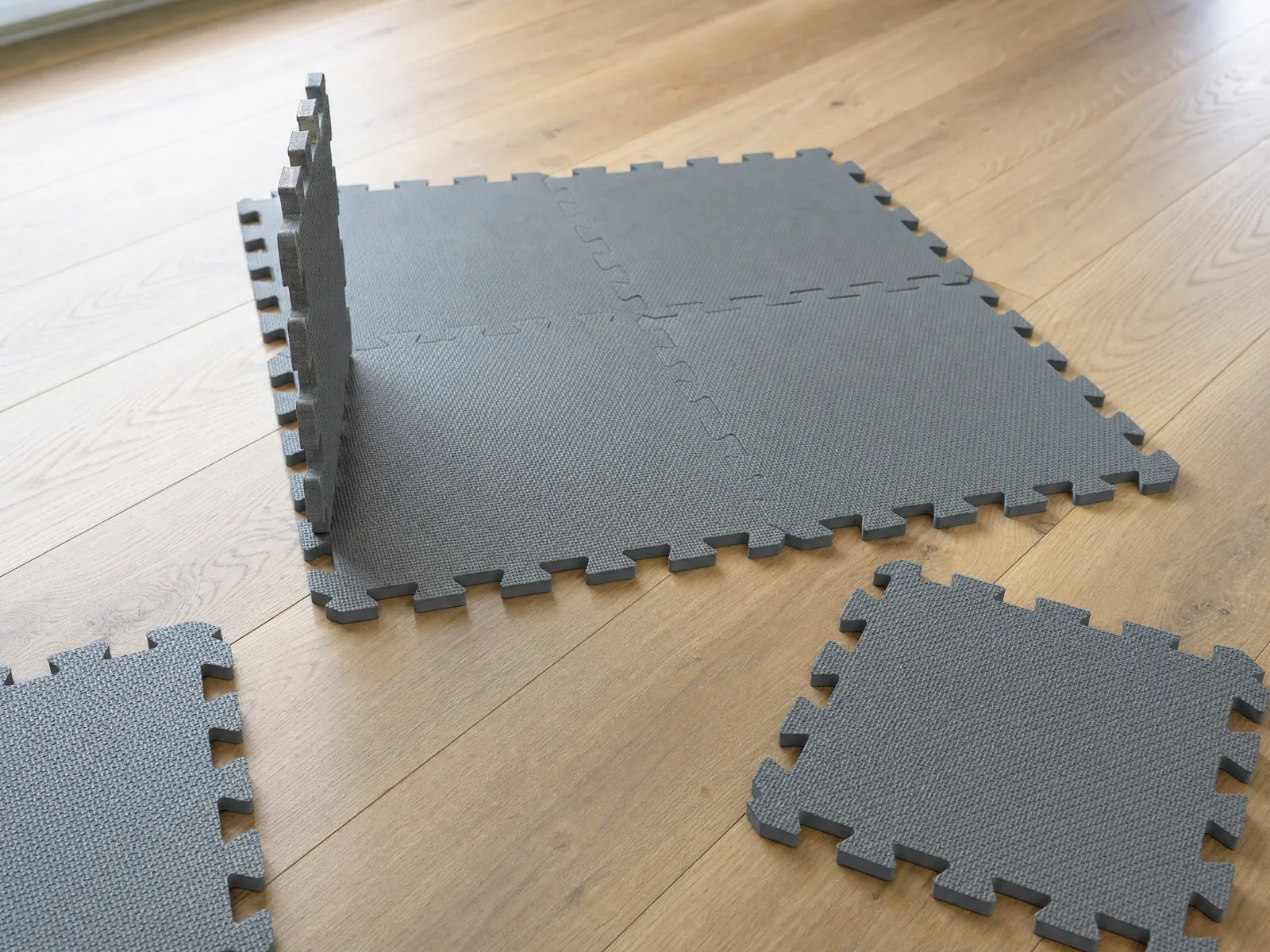
Interlocking foam tiles do reduce impact noise, a little, in the exact squares where you lay them. What they do not do is reduce it by anything close to what the listings imply, and almost nothing printed on a puzzle mat listing is a measurement of impact noise in the first place.
That second part is where the money goes. So the short answer to do interlocking foam tiles reduce noise is partly, for one of your two noise problems, by an amount nobody in this category has measured and published. The rest of this page is what those numbers actually describe, why a few millimetres of closed-cell foam is weak at the job renters buy it for, and what puzzle mats are genuinely good at. If you have not yet worked out which of the two problems is yours, start with our walkthrough on soundproofing an apartment floor and treat this page as the close reading of one product.
One free step before any of it. Soft soles indoors, lifting a chair instead of dragging it, and keeping the treadmill out of the small hours will do more for the apartment below than any taped-down square of foam, and they cost nothing.
Absorption is not isolation, and foam tiles are sold on the wrong one
There are two noise problems on a floor, and two different laboratory tests settle them.
Airborne noise is what you hear in your own room - the slap of a hard floor, the chair scrape, the flutter echo in a half-furnished apartment. The rating for it is absorption. According to Wikipedia's entry on the noise reduction coefficient, NRC is a single-number rating intended to describe the average sound absorption performance of a material, derived from reverberation-room measurements and reported from 0.0 for very low absorption to 1.0 for very high. The same entry explains that the number is the average of the absorption coefficients at the 250, 500, 1,000 and 2,000 Hz third-octave bands, rounded to the nearest 0.05, and that NRC should not be confused with sound transmission class, because STC relates to transmission loss through a construction element while NRC relates to sound absorbed within a room. Intertek's page on ASTM C423 confirms that the absorption coefficients come from the reverberation room method.
Impact noise is what the person below hears - the heel strike, the dropped phone, the castor rattle, energy injected straight into the structure. The rating that describes a single layer's contribution to that is delta IIC. ASTM's listing for E2179 titles the standard as the laboratory measurement of the effectiveness of floor coverings in reducing impact sound transmission through concrete floors, and Commercial Acoustics describes delta IIC as how many impact-isolation points a single underlayment or floor covering adds on its own, found by testing a bare 6-inch concrete reference slab and then re-testing the same slab with the material installed.
Foam tiles are marketed in absorption language and bought for impact reasons. That mismatch is the whole problem with the category, and it is the trap we took apart in do soundproof floor mats actually work.
What the numbers on a puzzle mat listing actually mean
Four kinds of number show up on these listings. Only one of them is evidence of anything you care about.
NRC and absorption coefficients. When a tile publishes one of these, it is usually a real figure from a real reverberation-room test, but it is a figure about your room rather than your neighbor's ceiling. By the definition above, every microphone in that test sits on the same side of the material as the sound source. An absorption number is not weak evidence about impact noise. It is a measurement of a different physical quantity.
STC and IIC figures in the seventies. Flooring-adjacent listings sometimes quote these, and they are not properties of the thing in the box. Commercial Acoustics' explanation of the delta approach is explicit about why: the delta figure exists precisely to pull the flooring product's own contribution out of the total measurement for the rest of the building assembly. An IIC is measured on a complete floor and ceiling - finish floor, subfloor, joists or slab, cavity, ceiling board - in a laboratory. We made the same point about a thin foam underlayment roll in this tower, and it holds harder here: quoting an assembly rating for something you can lift with one hand tells you nothing about what the tile adds.
Density, usually EVA foam, often given as a figure in kg/m3 or just as "high density". Density is a genuine material property, and it is not an acoustic rating. It also covers an enormous span. A published property table for cross-linked closed-cell EVA foams from U-Perform runs from an EVA30 grade at 28 to 36 kg/m3 up to an EVA400 grade at 370 to 420 kg/m3, which is better than a tenfold range inside the words "EVA foam". EVA Glory, which describes itself as a PE and EVA foam supplier, says its EVA and PE foam absorbs vibration energy and moderately reduces mid-high frequency noise - a supplier's description of a material, not a measurement of a tile. No interlocking foam tile we have found publishes an impact insulation figure for itself, and in a category this size that silence is information.
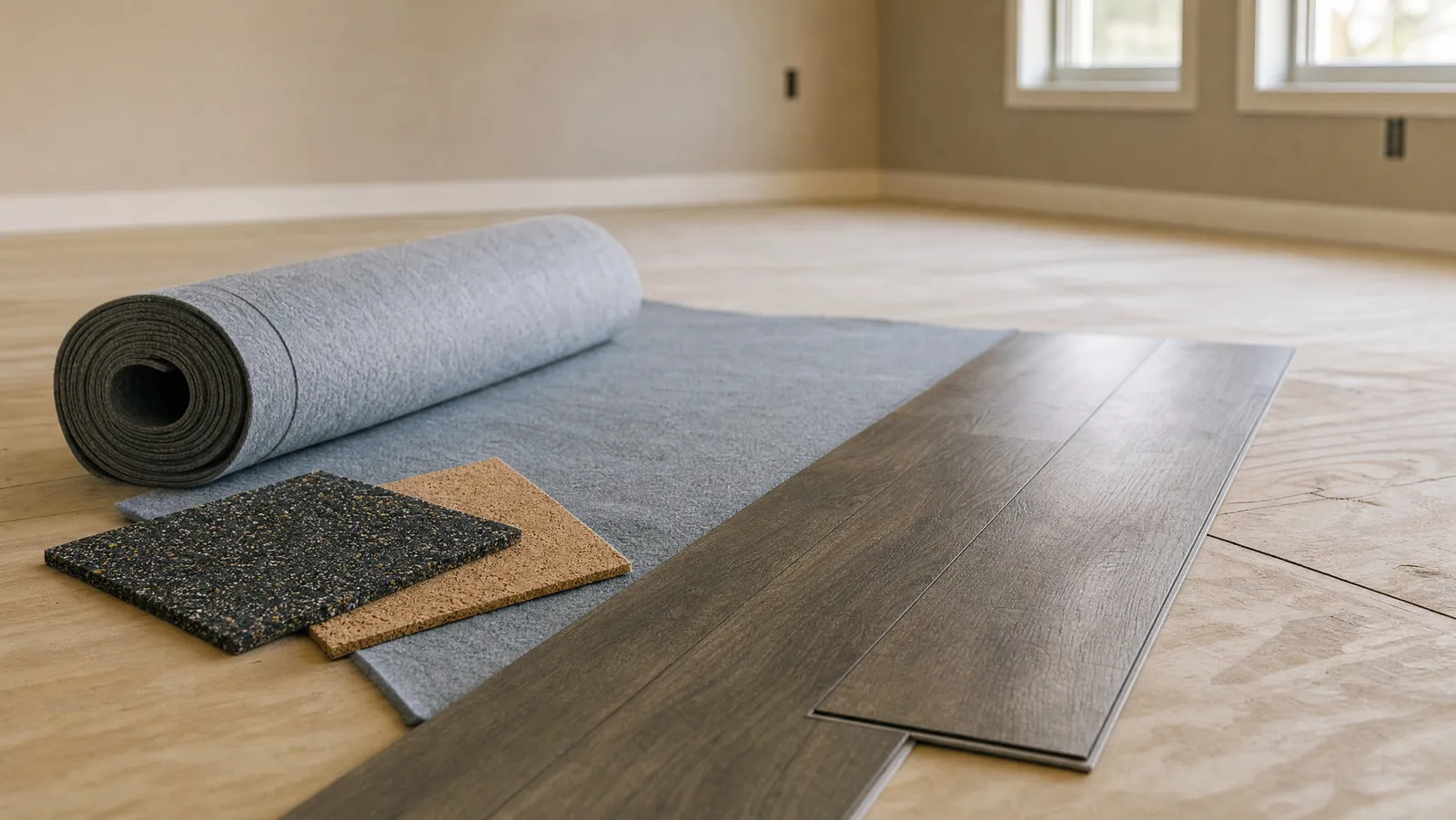
Thickness, in millimetres or inches. This is the one listing number that correlates with doing something, because deflection needs material to deflect in. You can see it inside Commercial Acoustics' own table of named materials: natural cork at 3 mm sits at a delta IIC of 18 to 21 and the same cork at 6 mm at 20 to 23, while recycled rubber at 5 mm sits at 21 to 25 and at 10 mm at 25 to 29. Those are underlayments measured on the bare 6-inch concrete reference slab that ASTM E2179 specifies rather than puzzle mats, but the direction of the effect is the physics, not the product.
Why thin closed-cell foam bottoms out
Impact isolation needs a resilient layer that deflects under load and keeps deflecting.
A ScienceDirect topic overview on resilient layers states that insulation materials suitable for use as a resilient layer under a floating floor need to have low dynamic stiffness, a parameter describing the ability of a resilient material to transmit vibration, and that as the dynamic stiffness of the resilient layer decreases, the impact sound reduction level increases. The same overview gives a working target of 8 MN/m3 or less, and notes that a layer with high compressibility can deflect under load and lose thickness, which increases its relative dynamic stiffness and deteriorates the acoustic performance of the layer.
Read that last clause again. The overview is describing a layer squashed by sustained load rather than by a single footfall, but we read the same mechanism in what a heel does to a thin tile. A resilient layer that runs out of travel stops being resilient. A point load - a heel, a chair leg, a dropped tin - compresses a few millimetres of foam to its limit and then transmits through what is effectively a hard surface.
Commercial Acoustics puts closed-cell polyethylene foam at 2 mm in the delta IIC 15 to 18 range, inside a band it labels minimal and annotates as thin foams that barely move footfall noise. That figure is for a named different material, measured as an underlayment installed over a bare 6-inch concrete reference slab, which is the way a layer like that is designed to be fitted. Nobody uses puzzle mats that way. The best case for thin foam in a laboratory, installed correctly, is the bottom of the published scale.
Closed-cell construction is also the wrong structure for the absorption half of the job. NASA Glenn Research Center's technical memorandum on acoustic absorption in porous materials (Kuczmarski and Johnston, NASA/TM-2011-216995) explains that a foam is open-cell when the pores interconnect without barriers between them, while in a closed-cell foam each bubble has intact walls and the internal volumes of the individual bubbles do not communicate, and that closed-cell foams are not typically useful as acoustic absorbers because, instead of penetrating into the foam, the acoustic pressure wave reflects from the outer surface.
What puzzle mats are actually good at
For a renter the advantages are real:
- Cheap coverage of an awkward area. A spare room, an alcove, a gym corner.
- Installs and lifts in one evening. No adhesive, no fasteners, nothing touching the subfloor, nothing to explain at move-out.
- Cuts with a utility knife. You can shape a run around a radiator or a door swing in minutes.
- Reconfigurable. Furniture moves, the tiles move with it.
- Takes the sharp top edge off an impact. The click and the clack get softer even when the thump does not.
- Warm and soft underfoot, which is why they outlast their acoustic purpose in most apartments.
That is a legitimate product. It is simply not an impact isolation system.
Interlocking foam tiles versus interlocking carpet tiles
These get searched as the same thing and they behave differently.
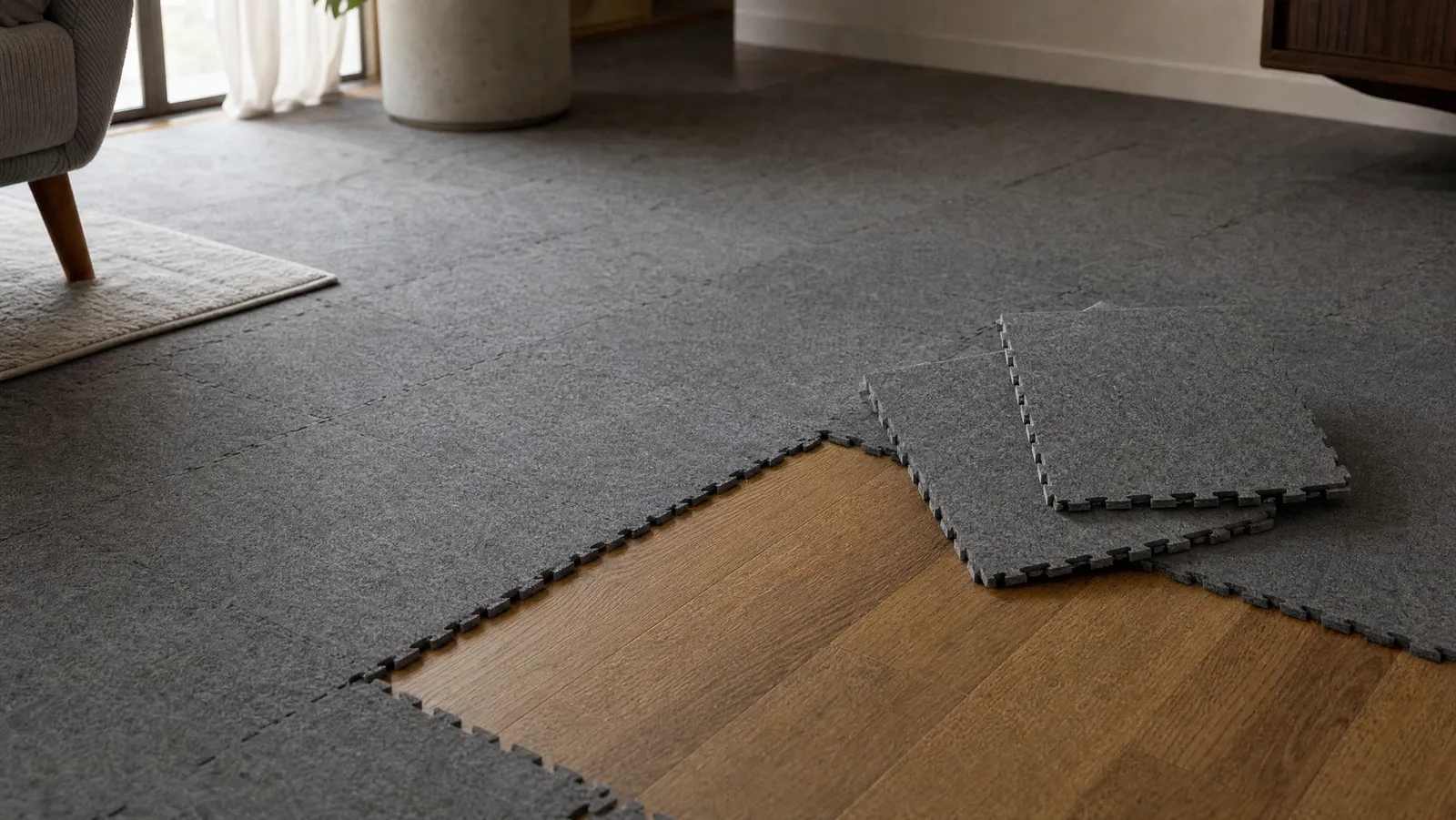
Carpet tiles bring a fibrous surface, so they absorb better. Goodrich Global, which sells acoustic carpet tiles, states that quality acoustic carpet tiles typically achieve NRC values between 0.15 and 0.35 - a seller's figure for its own category rather than a finding of ours, but consistent with what fiber does. The absorption effect of a fibrous floor is well documented for carpet proper: in acoustical research sponsored by the Alliance for Flexible Polyurethane Foam and the Carpet Cushion Council and conducted by Intertek Testing Services, as reported by FMLink, a commercial cut pile carpet direct-glued to concrete measured approximately NRC 0.25, rising to 0.55 once a bonded commercial polyurethane cushion went under it.
Foam tiles bring thickness and give, so they deflect better. Carpet tiles are usually a thinner profile with a stiffer backing, and a stiff thin layer has little travel under a point load.
So: carpet tiles for a room that sounds harsh and echoey to you. Foam tiles, thicker ones, for a zone where force enters the floor. Neither is an answer to a television through the ceiling below.
How to lay them if you are going to
- Go thicker and denser than the cheapest option. Thickness is the only listing number with a mechanism behind it.
- Cover the whole zone that generates the noise, not scattered squares. Impact energy goes in wherever the floor is still bare, and a neighbor judges your floor by your worst step, not your average one.
- Work out where that zone really is. It is rarely the middle of the room. It is a walkway, a desk chair, a treadmill deck, or a play corner - which is why pets and kids on hard floors is a problem in its own right rather than a footnote to this one.
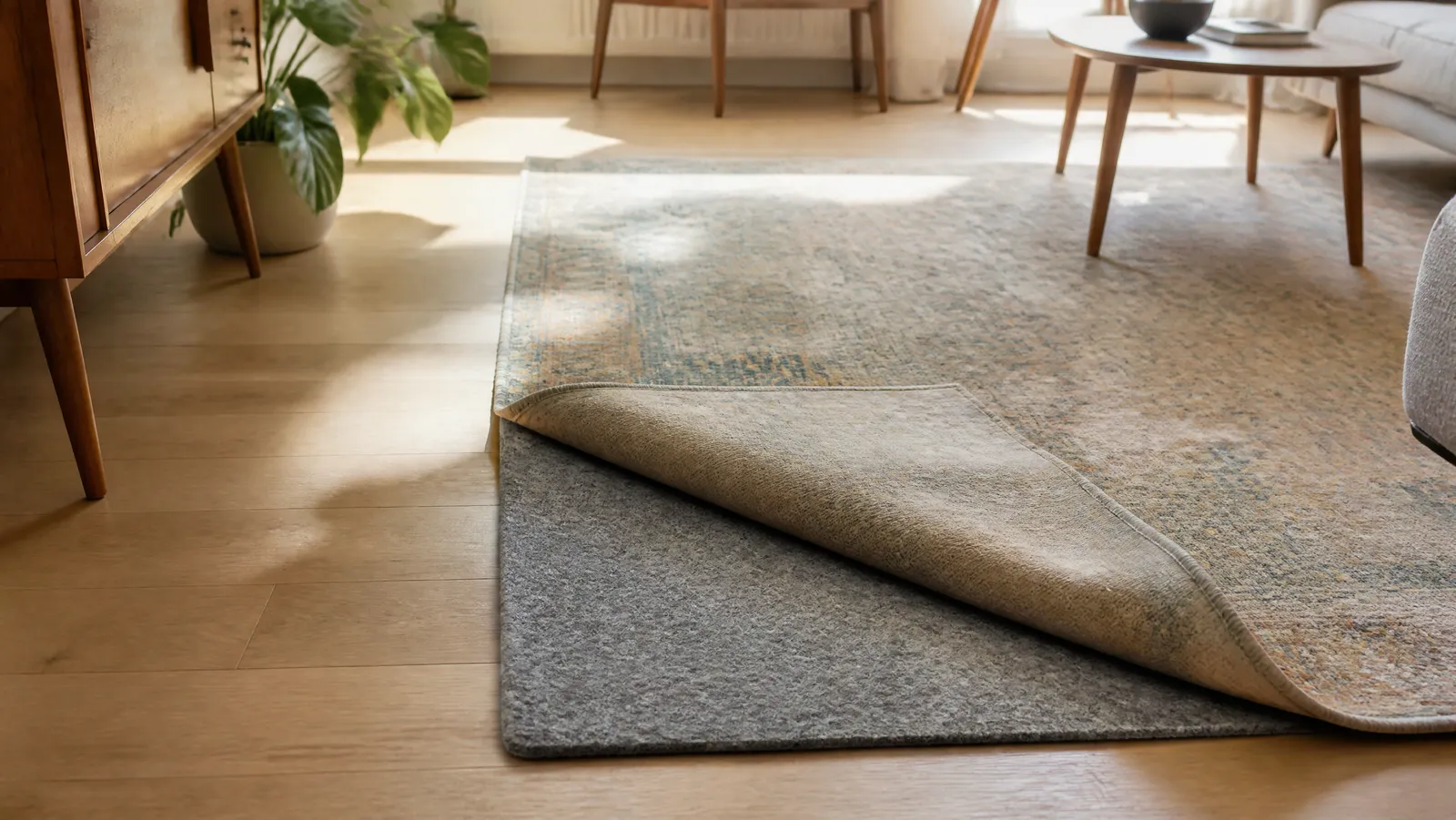
- Put a rug on top if you can stand the look. Fiber on top of give is the combination that works, and the Intertek figures above show what adding a resilient cushion under a fibrous surface does.
- Expect a difference in the click, not in the boom. Low-frequency thump is the part travelling furthest through your building and the part a few millimetres of foam is least able to touch.
What to buy instead if the complaint comes from downstairs
If the actual problem is the neighbor below, spend the money in this order.
- Change how you move. Free, applies to the entire floor, and more effective than a partial foam layer.
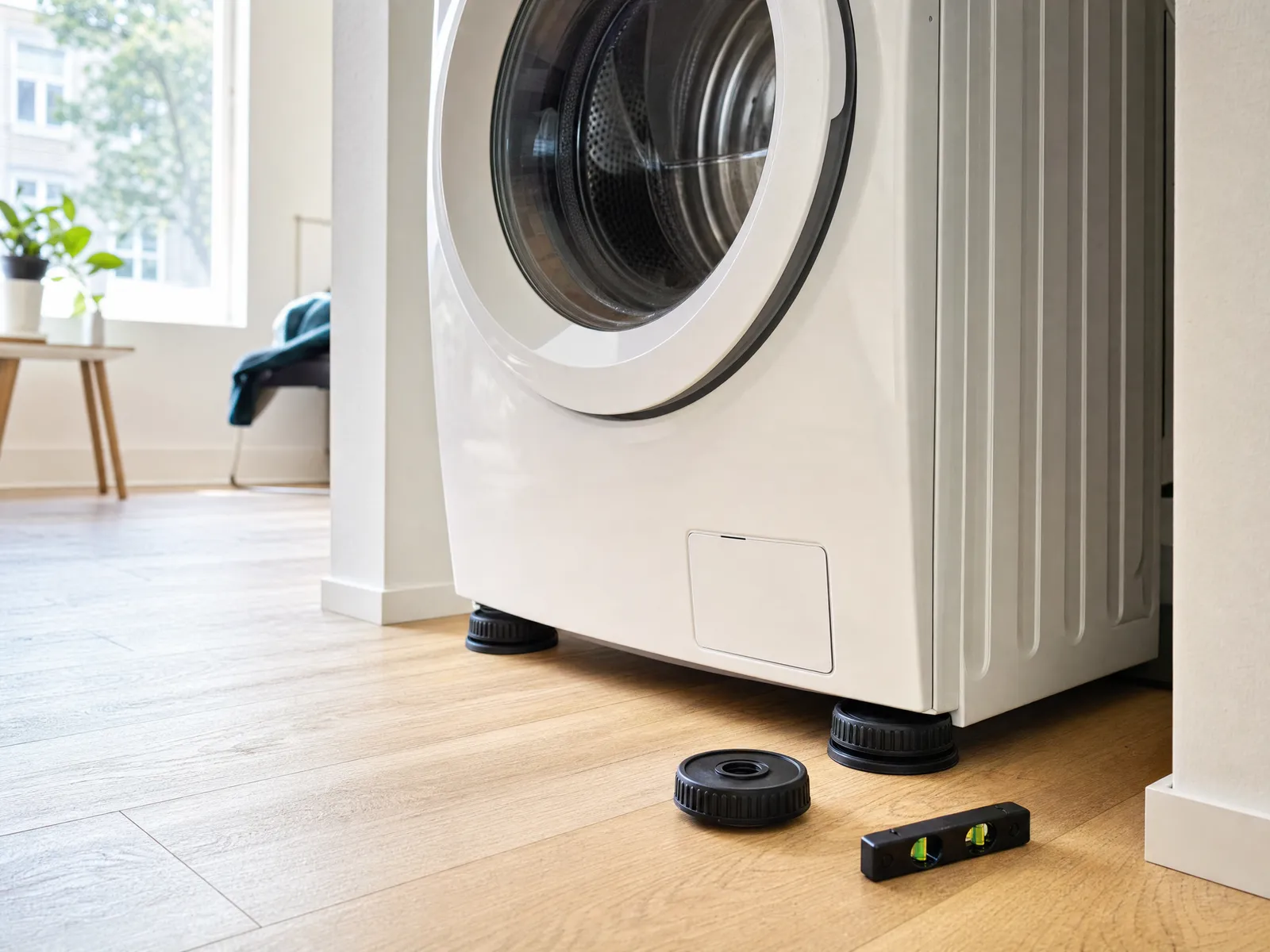
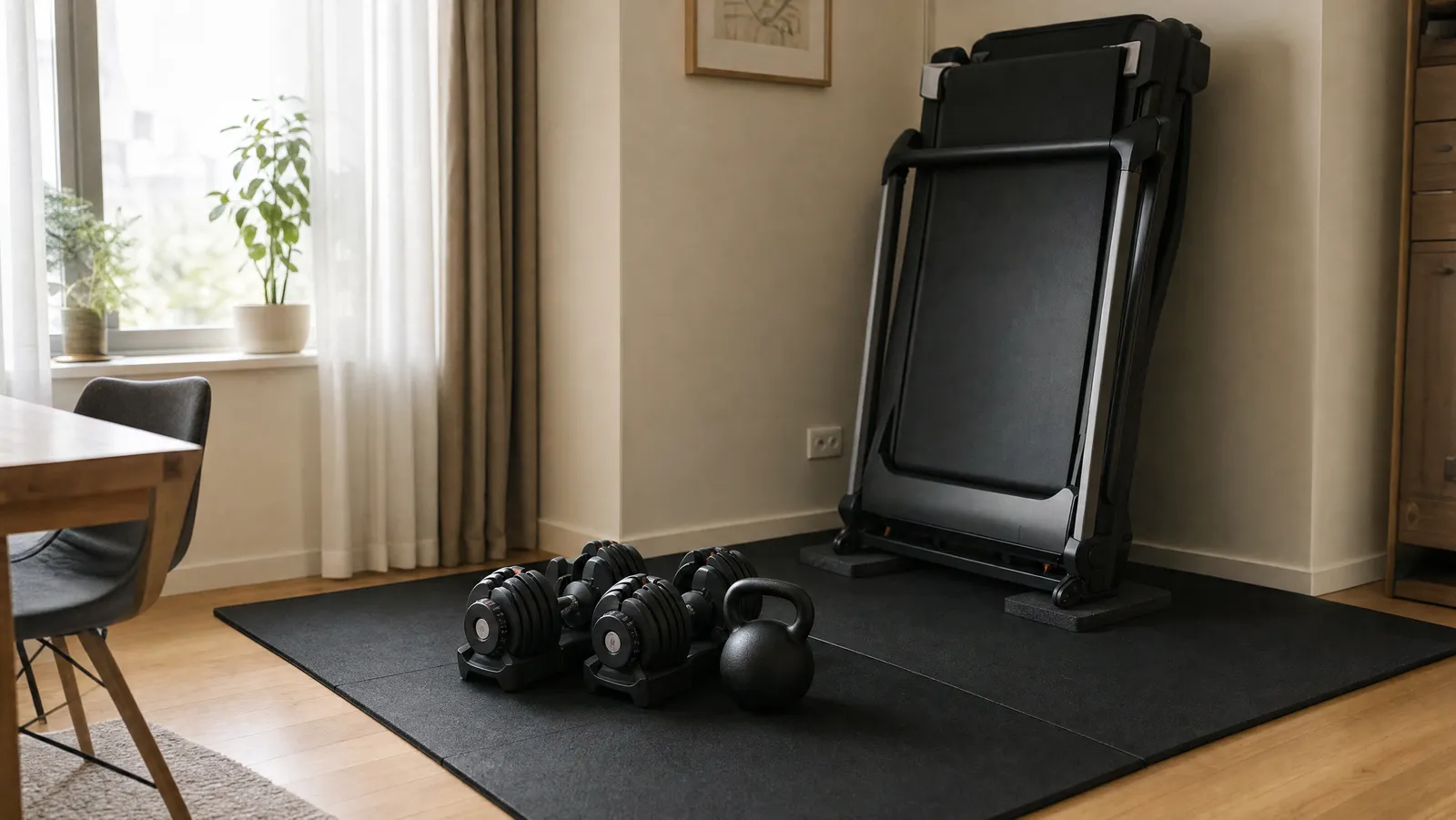
- Isolate the machines. Washer, dryer, treadmill, subwoofer. Four small hard feet are where vibration enters the structure, and a pad under each one is the cheapest mechanism-correct fix in this category.
- Rug plus a dense pad. The one combination in a rental with real measurement behind the mechanism. The same Intertek testing reported by FMLink took a bare concrete slab from IIC 19 to 58 with direct-glue carpet, and to 69 with a bonded commercial polyurethane cushion under the same carpet. Two caveats we will not bury: that is industry-sponsored testing, and it describes glued-down commercial carpet on concrete rather than an area rug in an apartment.
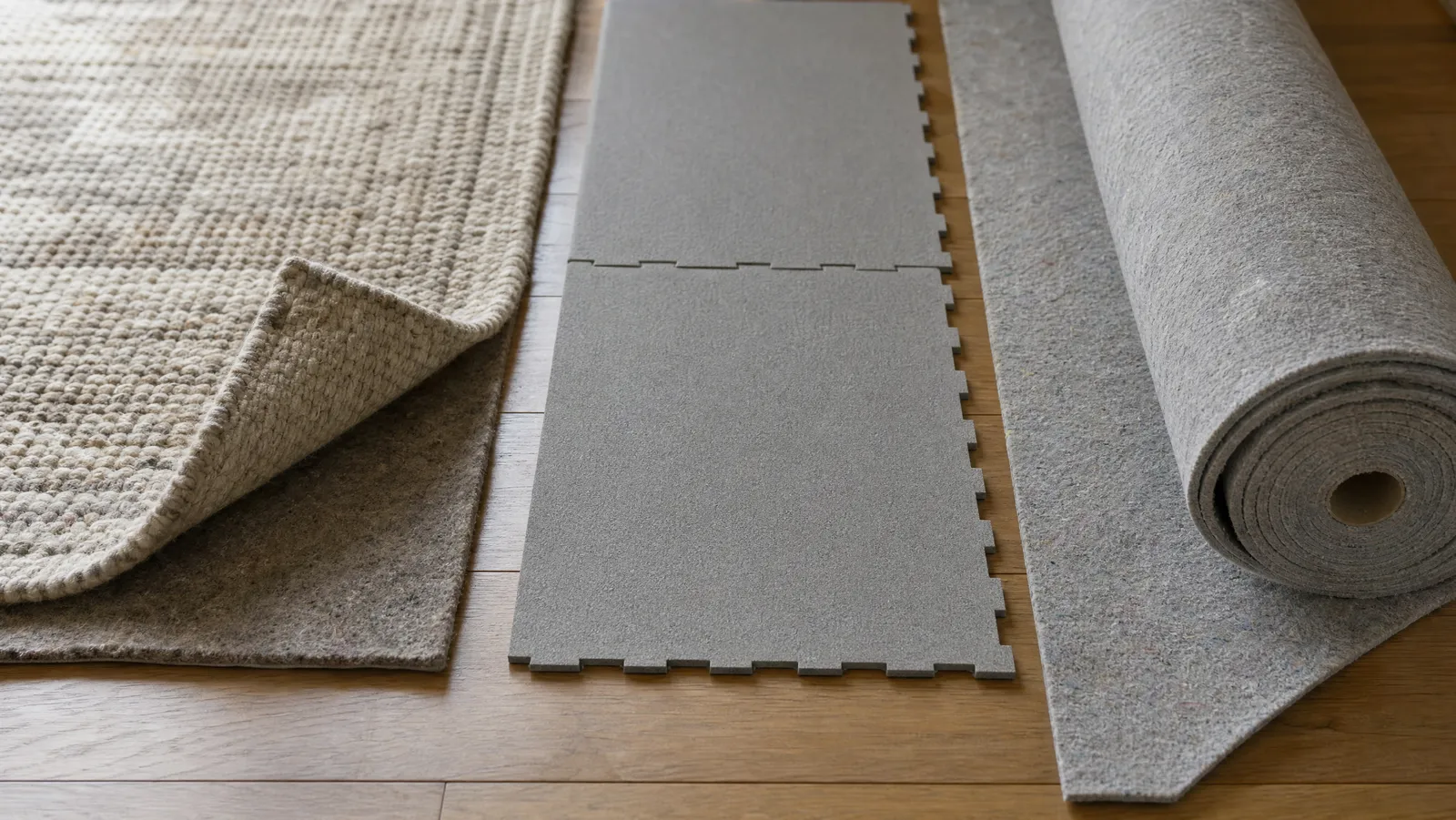
- Dense felt tiles over thin foam tiles where you want the interlocking format. They are the better-engineered cousin of the puzzle mat, and we went through the options in the best soundproof floor mats.
The verdict
Do interlocking foam tiles reduce impact noise? A little, where you laid them, and by an amount nobody has published.
They are a decent renter product sold with the wrong vocabulary. The absorption numbers describe your room. The STC and IIC numbers describe a laboratory assembly you do not own. The density figure has a tenfold spread hiding inside the phrase "high density". Thickness is the only listing number pointing at the mechanism, and every published figure for thin closed-cell foam in a named comparable material sits at the bottom of the scale.
Buy them for coverage, warmth, cuttability and the fact that they lift out in an evening. If the downstairs neighbor is the reason you are shopping, put the money into movement habits, machine isolation and a rug over a dense pad, and read what actually reduces impact noise underfoot before you order anything.

Lillie Metayer
Lillie Metayer is the founder of a local program that helps apartment-dwellers take action against noise pollution. Involved in environmental activism since high school, Lillie is passionate about raising awareness of the harms of noise exposure and helping people reduce noise in their communities. In her free time, Lillie enjoys playing the violin and spending time outdoors.