The best acoustic panels for walls in a rental are the ones that absorb the most echo without wrecking your deposit — and our top pick is the 2-inch, NRC 1.0 ATS Acoustics Sona panel. But read this first: every panel on this list absorbs echo inside your room. None of them blocks a noisy neighbor. If your real goal is soundproofing your apartment walls, that is a different job that needs mass and airtight seals, not fabric-wrapped foam.
We ranked these six on four things: measured absorption (NRC rating and thickness), how renter-friendly they are (damage risk and removability), how they look on a wall, and price. If you only want the echo on your calls, streams, and music to stop bouncing around a hard-floored apartment, any of these will help. If you want to stop hearing the neighbor's TV, none of them will — and we will explain exactly why below.
Absorbing vs. Blocking: Read This First
This is the single most important distinction in the whole category, and it is where most people waste money. Absorption and blocking are two different jobs done by two different products.
Acoustic panels absorb. They are porous, so sound waves that hit them get converted to a tiny amount of heat inside the material instead of bouncing back into the room. That reduces echo and reverb, which makes voices clearer and music tighter. Blocking, or true soundproofing, is about adding dense mass so sound cannot pass through a wall in the first place. According to Acoustical Surfaces, an NRC (Noise Reduction Coefficient) rating measures absorption while an STC rating measures blocking — so if a product listing shows an NRC number and no STC, it only absorbs.
That is why acoustic panels do nothing for a loud neighbor. As US Builders Depot's acoustics guide puts it, a panel's job is to improve the sound inside a room, not to stop sound from getting in or out; hang panels to fix your own echo and they work, hang them to silence the unit next door and they fail. If you have both problems, the order matters: block first, then treat the echo. This is also the myth that trips up foam buyers — we broke it down in detail in does acoustic foam actually block sound, and the short answer is no.
Keep that framing in mind for every pick below. When we say a panel "helps," we mean it cuts echo. We never mean it stops your neighbor.
Best Overall — ATS Acoustics Sona Fabric Acoustic Panel
This is the panel to buy if you want measured absorption rather than wall decoration. It is a 24" x 48" x 2" fabric-wrapped panel built around a mineral-wool core, fire-rated Class A per ASTM E84, and it carries a Noise Reduction Coefficient of 1.0 — the highest on this list. It ships with a mounting template and hardware and is made in the USA, and runs about $90 (as of July 2026).
The reason it wins is the 2-inch mineral-wool core. According to the acoustic-panel guide at AcousticPanelChina, a porous absorber only starts capturing a given frequency once its thickness reaches roughly a quarter of that frequency's wavelength, so the thicker the panel, the lower it reaches — which is why a 2-inch panel outperforms the thin peel-and-stick tiles across the low-mid range. An NRC of 1.0 means it absorbs essentially all the sound that hits it across the tested frequencies.
Who it is for: anyone serious about killing echo in a home office, studio corner, or hard-surfaced living room. The honest limitation is the usual one — this absorbs echo inside your room, it does not block a neighbor — plus one panel only covers 8 square feet, so plan on several, and stock was running low at the time we sourced it. Grab the ATS Acoustics Sona panel if performance is your priority.
Best Looking — Vellorise Acoustic Wood Slat Wall Panels
If you do not want the room to look like a recording booth, start here. The Vellorise set is four 47.24" x 12.79" walnut-look slat panels — about 16.8 square feet of coverage — built as MDF slats over a high-density polyester felt backing. They can be cut to size and mounted with nails or adhesive, and they cost about $58 (as of July 2026) for the pack.
The build is the whole point: the wood slats read as warm, intentional decor, and the felt visible in the gaps between slats absorbs some of the reflected sound. It is a genuine trade-off. Because much of the surface is solid wood rather than open absorber, these will not tame echo the way a full fabric-wrapped panel does, so do not expect the NRC 1.0 performance of the ATS pick. Think of them as the acoustic member of the decorative acoustic panels family — a category we cover on its own — that happens to warm up a wall while it works.
Who it is for: renters who care how the wall reads and want a modest echo improvement without a studio look. The honest limitation is that you are paying partly for aesthetics, so the absorption per square foot is lower than the dedicated panels here. If looks matter most, the Vellorise wood slat panels are the easy pick.
Best Renter-Friendly Pick — Kuchoow Hexagon Self-Adhesive Acoustic Tiles
For under thirty dollars, this is the lowest-risk way to try panels in an apartment. You get twelve peel-and-stick hexagon tiles (12" x 10" x 0.4") in dense polyester fiber at 9.63 lb/ft³. They install in minutes with no tools, and they come off without wrecking paint if you peel carefully. The set runs about $29 (as of July 2026).
The catch is thickness. At 0.4 inches these tiles only reach into the mid and high frequencies — the maker rates them for roughly 600–1600 Hz and 2200 Hz and up. That lines up with the quarter-wave physics above: a thin absorber physically cannot touch bass, so these will not quiet a bass-heavy neighbor or a rumbling subwoofer. What they will do is cut the harsh echo on video calls and streams, which for many renters is the whole problem.
Who it is for: first-timers, anyone testing whether panels help before committing money, and people who need the safest possible removal. The honest limitation is right there in the numbers — mid and high frequencies only, and, as always, echo control rather than blocking. If you want to dip a toe in, the Kuchoow hexagon tiles are the cheapest sensible start.
Best for Covering a Whole Wall — INNO STICKERS 3D Faux Brick Felt Acoustic Panels
When you want to treat an entire accent wall without spending studio money, this is the value play. The pack is sixteen 11.8" x 11.8" tiles in recycled-PET felt with a 3D faux-brick face, carrying a rated Noise Reduction Coefficient of 0.6–0.85. They install with included adhesive tabs and cost about $40 (as of July 2026) — roughly the price of a single premium panel, but enough to cover a full wall.
PET felt is worth understanding here. Per Wall Panels Pro, PET felt is made from recycled polyethylene terephthalate — usually old drink bottles — spun into a porous fiber that absorbs sound and, unlike raw mineral wool, can be a clean finished surface on its own. The 3D brick texture hides that it is acoustic felt at all, and an NRC of 0.6–0.85 is respectable across the mid and high frequencies, though like every felt tile here it does little for bass.
Who it is for: renters treating a large area on a budget who want texture, not a gray grid. The honest limitation is the mounting — the adhesive tabs are removable and renter-friendly, but permanent mounting needs a stronger adhesive, and the absorption is mid-and-high focused. For whole-wall coverage, the INNO STICKERS faux-brick panels stretch the furthest.
Best Premium Felt — ECOACOUSTICS RT60X PET Felt Acoustic Panels
If you want felt that looks deliberately designed, this is the nicest option here. The set is four 24" x 24" x 1" tiles in ultra-high-density 6K PET felt with a 12 mm core, a Class B fire-retardant treatment, and a heavy-duty peel-and-stick backing the maker rates as damage-free for rentals. It is the priciest felt on the list at about $133 (as of July 2026).
Two things justify the premium. First, at a full inch thick these do more than the 0.4-inch peel-and-stick tiles, reaching further down the frequency range for the same porous reason the 2-inch boards outperform everything. Second, the density and finish are a clear step up — the clean textile look and the damage-free backing make it an easy sell in a place you do not own. We are not quoting an NRC figure because the maker does not publish one, so judge it on thickness and density rather than a rating.
Who it is for: renters who want the polished, design-forward look without giving up real absorption. The honest limitation is price per square foot, and the reminder that one inch of felt still leans mid-and-high — it tames echo, it does not block. If finish matters, the ECOACOUSTICS RT60X panels are the best-looking felt we would buy.
Best for DIY Panels and Bass Traps — ROCKWOOL Rockboard 60 Mineral Wool Board
This is the pick for people willing to do a little building. Rockboard 60 is four 24" x 48" x 2" rigid mineral-wool boards at 6 lb/ft³ density, NRC 1.0, Class A fire rated, at about $123 (as of July 2026). It is raw material, not finished decor — the standard core that DIYers wrap in fabric to make their own panels and stack in corners as bass traps.
Why go this route? According to Wall Panels Pro, mineral wool has a more open, less dense fibrous structure than PET felt at the same thickness, which gives it slightly better low-frequency absorption — that is exactly why it is the material of choice for corner bass traps, where you are chasing the lowest frequencies in the room. Wrap these boards yourself and you get the same mineral-wool core that sits inside finished panels costing far more, for the most absorption per dollar on this list.
Who it is for: hands-on renters and anyone building a proper reflection-free setup on a budget. The honest limitations are real: it arrives as bare board, so you supply the frames and fabric; the fibers are itchy and want gloves and a mask; and it is not something you hang unfinished. Stock was low when we sourced it. If you like a project, the ROCKWOOL Rockboard 60 is the most cost-effective absorption you can buy.
How Many Panels Do You Actually Need?
You need fewer than the internet implies, and placement matters more than raw quantity. According to Burton Acoustix, most rooms show a clear improvement at around 20–30% wall coverage, and going past roughly 40% rarely adds much — it can even make a room sound lifeless and dead. So resist the urge to tile every wall; treat the surfaces that are actually bouncing sound at you.
The highest-value spots are your first reflection points — the places on the side walls where sound bounces once before it reaches your ears. Primacoustic's mirror trick is the easy way to find them: sit where you normally sit, have a friend slide a mirror along the side wall, and mark every spot where you can see your speaker (or your own mouth, for a call setup) in the glass. A panel on each of those marks does more than the same panels scattered randomly. For a hard-floored apartment, a couple of panels at the reflection points plus something on the wall behind your desk will usually knock the echo down noticeably.
If your budget is tight, do not feel obligated to cover a whole wall at once. Start with two panels at the first reflection points and add more only if the room still rings. If you would rather work from the physics than a coverage percentage, our free reverberation calculator works out how many sabins your room actually needs, counting the absorption your floor, walls and furnishings already provide before you add a single panel. And if what you actually want is to keep sound out rather than tidy the echo inside, panels are the wrong tool — the cheapest ways to soundproof a wall (a topic we will cover separately) start with sealing gaps and adding mass, not with buying more absorption.
The Bottom Line
Every panel here does one job well: it absorbs echo so your own room sounds cleaner. For most apartments we would buy the ATS Acoustics Sona for pure performance, the Kuchoow hexagons for the cheapest low-risk trial, and the Rockboard 60 if you enjoy a build. Just keep the expectation honest — none of these will help with a neighbor. If the noise is coming through the wall, what you want is quieting a noisy apartment wall with mass and seals, and panels are the finishing touch you add afterward, not the fix itself.

A 2-inch mineral-wool core wrapped in fabric, fire-rated Class A, with a Noise Reduction Coefficient of 1.0 — the highest absorption on this list. It ships with a mounting template and hardware and is made in the USA.
If you want a panel that measurably tames echo rather than just decorating the wall, this is the one. The thick mineral-wool core is what does the work, and NRC 1.0 means it absorbs essentially all the sound that hits it across the tested range.
*Price shown on Amazon and subject to change.

Four 47.24" x 12.79" walnut-look slat panels (about 16.8 sq. ft. of coverage) on a felt backing. They cut echo while reading as decor, and can be cut to size and mounted with nails or adhesive.
These are the panels you put up when you don't want the room to look like a recording booth. The slats-over-felt build absorbs some reflected sound and warms the room's look at the same time — a fair trade for renters who care how the wall reads.
*Price shown on Amazon and subject to change.
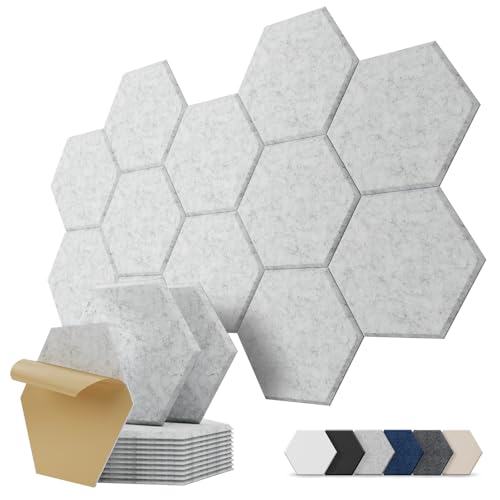
Twelve peel-and-stick hexagon tiles (12" x 10" x 0.4") in dense polyester fiber. They install in minutes with no tools and absorb mid-to-high frequencies, making them a cheap, damage-light option for a rental.
For under thirty dollars this is the lowest-risk way to try panels in an apartment. At 0.4 inches thick they only touch the mid and high frequencies — they will not quiet a bass-heavy neighbor — but for echo on calls and streams they help, and they come off without wrecking paint if you're careful.
*Price shown on Amazon and subject to change.

Sixteen 11.8" x 11.8" recycled-PET felt tiles with a 3D faux-brick face and a rated Noise Reduction Coefficient of 0.6-0.85. They install with included adhesive tabs and cover a full accent wall for the price of one premium panel.
This is how you treat a whole wall on a budget. The 3D brick texture hides that it's acoustic felt, the NRC of 0.6-0.85 is respectable for mid and high frequencies, and the adhesive tabs keep it renter-friendly — though permanent mounting needs stronger adhesive.
*Price shown on Amazon and subject to change.

Four 24" x 24" x 1" tiles in ultra-high-density 6K PET felt with a Class B fire-retardant treatment and a heavy-duty peel-and-stick backing rated by the maker as damage-free for rentals.
The most polished-looking felt option here, and the thickest at a full inch, so it does more than the thin peel-and-stick tiles. You pay for the finish and the density, but the damage-free backing and clean textile look make it an easy sell in an apartment you don't own.
*Price shown on Amazon and subject to change.

Four 24" x 48" x 2" rigid mineral-wool boards at 6 lb/ft³ density, NRC 1.0, Class A fire rated. This is raw material, not finished decor — the standard core for building your own fabric-wrapped panels and corner bass traps.
If you're willing to wrap boards in fabric yourself, this is the most absorption per dollar you can buy. It's the same mineral-wool core that sits inside panels costing far more. Just know it arrives as bare board — you supply the frames and fabric.
*Price shown on Amazon and subject to change.
| Pick | Product | Link | |
|---|---|---|---|
| Best Overall | ATS Acoustics — ATS Acoustics Sona Fabric Acoustic Panel (24" x 48" x 2", NRC 1.0) | $89.99 | Check → |
| Best Looking | Vellorise — Vellorise Acoustic Wood Slat Wall Panels (4-Pack, Walnut) | $58.49 | Check → |
| Best Renter-Friendly Pick | Kuchoow — Kuchoow Hexagon Self-Adhesive Acoustic Tiles (12-Pack) | $28.99 | Check → |
| Best for Covering a Whole Wall | INNO STICKERS — INNO STICKERS 3D Faux Brick Felt Acoustic Panels (16-Pack) | $39.99 | Check → |
| Best Premium Felt | ECOACOUSTICS — ECOACOUSTICS RT60X PET Felt Acoustic Panels (4-Pack, 24" x 24") | $132.89 | Check → |
| Best for DIY Panels and Bass Traps | Roxul — ROCKWOOL Rockboard 60 Mineral Wool Board (2", 4-Pack) | $122.99 | Check → |

Lillie Metayer
Lillie Metayer is the founder of a local program that helps apartment-dwellers take action against noise pollution. Involved in environmental activism since high school, Lillie is passionate about raising awareness of the harms of noise exposure and helping people reduce noise in their communities. In her free time, Lillie enjoys playing the violin and spending time outdoors.