The best rug pad for soundproofing is the thickest, densest felt pad you can fit under the biggest rug the room will take — and it has to go on the floor above the noise, not the ceiling below it. Our overall pick is RUGPADUSA's quarter-inch felt-and-rubber Dual Surface pad, about $90 for an 8-by-10 as of August 2026.
That first sentence creates an awkward split, so let's name it. Two very different people land on this page:
- You're the one downstairs. You hear heels at 11 p.m. and you've read that rugs help. They do — but the rug has to be in their apartment. You're shopping for something to give, lend, or attach to a polite ask.
- You're the one upstairs. Someone knocked, or left a note, or you looked at your bare hardwood and did the math. You're the reader who can fix this today.
Both of you are in the right place. If you're downstairs, this is one chapter of our larger guide to reducing noise from upstairs neighbors — and the only chapter where the fix genuinely works rather than just taking the edge off.
Why a Rug Pad Is the One Upstairs-Noise Fix That Actually Works
Footsteps are impact noise. A heel strike puts its energy straight into the floor structure, which carries it through the building as vibration — which is why it arrives as a thud you feel as much as hear. That's a different transmission path from a TV or a conversation, which move through air and leak through gaps. We break the distinction down in impact noise vs. airborne noise, and it's why the two problems need opposite treatments.
Acoustics has a number for this. According to Soundproof Cow, Impact Insulation Class (IIC) measures how well a floor-ceiling assembly blocks structure-borne noise from footsteps, dropped objects and furniture movement, tested in a lab under ASTM E492 with a standardized tapping machine on the floor above. According to Commercial Acoustics, the International Building Code sets a minimum of IIC 50 for the floor-ceiling assemblies that separate one dwelling unit from another in multifamily housing (IBC Section 1206; the field-tested equivalent is 45).
Here's the number that should decide your purchase. Commercial Acoustics lists a 6-inch concrete slab with no treatment at a typical IIC 25 to 35, and the same slab with carpet and pad on top at IIC 65 to 75. Nothing else a renter can buy moves a floor that far. Acoustical consultants Graeme E Harding and Associates put it bluntly in guidance published by the Carpet Institute of Australia: "The installation of carpet or similar types of floor covering is the only method available for eliminating excessive noise generated by floor impacts," with carpeted floors capable of reducing noise by over 20 decibels.
Read that carefully, because it contains the whole problem and the whole solution. The treatment goes on top of the floor, at the point of impact. If you're downstairs, that surface is in someone else's apartment, and everything you can do from below is damage control — we cover the realistic version of that in how to soundproof an apartment ceiling. If you're upstairs, the reverse is true: you own the single most effective lever in the building, and it costs less than a hundred dollars.
What Makes a Good Rug Pad for Noise Reduction in an Apartment
Four things, in order of how much they matter.
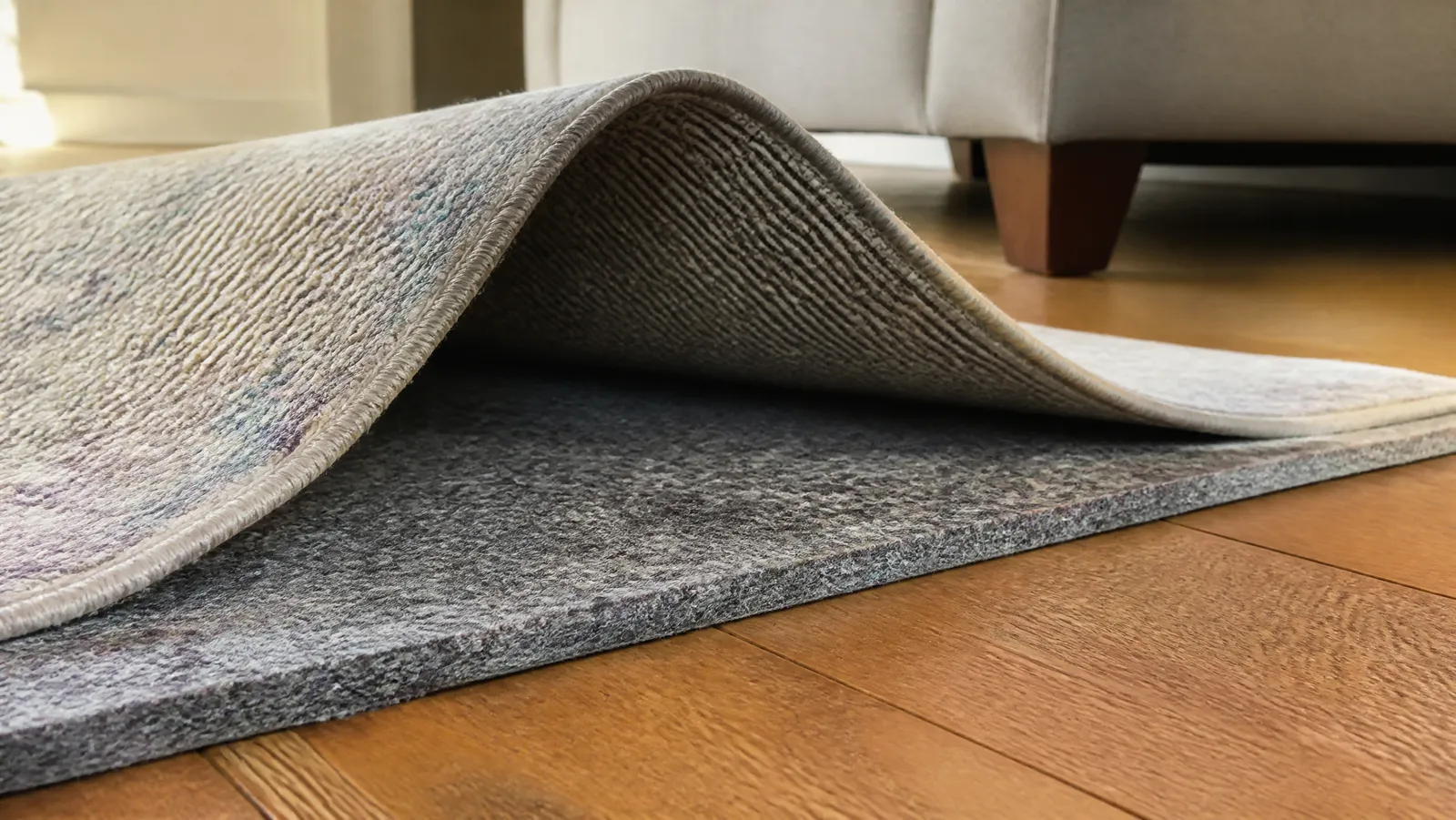
1. Felt, and lots of it. Felt is dense, compressible fiber with both mass and spring, so it absorbs impact energy instead of passing it along. This is the working part of the pad. According to the Acousart soundproof rug pad guide, high-density felt with a rubber backing is the construction to look for, and thicker pads in the 0.25-to-0.5-inch range yield greater impact sound reduction.
2. Thickness. More felt means more absorption. RUGPADUSA's own guidance on thick pads notes that soundproofing is a property more prominent in thicker pads, and that a thick felt pad dampens sound. A quarter-inch is the standard, widely available thickness; three-eighths and half-inch felt do more. According to Jaipur Rugs' rug pad guide, 1/4 to 3/8 inch is the sweet spot for living rooms — enough cushioning and sound absorption without throwing off furniture balance or catching on door clearance. In an apartment with doors that swing inward over a rug, measure first.
3. Density, if it's published. Few listings give a density figure. When one does — like the 24 ounces of felt per square yard on the RUGPADUSA Basics pad — it's the most useful spec on the page, because two pads of identical thickness can be very different products.
4. Rubber, for grip only. A natural rubber backing keeps the rug from sliding on hard floors without glue or adhesive, which is exactly what a renter needs. It is not the acoustic layer. A thin rubber or PVC film has almost no mass and almost no thickness, so it does very little for impact noise on its own — the Acousart comparison rates a PVC grid mat as low for noise reduction. Grip and quiet are separate jobs, and only felt does the second one.
The trap: grip-only mats and real felt pads sit side by side in the same sizes with similar-sounding copy. The price gap tells you which is which.
The Best Rug Pads for Soundproofing, Ranked
All prices are for the 8-by-10 size as of August 2026. Amazon pricing moves constantly, so treat them as a snapshot.
Best Overall for Footstep Noise — RUGPADUSA Dual Surface Felt + Rubber
Heat-pressed quarter-inch felt bonded to a natural rubber non-slip backing, about $89.95 as of August 2026 (down from a $120.95 list price). RUGPADUSA makes it in the USA from 100% recycled, needle-punched felt that's low-VOC and hypoallergenic, and the maker states the felt adds soundproofing and insulation.
The renter-relevant part: no glues, no PVC, no adhesives anywhere in it, and it's rated safe on hardwood, laminate, stone, tile, bamboo, concrete and radiant heat. Nothing about installing it can cost you a deposit — roll it out, put a rug on it, done.
This is the pad we'd name in a note to an upstairs neighbor, and the one we'd buy for our own floor. If you want to stop reading and act, the RUGPADUSA Dual Surface pad is the safe choice.
Honest limitation: a quarter-inch is the standard thickness, not the maximum. If your doors and furniture allow it, thicker felt does more.
Most Felt per Dollar — RUGPADUSA Basics 100% Felt
About $69.94 as of August 2026 (list $99.95) for 100% felt, no rubber layer, at roughly a quarter-inch thick and 24 ounces of felt per square yard. RUGPADUSA states it's good for noise reduction and insulation, and it's USA made with no glues, PVC or latex. It's also sold in thicker 3/8-inch and 1/2-inch versions, which is the real reason to look at this line.
Honest limitation, and it's a big one: RUGPADUSA explicitly labels this pad not non-slip and tells you to use it under a heavy rug or one anchored by furniture. Under a light rug on bare hardwood, it will slide. Don't buy it for a runner or a small entry rug — buy it for a big wool rug with a sofa sitting on two corners.
Best Value — Deep Dream Felt + Natural Rubber
About $59.55 as of August 2026 (list $89.99) for a quarter-inch of felt over a natural rubber backing — the same construction as our top pick at the same stated thickness, for about thirty dollars less. Deep Dream cites preventing bunching and reducing noise, and rates it for hardwood, stone, vinyl, laminate, tile and carpet. The felt is hypoallergenic, moisture-resistant and low-VOC.
The sleeper feature is that it's trimmable with household scissors. Apartment rooms are rarely the shape of a rug, and cutting a pad to clear a radiator or an odd alcove is worth more than it sounds. If your budget is the difference between a real felt pad and nothing, get the Deep Dream felt and rubber pad.
Honest limitation: you're trusting a less established brand's published spec, and there's no long warranty behind it.
Cheapest Real Felt + Rubber Pad — TravLand Non-Slip Felt & Rubber
About $46.99 as of August 2026 (list $49.99) for a dense felt top layer over a high-traction rubber backing. TravLand describes the rubber base as 100% waterproof against spills and pet accidents — a genuine perk in a rental where a stain is a line item. It's trimmable, latex-free and odor-free per the maker, and specified for use underneath an area rug rather than as a standalone mat.
Honest limitation: the listing publishes no thickness figure, and thickness is the number that decides how much footstep energy a pad absorbs. We won't estimate one for you. You're buying the right construction without the spec that determines performance — a fair trade at this price, but a real unknown.
The Long-Warranty Upgrade — RUGPADUSA Eco-Complete
About $150.40 as of August 2026 for dense quarter-inch felt over a natural rubber non-slip backing, USA made with low-VOC materials and covered by a 5-year manufacturer's warranty instead of the 2 years on RUGPADUSA's standard felt-and-rubber pad. Stock was low when we sourced it.
Honest limitation: this is nearly double the price of the Dual Surface pad at the same stated quarter-inch thickness, so expect the acoustic difference to be negligible. You are not buying more quiet; you are buying three more years of warranty and a greener build. Legitimate if the pad is going under a rug you'll never move again. Not if you're chasing footstep noise on a budget.
The Kind to Skip for Noise — TravLand PVC Anti-Slip Carpet Gripper Mat
About $25.99 as of August 2026 for a thin, textured PVC mesh sold in 14 sizes, trimmable with household scissors, lightweight and non-adhesive with no residue.
We're including it because you'll see dozens of these, they're the cheapest thing in the category, and the marketing invites the wrong purchase. TravLand's copy claims the mat "minimizes footstep noise" and adds "subtle cushioning."
Here's our pushback. A thin PVC mesh has almost no mass and almost no thickness, the only two properties that meaningfully absorb impact energy — and the Acousart guide rates PVC grid mats as low for noise reduction. "Subtle cushioning" is accurate, and subtle is not what a downstairs neighbor needs at 11 p.m.
It's genuinely good at the job it's built for: keeping a rug from creeping across tile. If that's your problem, buy it. If footsteps are your problem, spend twenty dollars more on the TravLand felt-and-rubber pad and get an actual felt layer.
The Pad Is Half the System: The Best Rugs to Reduce Footstep Noise
A pad under a thin, flat rug beats nothing. A pad under a thick, dense rug is a different animal. Both layers add mass and both absorb impact, so treat it as one assembly rather than a pad plus a decoration. What to prioritize in the rug:
- Pile height and density. A high, dense pile — wool, heavy shag, thick tufted synthetic — absorbs more than a flatweave or jute rug, which are essentially stiff mats.
- Weight. If you can barely carry it up the stairs, it's doing acoustic work. Weight is also what makes the not-non-slip RUGPADUSA Basics pad viable.
- Backing. A rubber- or latex-backed rug adds a little mass, though it's no substitute for the pad.
Skip the very thin "apartment-friendly" rugs sold on their low profile. Low profile means low mass, the opposite of what impact noise needs.
Coverage Math: Why a Thick Rug Pad for Downstairs Neighbors Needs Square Footage
This is where most people get the trade-off backwards. A half-inch pad under a 5-by-7 rug floating in the middle of a 12-by-15 living room leaves every walking lane bare. Nobody walks through the middle of a room — they walk door to couch, couch to kitchen, bed to bathroom, and those lanes hug the edges.
On a fixed budget, buy coverage before thickness. A quarter-inch pad under a 9-by-12 rug beats a half-inch pad under a 5-by-8 every time, because it sits under the footsteps that are actually happening. The Acousart guide makes the same point: cover large floor sections rather than small ones, and concentrate coverage in high-traffic areas.
There's a useful benchmark from the rental world. According to StreetEasy, leases and co-op agreements in many buildings — New York City is the classic example — include a clause requiring residents to cover roughly 80% of their floors with carpeting or rugs, usually excluding kitchens and bathrooms, with area rugs counting toward the total. That's a common lease and building-rule clause, not a law. But it's a good target regardless of what your lease says, and it's a specific, non-hostile thing to point at: "the building standard is 80% coverage" lands much better than "you're loud."
Practical version: measure the room, buy the largest rug that still leaves an even border of visible floor, then match the pad to it, trimmed slightly smaller so the edges stay hidden.
If You're the One Downstairs: How to Ask Without Starting a War
You're asking someone to spend money and rearrange their living room for your benefit. It can absolutely work. Here's what makes it work:
- Assume they don't know. Most upstairs neighbors have no idea how much of their normal walking transmits downward — the structural reasons are laid out in why upstairs neighbors are so loud, and none of them are about anyone being rude.
- Ask for one specific thing. "Would a rug pad in the hallway help?" is answerable. "Could you be quieter?" is not.
- Offer to pay. A $60 pad is cheaper than months of bad sleep and far cheaper than moving. Buying it turns a complaint into a favor.
- Don't cite a standard at them. Mention 80% coverage as a building norm, not a rule you're enforcing.
- Give them an easy out on timing. "Whenever it's convenient" gets a yes far more often than a deadline does.
- Go to management only after. A documented friendly ask makes a later complaint much stronger.
If the answer is no, or there's no answer at all, your remaining moves are on your side of the ceiling — and you should set expectations before you spend. That includes ceiling treatments, which get sold for exactly this problem and mostly don't solve it. Read do ceiling acoustic panels work before you buy any.
What a Rug Pad Will Not Fix
Being straight about the limits is the only way the recommendation above stays trustworthy. A felt pad handles impact energy at the walking surface. It does not handle:
- Bass and subwoofers. Low frequencies move through the building structure itself; felt on the floor barely touches them.
- Voices, TV and music. Airborne noise on a different path — through the ceiling assembly, wall cavities, vents and gaps.
- Furniture dragging at 2 a.m. A chair pulled across a hard floor still transmits, and a rug only helps where the rug is. Felt pads under the chair legs fix that one.
- Bare hallways, kitchens and bathrooms. These almost never get rugs, and they're where hard-soled shoes are loudest.
- Dogs, kids running, or a treadmill. It'll take the sharp edge off. It won't make them inaudible.
Expect a real, noticeable reduction in the sharp crack of footfall, and expect the low thud to survive. That's an honest description of what this purchase buys.
The Honest Bottom Line
If you're the upstairs neighbor: buy a quarter-inch felt-and-rubber pad, put it under the largest rug your main living space will take, and you'll have done more for the person below you than every other product on this site combined. The RUGPADUSA Dual Surface pad is the pick at about $90 as of August 2026; Deep Dream does the same job for about $60; the RUGPADUSA Basics felt pad gives you the most raw felt for the money if — and only if — a heavy rug or furniture holds it down. Skip the PVC gripper unless all you want is grip.
If you're the downstairs neighbor: the product is right, the location is wrong, and shopping won't change that. Your best play is a specific, friendly, funded ask. The Soundproof Apartment's upstairs-noise guide walks the whole sequence, from that first conversation to what's worth buying when it doesn't work.
Either way, the physics don't negotiate: mass and thickness at the point of impact, over as much floor as you can cover. Everything else is a rounding error.

A quarter-inch of heat-pressed felt over a natural rubber non-slip backing, made in the USA from 100% recycled felt. No glues, PVC or adhesives, and rated by the maker for hardwood, laminate, stone, tile, bamboo, concrete and radiant heat.
This is the one to ask your upstairs neighbor for, or to put under your own rug so you are never the problem for the unit below. The quarter-inch of dense felt is what soaks up footstep energy; the rubber layer just keeps the rug from sliding. RUGPADUSA states the felt adds soundproofing and insulation, and it does it without a drop of adhesive touching a rental floor.
*Price shown on Amazon and subject to change.

All felt, no rubber: 24 ounces of felt per square yard at roughly a quarter-inch thick, USA made with no glues, PVC or latex. Also sold in thicker 3/8-inch and 1/2-inch versions.
Pure mass for the money, and the only pad here that publishes an ounces-per-square-yard figure. The catch is non-negotiable: RUGPADUSA explicitly labels this pad NOT non-slip and says to use it under a heavy rug or one anchored by furniture. Put it under a light rug on bare hardwood and it will wander. Buy it for a big, heavy rug, and buy it thicker if the listing lets you.
*Price shown on Amazon and subject to change.

A quarter-inch of felt over a natural rubber backing for about two-thirds the price of the RUGPADUSA equivalent. Trimmable with household scissors, hypoallergenic, moisture-resistant and low-VOC.
Same construction as our top pick at the same stated thickness, for meaningfully less money. Deep Dream cites preventing bunching and reducing noise, and the trimmability matters more than it sounds in an apartment where rug sizes rarely match room shapes. If budget is the deciding factor between buying a real felt pad and buying nothing, buy this.
*Price shown on Amazon and subject to change.

A dense felt top layer over a high-traction rubber backing that TravLand describes as 100% waterproof against spills and pet accidents. Trimmable with scissors, latex-free and odor-free per the maker.
The cheapest way onto this list without dropping down to a grip-only mat. Be clear-eyed about one thing: the listing does not publish a thickness figure, and thickness is the number that matters most for footstep noise, so you are buying without the spec that decides performance. TravLand also specifies it is for use underneath an area rug, not as a standalone mat.
*Price shown on Amazon and subject to change.

Dense quarter-inch felt over a natural rubber non-slip backing, made in the USA with low-VOC materials, and carrying a 5-year manufacturer's warranty instead of the 2 years on RUGPADUSA's standard felt-and-rubber pad.
Honest read: this is nearly double the price of the Dual Surface pad at the same stated quarter-inch thickness, so expect the acoustic difference to be negligible. What you are paying for is the extra three years of warranty and the eco-focused build. Worth it if this pad is going under a rug you never plan to move again; otherwise the top pick does the same acoustic job for $60 less.
*Price shown on Amazon and subject to change.

A thin textured PVC mesh gripper sold in 14 sizes, trimmable with household scissors, lightweight and non-adhesive with no residue left behind.
It grips, it is cheap, and it will keep a rug from sliding on tile. But the marketing copy claims it minimizes footstep noise and adds subtle cushioning, and that is the part we would push back on: a thin PVC mesh has almost no mass and almost no thickness, which are the two properties that actually stop impact energy. Buy it to stop a rug from creeping. Do not buy it to stop your neighbor from hearing you.
*Price shown on Amazon and subject to change.
| Pick | Product | Link | |
|---|---|---|---|
| Best Overall for Footstep Noise | RUGPADUSA — RUGPADUSA Dual Surface Felt + Rubber Rug Pad (8' x 10', 1/4-inch thick) | $89.95 | Check → |
| Most Felt per Dollar | RUGPADUSA — RUGPADUSA Basics 100% Felt Rug Pad (8' x 10', 1/4-inch thick) | $69.94 | Check → |
| Best Value | Deep Dream — Deep Dream Felt + Natural Rubber Rug Pad (8' x 10', 1/4-inch thick) | $59.55 | Check → |
| Cheapest Real Felt + Rubber Pad | TravLand — TravLand Non-Slip Felt & Rubber Rug Pad (8' x 10', dark gray) | $46.99 | Check → |
| The Long-Warranty Upgrade | RUGPADUSA — RUGPADUSA Eco-Complete Felt + Rubber Rug Pad (8' x 10', 1/4-inch thick) | $150.40 | Check → |
| The Kind to Skip for Noise | TravLand — TravLand PVC Anti-Slip Carpet Gripper Mat (8' x 10') | $25.99 | Check → |

Lillie Metayer
Lillie Metayer is the founder of a local program that helps apartment-dwellers take action against noise pollution. Involved in environmental activism since high school, Lillie is passionate about raising awareness of the harms of noise exposure and helping people reduce noise in their communities. In her free time, Lillie enjoys playing the violin and spending time outdoors.