Let's be honest, because a lot of people learn this the expensive way: no, acoustic foam does not block sound. It absorbs echo and reflections inside your room, and it does almost nothing to stop noise passing through a wall. If you stuck egg-crate foam on a shared wall hoping to mute a loud neighbor, you bought the right product for the wrong job.
That distinction, between absorbing sound and blocking it, is the single most important idea in this whole site, and it's the reason so many people feel cheated by a wall of foam. Below we'll walk through what foam genuinely does well, why physics won't let it quiet your neighbor, and what actually will. If your real goal is a quieter shared wall, start with how to soundproof apartment walls and treat this article as the "why foam isn't the answer" companion.
What Acoustic Foam Actually Does
Acoustic foam is an absorber. When sound waves bounce around a bare room, that soft, open-celled foam catches some of the energy in the mid and high frequencies instead of letting it reflect off hard walls. The result is less echo, less reverberation, and clearer-sounding audio in the room. That's it. That's the whole job.
How well a material absorbs is measured by its NRC (Noise Reduction Coefficient). According to Commercial Acoustics, NRC is the average of a material's absorption coefficients measured at 250, 500, 1,000, and 2,000 Hz, on a scale from 0.0 to 1.0, so a panel rated NRC 0.85 absorbs roughly 85% of the sound energy that hits its surface rather than reflecting it back.
Here's the catch most foam buyers miss: thin foam is weak foam. According to Sound Pro Solutions, a typical 2-inch acoustic foam panel lands around NRC 0.60 to 0.75 and barely absorbs anything below 500 Hz. The bargain 1-inch wedge tiles you see in bulk online are thinner and worse, and they do nothing for low, boomy bass. So even at the one thing foam is designed to do, cheap thin foam is only mediocre. That's why a room papered in dollar-store wedges can still sound boomy, the foam is skimming off the top of the frequency range and leaving the low end untouched.
Why It Can't Block Your Neighbor
Blocking sound is a completely different physics problem from absorbing it. To stop airborne noise from crossing a wall you need three things foam simply doesn't have: mass, an airtight seal, and decoupling (structurally separating the two sides so vibration can't travel across).
Foam fails on all three. It's light, it's porous, and air (along with sound) passes right through it. As the sound-panel maker Persy Booths puts it, sound-absorbing foam works entirely within a space and does not stop sound from entering or leaving a room.
The mass part is governed by a rule acousticians call the mass law. According to Aural Exchange, a barrier's transmission loss increases by about 6 dB for every doubling of its mass per unit area. In plain terms: to block more sound, you add weight. A square foot of foam weighs almost nothing, so it adds almost nothing to a wall's blocking power. Picture it this way, a sheet of drywall or a slab of mass-loaded vinyl is heavy enough to be a barrier; a foam wedge is so light you can toss it across the room, and sound treats it about the same way, passing straight through.
Absorption and blocking even use different scorecards. Absorption is rated by NRC; blocking is rated by STC (Sound Transmission Class). According to Commercial Acoustics, apartments and condos generally need a wall around STC 50 to 55 to keep traffic and neighbor noise in check, and you get there through mass, isolation, and airtight construction, not by gluing something soft to the surface. This is the heart of the acoustic foam vs soundproofing confusion: they aren't two versions of the same product, they're answers to two different questions.
The One Thing People Get Right
Here's where we give foam its due. If your actual complaint is that your room sounds harsh, echoey, or hollow, foam-style panels are a legitimately good, cheap fix. A hard-surfaced home office, a streaming or podcast corner, a bare bedroom that rings when you talk, those are echo problems, not neighbor problems, and absorption is exactly the right tool.
For that job, cheap peel-and-stick tiles are fine. The Kuchoow Hexagon Self-Adhesive Acoustic Tiles run about $29 (as of July 2026), go up in minutes, and come off cleanly, which matters when you're renting. Use them to tame echo behind a desk or a mic. Just hold on to the honest expectation: they'll make your voice sound better on a call, they will not make your neighbor quieter.
If you want the fuller picture on doing room absorption properly, including layout, coverage, and which panels are worth the money, see the best acoustic panels for apartment walls.
If You Want Real Absorption
If thin foam already disappointed you, the fix isn't more foam, it's more mass and thickness. This is where the gap between a bag of foam wedges and a proper panel is huge. According to Sound Pro Solutions, a 2-inch mineral wool panel reaches roughly NRC 0.95 to 1.00, absorbing far more sound energy than a same-thickness foam tile that manages only 0.60 to 0.75, and it reaches lower into the frequency range where foam gives up.
That's the case for a panel like the ATS Acoustics Sona Fabric Acoustic Panel, a 2-inch, mineral-wool-core panel rated NRC 1.0. At about $90 (as of July 2026) it costs more than a foam kit, but it's the upgrade a lot of people should have bought in the first place. It genuinely deadens a room. Before you buy, it is worth running your room through the reverberation-time calculator to see how much a given number of full-size panels will really move the echo in a space your size.
But stay clear-eyed about what "deadens a room" means. Even at NRC 1.0, this is still an absorber. It kills echo beautifully. It still won't stop sound from crossing your wall, because absorbing reflections inside your space and blocking transmission through a barrier remain two separate problems, no matter how good the panel is.
What to Do If You Actually Need to Block Sound
If your real goal is to stop hearing the neighbor, or to stop the neighbor hearing you, you have to work on the wall itself, not decorate its surface. That means the mass-and-seal playbook:
- Add mass. Because of the mass law, weight is what blocks sound. In renter terms, that can mean a dense limp barrier product like mass-loaded vinyl behind a bookshelf, or an extra layer of drywall if you own the place. (These are barrier products, not surface treatments, and we cover them as plain options, not as foam substitutes.)
- Seal the gaps. A wall is only as quiet as its leaks. Outlet boxes, baseboard gaps, and the edges around a shared wall all leak sound; acoustic caulk and sealing those flanking paths often does more than any panel.
- Manage expectations on shortcuts. Products marketed as soundproof paint add a thin damping layer at best; they are not a mass barrier and won't come close to the results of adding real weight and sealing.
For the full, renter-safe method, including which of these are landlord-friendly and how to combine them, work through the mass and sealing sections of our main wall guide rather than reaching for foam.
The Bottom Line
Acoustic foam is not a scam, it's just badly marketed. It does one thing well, absorbing mid-and-high-frequency echo inside a room, and it does the thing people actually buy it for, blocking a neighbor, essentially not at all. If your room sounds harsh, foam (or better, a thicker mineral-wool panel) is a smart, cheap fix. If your neighbor is the problem, foam is the wrong purchase and no amount of it will help.
Match the tool to the problem: absorb echo with panels, block noise with mass and seals. When you're ready to actually quiet a shared wall, our complete renter's guide to soundproofing walls walks you through the methods that move the needle.
FAQ
Does acoustic foam work at all?
Yes, for one specific job. Acoustic foam absorbs mid-and-high-frequency reflections, so it reduces echo and reverb inside a room and makes recordings and calls sound cleaner. It does not reduce sound passing through walls, floors, or ceilings.
Will acoustic foam stop noise from neighbors?
No. Blocking a neighbor's noise requires mass, decoupling, and airtight sealing on the wall itself. Foam is light and porous, so it adds almost no transmission loss. You'd need a barrier and sealing approach, not a surface treatment.
What's the difference between acoustic foam and soundproofing?
They solve different problems. Acoustic foam (rated by NRC) absorbs sound to control echo inside a room. Soundproofing (rated by STC) blocks sound from crossing a barrier, using mass and airtight construction. One softens a room; the other isolates it.
Is thicker foam or a mineral-wool panel better?
For absorption, thicker and denser wins. A 2-inch mineral-wool panel can reach NRC 1.0, while a same-thickness foam tile often manages only 0.60 to 0.75. Neither blocks sound through a wall, but the denser panel deadens a room far more effectively.
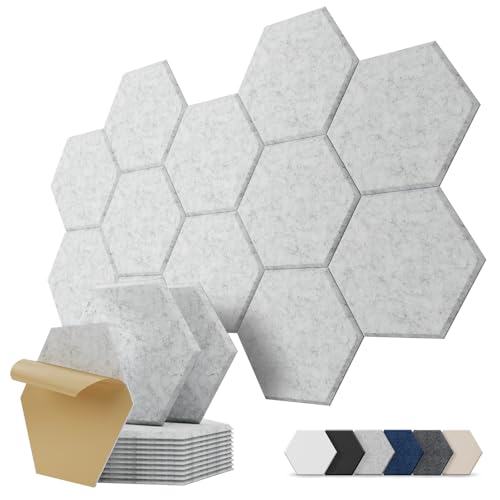
The honest job foam-style tiles are good at, absorbing mid-to-high echo inside your room. These peel-and-stick hexagons do that for under thirty dollars and come off cleanly, just don't expect them to quiet a neighbor.
Buy these for an echoey home-office corner or a streaming background, not to soundproof a wall. Within that limit they're a fine, cheap choice.
*Price shown on Amazon and subject to change.

If thin foam disappointed you, the difference is mass and thickness. This 2-inch mineral-wool panel has an NRC of 1.0, far more absorption than any egg-crate foam. Still absorption, still not a sound blocker.
The upgrade people should have bought instead of a bag of cheap foam wedges. It genuinely deadens a room; it still won't stop sound crossing the wall.
*Price shown on Amazon and subject to change.

Lillie Metayer
Lillie Metayer is the founder of a local program that helps apartment-dwellers take action against noise pollution. Involved in environmental activism since high school, Lillie is passionate about raising awareness of the harms of noise exposure and helping people reduce noise in their communities. In her free time, Lillie enjoys playing the violin and spending time outdoors.