Ask for a specific, cheap, physical change on their floor — a rug with a thick pad in the walking lane — not "please be quieter." If that fails, escalate in this order: a dated noise log, a written complaint to your property manager, then mediation or your city's noise ordinance. Never bang on the ceiling.
That is the whole ladder, and the order matters more than any single rung. Most advice on how to deal with noisy upstairs neighbors either skips to "just talk to them" (useless, and slightly insulting once you have tried) or to "call the cops" (a dead end for footsteps, and a great way to make an enemy of someone who lives eight feet above your pillow).
We will assume you are past the polite stage: you have lain awake, rehearsed speeches, maybe priced a ceiling thumper. The physics side lives in how to reduce noise from upstairs neighbors. This is the human side — what to say, in what order, to whom, and what to write down.
The Short Answer: What to Do About Noisy Upstairs Neighbors, in Five Steps
- Identify the noise. Footsteps and dropped objects are a different problem than a subwoofer, and need a different ask.
- Make one specific request, in person, about an object. A rug and pad, felt pads under chairs, house shoes. Not "be quieter."
- Start a log that night — date, start time, end time, type of noise, effect on you. Boring and factual.
- Email the landlord with the log attached and a concrete request. Email, not a call, so there is a timestamp.
- Escalate outward — community mediation, a tenant organization, your city's ordinance — only once steps 2 through 4 have a paper trail behind them.
Each rung works only if the one below it is documented. Skipping to step 5 with no log is how tenants end up looking like the problem themselves.
Step 0: Figure Out What You Are Actually Hearing
Spend two or three nights identifying the sound before you knock. Your ask depends entirely on the answer.
Impact noise is energy delivered into the structure — heel strikes, a chair leg dragged across hardwood, a dumbbell set down. It travels through the joists and radiates out of your ceiling, which is why it feels like it is happening inside your walls. Airborne noise is a TV, a conversation, music, a dog. Our breakdown of impact noise vs. airborne noise is worth ten minutes, because naming the problem accurately is the difference between a neighbor who says "I'll try" and one who says "I'll get a rug."
It also helps to know why the building does this — wood-frame construction, a renovation that swapped carpet for hard flooring, a skipped underlayment. None of it is your neighbor's fault, and knowing that changes your tone; the mechanism is in why upstairs neighbors are so loud. Pick your ask before you knock: one ask, one object, one room.
Step 1: How to Tell Your Upstairs Neighbor They Are Noisy
The conversation is hard. Here is how to make it as small as possible.
Time it well. A weekend afternoon or a weekday evening — never at 1 a.m. in a bathrobe, and never within an hour of the noise that set you off. Arrive as a neighbor with a request, not a victim with a grievance. Bring a six-dollar box of cookies; it signals a conversation, not a dispute.
Lead with the building, not the person. "This building is unbelievably thin" is a sentence you can both agree with. "You are loud" is one they must defend against.
Do not say any of these:
- "You need to be more considerate." Now it is a character discussion.
- "I can hear literally everything." That sounds like surveillance, and makes them defensive about privacy rather than noise.
- "I've been dealing with this for six months." They hear six months of silent resentment and wonder what else you have not said.
- Anything about their kids. Ask for felt pads and a play rug instead.
Do say: what you hear, when, and one thing that would help.
The Magic Sentence: Ask for an Object, Not a Behavior
This is the highest-leverage move in the article, so we will state it plainly. Asking someone to "be quieter" is asking them to change their personality inside their own home. Saying yes means agreeing that the way they walk to their own bathroom is a moral failing, so they say "sure" and nothing changes. Asking for an object is a request they can complete on a Saturday.
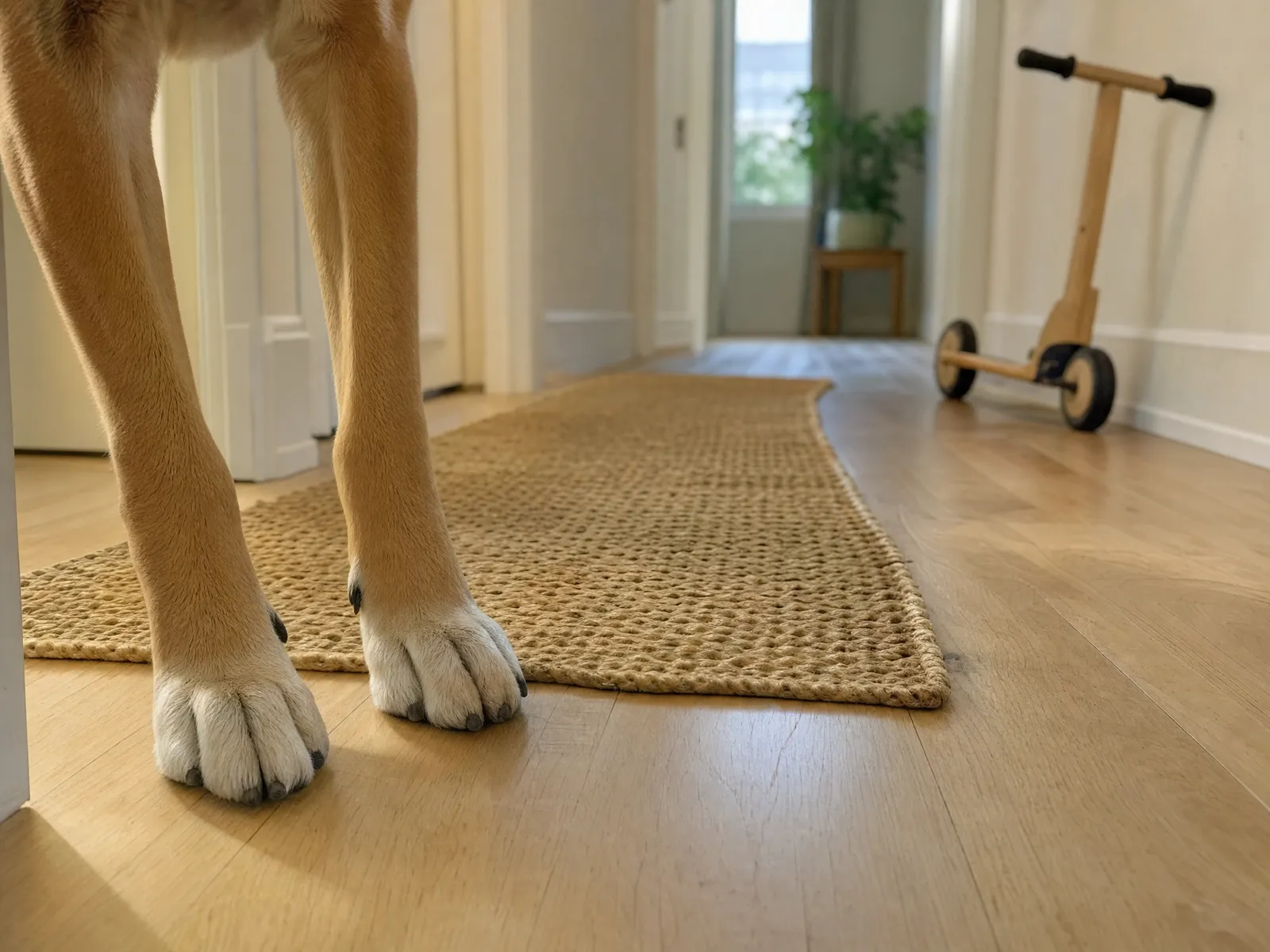
- "Would you consider a rug with a thick pad in the hallway?" The pad matters more than the rug — a quarter-inch felt-and-rubber pad under a large area rug in the walking lane is one of the most effective things anyone can add to a floor short of wall-to-wall carpet. If cost is the objection, offer to buy it; sixty to ninety dollars is cheap next to breaking a lease. We compare the options in the best rug pads for footstep noise.
- "Could we put felt pads under the dining chairs?" A twelve-dollar fix for the most jarring sound in most apartments.
- "Would house shoes be an option in the evenings?" Soft soles instead of hard heels — an evening thing, not a permanent house rule.
All three are small, cheap, finite, and none require your neighbor to admit they did anything wrong. That last part is the entire trick.
A Sample Letter to a Noisy Upstairs Neighbor
If they are never home, or the doorstep version is not something you can do, write it. Keep it under 150 words and sign it with your name and unit number — an unsigned note reads as a threat and turns a solvable problem into a feud.
Hi — I'm Sam in 3B, right below you.
I wanted to introduce myself and ask a small favor. The floors here carry sound way more than they should, and I hear footsteps and chair scrapes in my bedroom pretty clearly at night. I know that's the building's fault, not anything you're doing wrong.
Would you consider a rug with a thick pad in the hallway, and felt pads under the dining chairs? I'd be glad to pay for both — genuinely, just tell me and I'll order them.
My number is 555-0142 if it's easier to text. Thanks for reading this.
— Sam, 3B
Offering to pay is not weakness. It removes the only real objection, and it makes you the reasonable party in every conversation that follows — including the one with your landlord.
Step 2: Keep a Noise Log Your Landlord Will Actually Read
Start the log the night of the first conversation, whether or not it went well. It is not hostility; it is what makes every later step possible.
According to Alertify's tenant documentation guide, each entry should record the date and day of the week, the start and end time, a description of the noise, an estimate of its volume and impact, and how it affected you — whether it woke you, kept you from sleeping, or forced you out of a room. The same guide is blunt about tone: be specific and factual rather than emotive.
A usable entry looks like this:
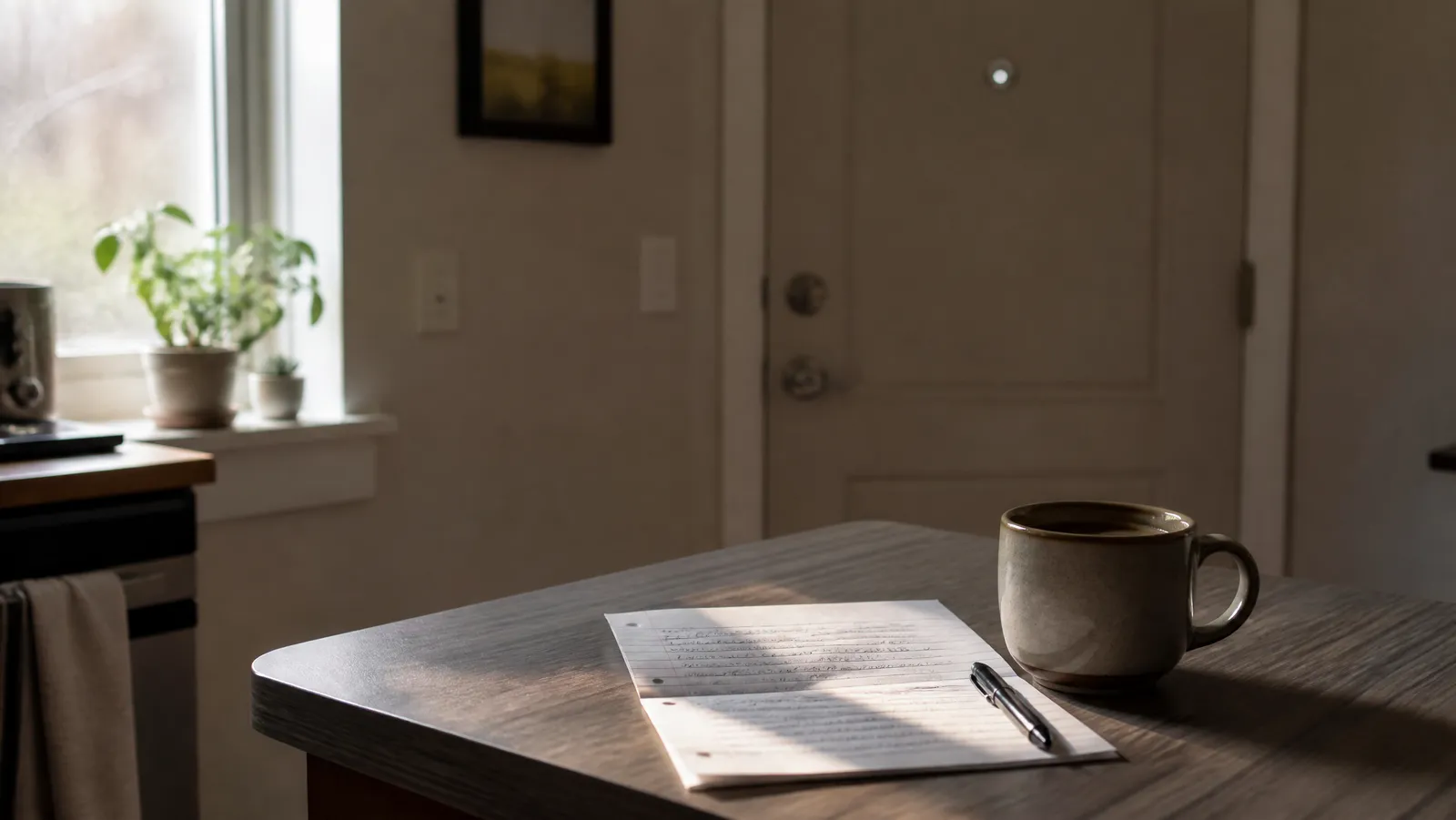
Tue 8/12 — 11:20 p.m. to 12:05 a.m. Repeated heavy footsteps and two loud impacts (dropped objects) in the area above my bedroom. Woke me; did not get back to sleep until roughly 1 a.m. Spoke to neighbor in person on 8/03 about a rug.
Keep it in a spreadsheet or notes app so it exports cleanly, and log the quiet nights too. A log showing "quiet" on 14 of 30 nights is more persuasive than one implying constant warfare.
On recording audio: check your state's rules first. According to Recording Law's state-by-state guide, twelve states — California, Connecticut, Delaware, Florida, Illinois, Maryland, Massachusetts, Montana, New Hampshire, Oregon, Pennsylvania and Washington — require all parties to consent before a conversation is recorded. Recording sound arriving in your own bedroom is a different question from recording a conversation. The written log is the safer backbone of any complaint.
Step 3: The Email to Your Landlord or Property Manager
Send email, not a phone call. You want the timestamp. Include, in this order:
- Your unit, their unit, and the dates. "Unit 3B, noise originating from 4B, ongoing since June 14."
- The log. Two or three of the clearest entries in the body, the full log attached.
- What you have already done. "I spoke with the tenant in person on 8/03 and offered to buy a rug pad." That sentence moves you from complainer to reasonable neighbor.
- A specific request. Not "please do something." Try: "Would you ask the tenant in 4B to add an area rug with a pad in the main living area, per the floor-covering requirement in the lease?" Many leases require a percentage of hard floors to be carpeted — check yours first, because if it is in there you are asking for enforcement.
- A response window. "Could you let me know how you'd like to proceed by Friday the 22nd?"
Expect to send more than one. According to LawInfo's guidance for landlords, a manager handling a noise complaint is told to gather the noise log and written account the tenant provides, talk to the accused tenant, and document everything before any legal action. Your log is the input their process runs on.
Set expectations honestly, though. A landlord can warn, mediate and enforce lease clauses, but cannot rebuild a floor, and few managers will start eviction proceedings over ordinary walking.
Step 4: Mediation, Tenant Organizations, and the Ordinance Question
Community mediation is the step almost everyone skips. A trained neutral helps the two of you write an agreement you both accept — quiet hours, rug commitments, advance notice for parties. Many counties run one: the Los Angeles County Dispute Resolution Program, for instance, covers neighbor disputes including noise, describes its services as free or low-cost, and states that participation is voluntary. Search your county name plus "dispute resolution program."
The ordinance question is where most upstairs-noise cases hit a wall, and we would rather you hear it from us. According to LegalClarity's guide to residential noise ordinances, quiet hours commonly run from about 10 p.m. to 7 a.m. on weekdays, with weekend quiet hours sometimes starting later and some jurisdictions extending the Saturday and Sunday morning restriction to 8 or 9 a.m. — but the same guide states plainly that footsteps from upstairs, a neighbor's TV through thin walls, or a baby crying do not qualify as violations, because ordinances target unreasonable disturbances rather than everyday life. Local Noise Laws describes the test as a "reasonable person" standard and notes that chronicity is what turns an annoyance into a violation.
Translation: a 1 a.m. party, a subwoofer, or a nightly two-hour treadmill session is worth a call to your city's non-emergency line (311 in New York and Chicago; find your code on Municode or American Legal Publishing). Someone walking to their kitchen at 11 p.m. is not, no matter how loud it is in your bedroom. That gap between "unbearable" and "legally fine" is what makes this problem so miserable.
One last piece of vocabulary. Cornell's Legal Information Institute describes the covenant of quiet enjoyment as an implied term in every lease that the tenant will have quiet and peaceful possession of the premises against the lessor, with a breach generally requiring substantial interference rather than a minor inconvenience. Worth naming in a written complaint; not a magic phrase that stops your ceiling.
What Not to Do (Every One of These Backfires)
- Banging on the ceiling. The most satisfying thing in the world at 2 a.m., and the most expensive. It converts a solvable neighbor problem into a lease problem, and makes you a party to a noise dispute rather than its victim.
- Ceiling thumpers and vibration devices. Same as above, with a receipt. If your landlord sees the order confirmation, your log stops mattering.
- Revenge noise. Speakers at the ceiling, alarms at 6 a.m., "give them a taste." Your neighbor starts logging you, and their log is just as persuasive as yours.
- Anonymous notes and public callouts. Unsigned notes read as menacing regardless of the words; naming a neighbor in a building group chat makes later mediation nearly impossible.
- Skipping straight to a lawyer. A complaint with no log behind it goes nowhere and costs money.
Each of these trades a small chance of a fix for a guaranteed loss of your standing as the reasonable party — the only leverage a renter has.
When to Stop Fighting and Armor Your Own Apartment
Sometimes the neighbor is unreachable: no answer at the door, or a yes followed by nothing, a landlord who shrugs, and noise that is legally ordinary. Escalating past that point just costs you sleep you do not have. Switch to defense.
- Move the bed. Sleep under their least-used space — a bedroom, sometimes a closet — rather than under their kitchen or hallway. Free, and often the biggest single improvement available.
- Mask, do not block. A white noise machine or a fan raises the noise floor so footsteps stop punching through the silence. Against impact noise in a structure you cannot modify, masking is often the most effective tool you own.
- Treat what you can. Heavy curtains, a full bookshelf on the offending wall, sealed door gaps. None of it touches footsteps, but it helps with everything else the building leaks — our genius ways to silence noisy neighbors playbook covers what is worth doing.
- Set a decision date. A reminder 90 days before renewal. If the log looks the same then, the building is the problem and moving is the fix.
The Ladder, One More Time
Ask for an object, not a behavior. Log it the same night, factually. Email the landlord with the log and a specific request. Try mediation before the ordinance. And whatever happens, do not touch the ceiling with a broom.
Most people who get a result get it at step two — a rug and a pad, bought by the person downstairs, installed on a Saturday. The rest of the ladder exists because sometimes that fails, and it works only when it is documented, dated and unemotional.
For the physics behind all of it — what your ceiling can and cannot do, and why the fix mostly lives on the floor above you — read the complete renter's guide to upstairs noise next.
This describes how these processes generally work in US rentals. It is not legal advice. Check your own lease and local ordinance, and consult a tenant attorney or tenant union about your situation.

Lillie Metayer
Lillie Metayer is the founder of a local program that helps apartment-dwellers take action against noise pollution. Involved in environmental activism since high school, Lillie is passionate about raising awareness of the harms of noise exposure and helping people reduce noise in their communities. In her free time, Lillie enjoys playing the violin and spending time outdoors.